Concept
Opening Range & ORB
Opening Range & ORB, also known as 5/15/30/60m ranges, breakout, first-hour range, is a Time, Sessions & Seasonality concept. The Library holds 6 implementations, each one a working definition you can pull into Quant.
Top Opening Range & ORB indicators
The top custom implementations, built on the original standard Opening Range & ORB formula.
6 total
Any of the 6 Opening Range & ORB implementations below can become a backtested trading strategy — describe your rules and Quant writes the code.
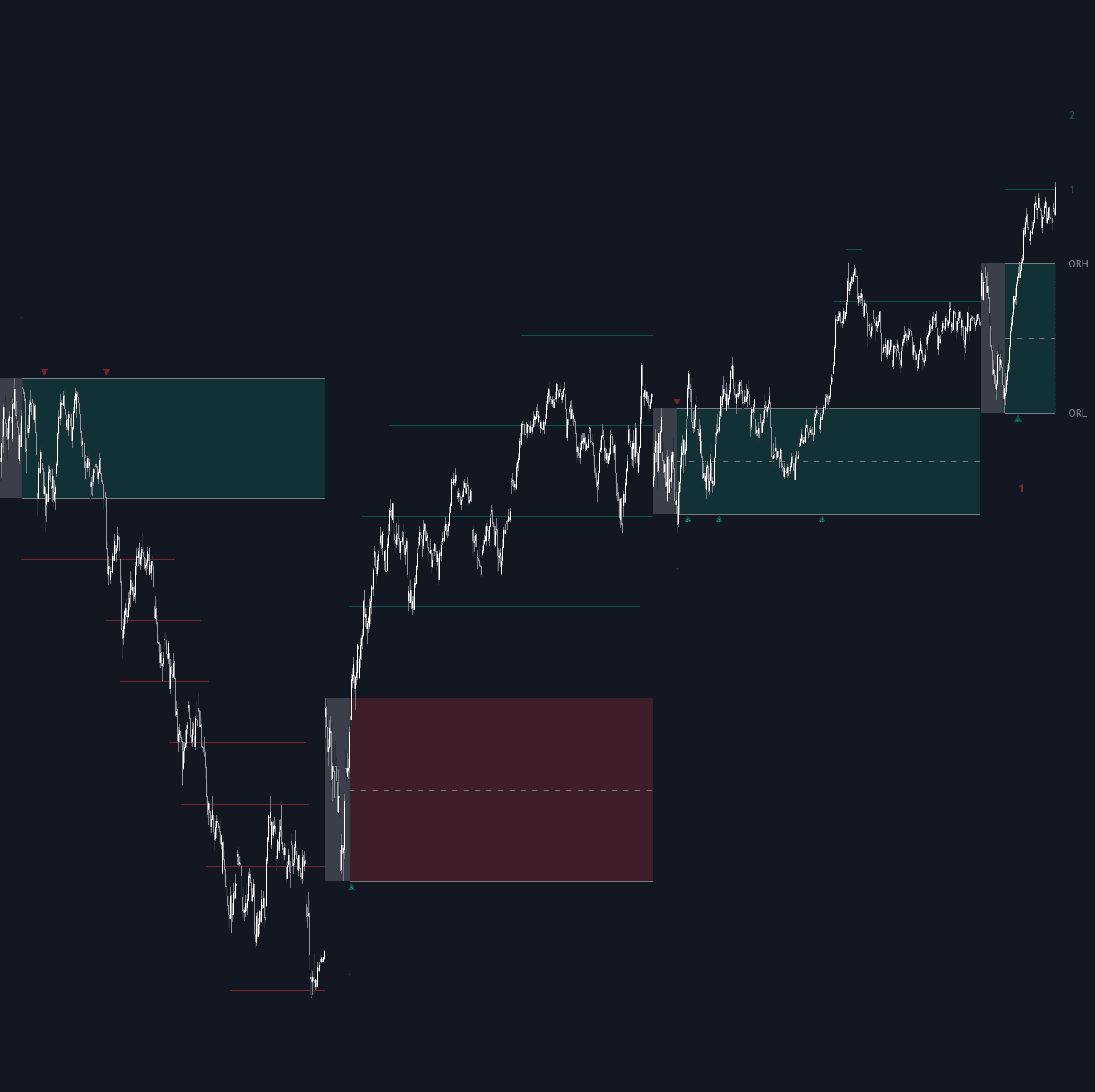
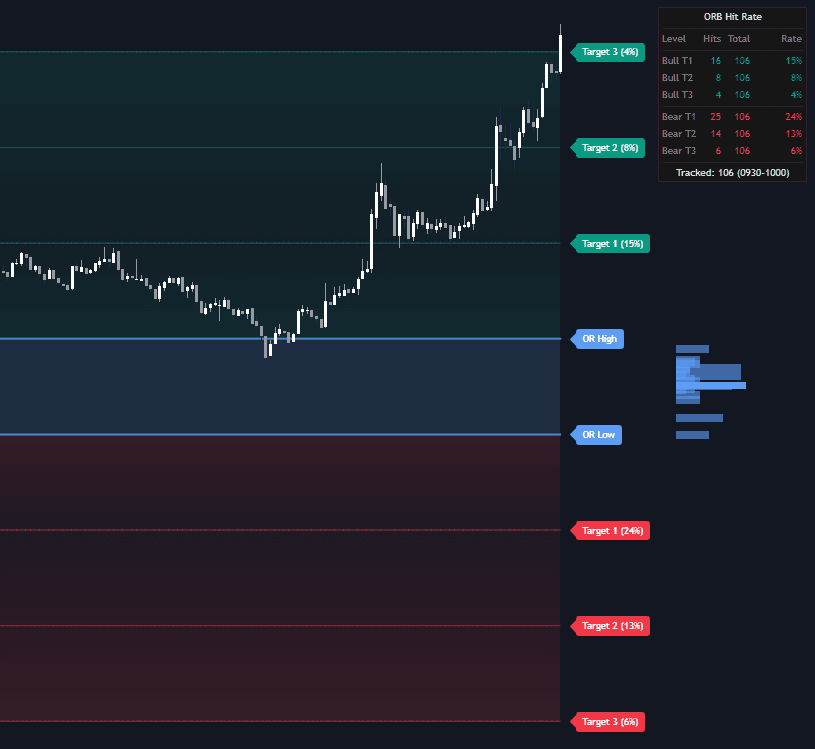
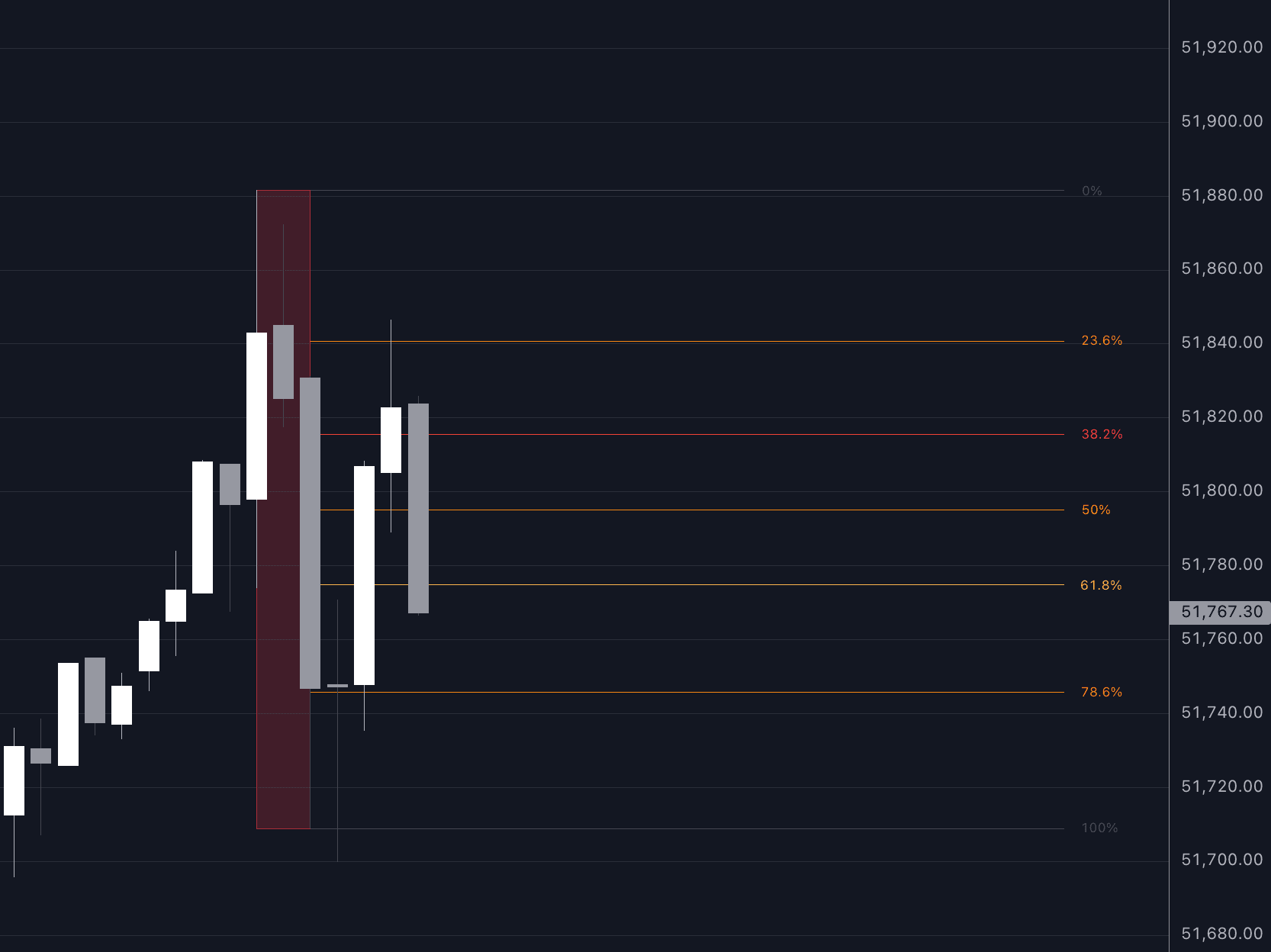
What are the Opening Range & ORB?
The opening range is the high-low span a market prints in the first minutes of a session, most commonly the first 5, 15, 30, or 60 minutes after the open. Its two boundaries, the opening range high and low, become reference levels for the rest of the day. An opening range breakout (ORB) is the classic strategy built on top: once price trades decisively outside the range, trade in the direction of the break on the premise that the early auction has resolved.
The logic is auction-based. Overnight news, gaps, and queued orders all collide at the open, so the first window of trading concentrates volume and two-sided price discovery; the range it leaves behind shows where buyers and sellers first agreed to do business. Toby Crabel popularized the ORB approach in his 1990 book on short-term price patterns, and Market Profile traders formalized the related idea of the first hour as the initial balance. Acceptance outside the early range is read as one side winning the opening auction.
It matters because it gives an intraday trader structure for the rest of the session as soon as the window closes: defined levels, a defined invalidation, and a running bias (above the range, below it, or still inside). The honest caveat is that opening range breaks fail regularly, especially on rotational days, so most traders treat the ORB as a conditional setup that needs volatility, volume, or trend context rather than a standalone signal.
How to identify the Opening Range
The construction is the same on stocks, futures, or FX; only the anchor changes.
- 1Fix the session open for your market (09:30 ET for US equities, the regular-hours open for index futures, or a chosen session open on 24-hour markets) and pick a window: 5, 15, 30, or 60 minutes.
- 2Mark the highest high and lowest low printed inside that window. Those two levels are the opening range; extend them across the rest of the session.
- 3Define the breakout trigger in advance. A first close beyond the range on your trading timeframe is stricter than a simple wick through it and filters some noise.
- 4Size the range against context, for example recent ATR or the prior day's range. Unusually narrow opening ranges tend to precede expansion but also break falsely more often; unusually wide ones often leave poor risk-reward for breakout entries.
How it's calculated
The high and low of the first minutes of the session, held as breakout levels for the rest of the day.
The window is anchored to the regular session open, so pre-market bars are excluded unless deliberately included.
The 60-minute case is the first-hour range.
Trigger rules vary by implementation: some require a bar close beyond the level, others count any trade beyond it.
How traders use it
- As a breakout entry: the classic ORB buys the break of the opening range high or sells the break of the low, with the stop inside the range or at the opposite boundary and targets projected as multiples of the range width, in the spirit of the measure rule.
- As a fade: when a break fails and price reclaims the range, the false breakout becomes its own setup, targeting a rotation back toward the opposite boundary.
- As an intraday bias filter: above the opening range favors longs, below favors shorts, inside means no directional edge yet, and many traders additionally require agreement with session VWAP before acting.
- As part of a level map: opening range extremes carry more weight when they cluster with prior period levels such as yesterday's high, low, or close, or with the overnight extremes.
Opening Range & ORB vs related concepts
Initial Balance: The initial balance is Market Profile's specific version: the first 60 minutes of the regular session, used to classify day types. The opening range is the general idea with a flexible window and a breakout strategy attached.
Defining Range: A defining range is whatever consolidation defines the structure a move is measured from, wherever it forms. The opening range is anchored strictly to the clock: it starts at the session open regardless of how price is behaving.
Breakout: Breakout is the umbrella concept for any move through a defined boundary. ORB is one specific, time-anchored instance where the boundary is the early-session range.
Opening Gap: The opening gap is the distance between yesterday's close and today's open; it exists before the first bar prints. The opening range is built from trading after the open, and gap direction is often used as context for ORB trades.
More Opening Range & ORB implementations
Concept family
Time, Sessions & Seasonality
32 concepts mapped · 32 in the Library
Opening Range & ORB FAQ
Turn Opening Range & ORB into a trading strategy.
Take any implementation from this page into Quant, then build on it, backtest it on real data, and keep refining it in conversation.