Concept
Turn-of-month Effects
Turn-of-month Effects, also known as first-day inflows, end-of-month window dressing, are Time, Sessions & Seasonality concepts. The Library holds 1 implementation, a working definition you can pull into Quant.
Top Turn-of-month Effects indicator
The top custom implementation, built on the original standard Turn-of-month Effects formula.
1 total
From studying Turn-of-month Effects to trading it: take the implementation below into Quant and backtest it instantly.
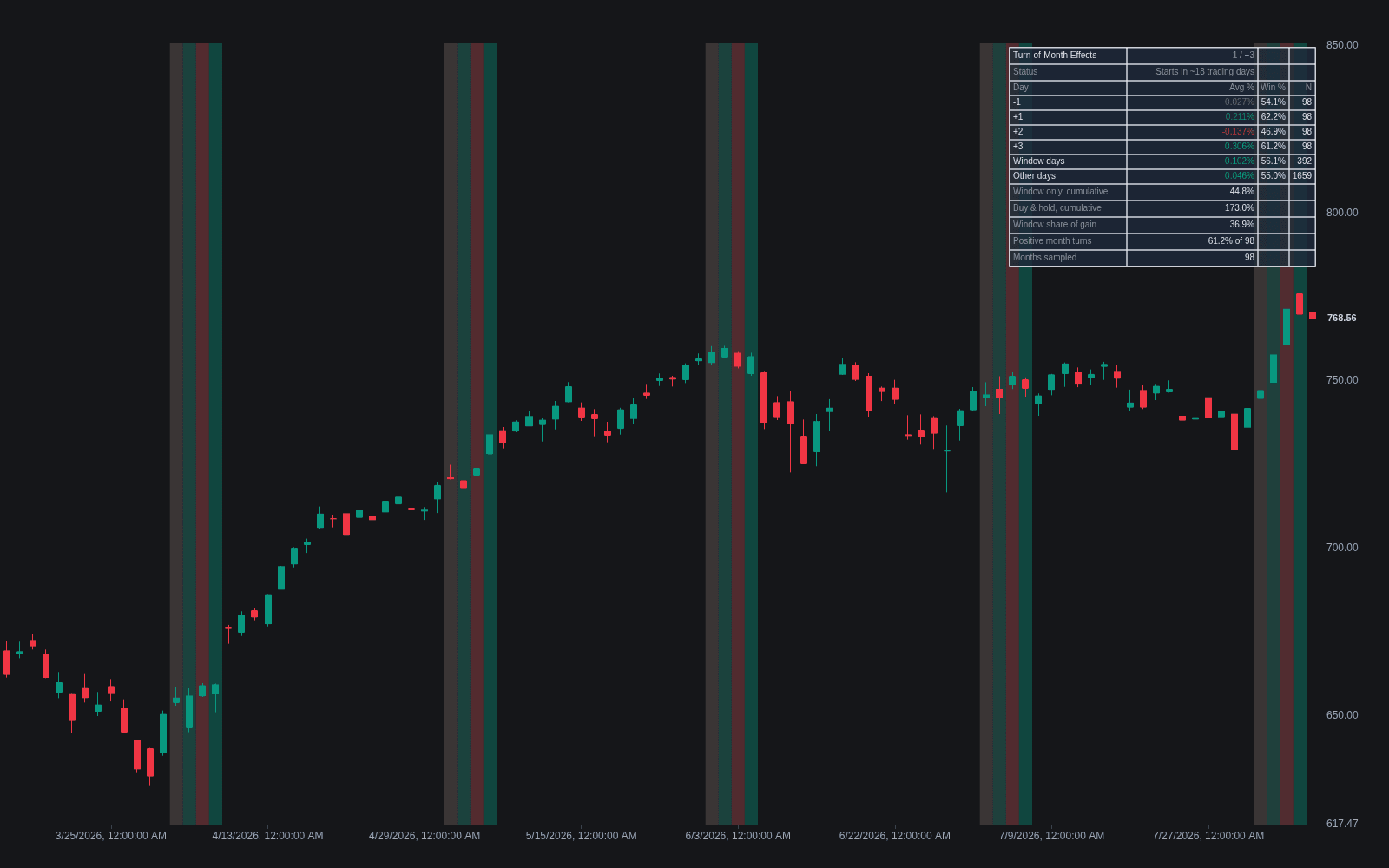
What are Turn-of-Month Effects?
Turn-of-month effects refer to the historical tendency of equity returns to concentrate in a narrow window around the month boundary, classically defined as the last trading day of the month through the first three or four sessions of the new month. Long US samples studied since the 1980s found that this handful of days accounted for a large share, in some samples essentially all, of the market's average monthly gain, with the remaining days contributing roughly nothing on net.
The most common explanation is recurring cash flow, sometimes summarized as first-day inflows: salaries, pension contributions, and automatic investment plans hit brokerage and fund accounts around month end and get put to work in the first days of the new month. A second strand of explanation is end-of-month window dressing, where institutions adjust holdings into month-end marks, plus mechanical rebalancing by funds that trade against or with the month boundary. As with most calendar anomalies, the mechanisms are plausible but not conclusively proven.
Traders care because, unlike many seasonal curiosities, the turn-of-month pattern has been documented across multiple decades and several countries, and it recurs twelve times a year, so evidence accumulates faster than for annual effects. It remains a statistical tendency, not a reliable per-month outcome: individual month turns are frequently negative, and the effect's size varies by era and market.
How traders use it
- As a timing overlay for planned entries: a trader intending to add equity exposure anyway may prefer executing just before the month turn rather than mid-month, harvesting the historical tilt at no extra cost.
- As a standalone seasonal system in research: holding the index only during the turn-of-month window has historically captured much of the market's return with a fraction of the exposure, though costs, taxes, and the risk of the pattern fading temper the live appeal.
- As a filter on short setups: some traders demand extra confirmation for shorts initiated during the turn window, on the logic that recurring inflows lean against them.
- In combination with other calendar studies: the window is stacked with pre-holiday drift and month-of-year seasonality into composite calendars, ideally validated with seasonality tooling on the trader's own market and sample.
- With honest limitations: the effect is an average over many months, its published strength invites arbitrage, and any single month's turn is dominated by news flow rather than by payroll mechanics.
Turn-of-Month vs Related Calendar Patterns
January effect: The January effect is specific to the year turn and historically concentrated in small-caps via tax mechanics; turn-of-month effects recur at every month boundary and are attributed to routine cash flows.
Month-of-year seasonality: Month-of-year seasonality compares whole calendar months against each other; turn-of-month effects compare positions within the month, so the two slice the calendar on different axes.
Pre-holiday drift: Pre-holiday drift keys off the holiday schedule and behavioral explanations, while turn-of-month effects key off the month boundary and flow explanations; the windows occasionally overlap, which composite studies must handle.
Concept family
Time, Sessions & Seasonality
32 concepts mapped · 32 in the Library
Turn-of-month Effects FAQ
Turn Turn-of-month Effects into a trading strategy.
Take the implementation from this page into Quant, then build on it, backtest it on real data, and keep refining it in conversation.