Concept
Trendline
Trendline, also known as trendline break, internal trendline, is a Trend concept. The Library holds 14 implementations, each one a working definition you can pull into Quant.
manual/auto-detected
Top Trendline indicators
14 total
.png&w=3840&q=75)
What is a Trendline?
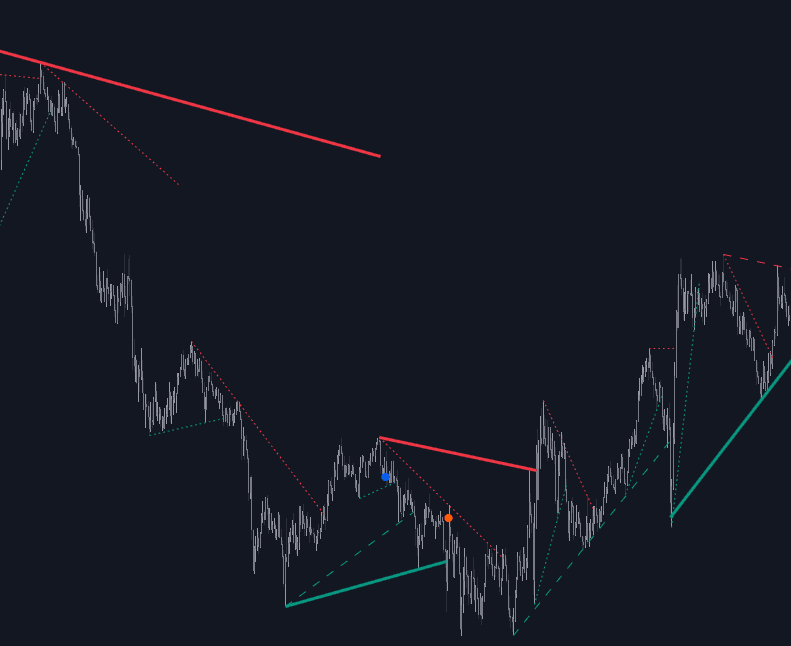
A trendline is a straight line drawn across successive swing points and projected forward: under rising lows to mark diagonal support in an uptrend, over falling highs to mark diagonal resistance in a downtrend. Two touches define the line; by common convention a third touch validates it. Once in place it does two jobs at once: its slope states how fast the trend is running, and its line marks where that pace is being defended.
Drawing rules are genuinely contested, so most sources present conventions rather than laws. Some connect wicks, others closes or candle bodies; 'internal' trendlines deliberately cut through a few extremes to fit the bulk of price action. On higher timeframes the chart scale matters too, since a line that is straight on a linear chart curves on a logarithmic one. Automated detection sidesteps the subjectivity by fitting lines through ZigZag or fractal pivots and flagging breaks mechanically.
Trendlines matter because they encode the trend's rate, not just its direction, and a broken line is often the earliest warning that the rate has changed, well before horizontal levels give way. The hedge is equally important: steep lines break routinely while the trend survives at a shallower angle, and two people rarely draw the same chart identically. A trendline break is information about pace, not by itself a reversal signal.
How to draw a trendline
The steps are simple; the discipline is in keeping your drawing rules consistent from chart to chart.
- 1Locate at least two clear swing points moving in the same direction: higher swing lows for an up trendline, lower swing highs for a down trendline. Prominent pivots beat minor wiggles.
- 2Connect them and extend the line to the right. Decide up front whether you draw on wicks, closes, or bodies and keep that choice fixed; on weekly and monthly charts, check the line on log scale.
- 3Wait for a third touch before treating the line as validated. More touches at spaced intervals mean the market has repeatedly defended that pace, and likely that more stops have accumulated behind the line.
- 4Judge breaks by closes, not pokes: a decisive close through the line, with follow-through or a retest from the far side, carries far more weight than a single intrabar violation.
How traders use it
- Trend participation: buying tests of a rising trendline (or shorting tests of a falling one) with a stop beyond the line, using the diagonal the way horizontal traders use a level.
- Break alerts and exit triggers: a close through a mature trendline is an early caution that the trend's pace has changed, commonly used to tighten stops, take partial profits, or arm a breakout entry in the new direction.
- Pattern construction: triangles, wedges, flags, and channels are all built from trendlines, and the measured objectives of those patterns inherit whatever drawing choices went into the lines.
- Automated trendline systems: algorithms fit lines through detected pivots, adjust slopes as swings evolve, and alert on breaks, trading human subjectivity for parameter sensitivity and the occasional line no human would draw.
Trendline vs. related concepts
Parallel Channel: A channel is a trendline plus a parallel copy projected on the other side of price, adding an opposite boundary for targets and overextension reads. A single trendline defines only one side of the move.
Linear-regression Channel: A regression channel is fitted through every bar by least squares, so it has a statistical midline and symmetric bands. A trendline touches only selected swing extremes and encodes a judgment about which pivots matter.
Fan Principle: The fan principle redraws successively flatter trendlines from the same anchor as steeper ones break. It exists precisely because a single trendline break so often means the trend slowed rather than ended.
Dynamic S/R Via MA: A moving average also provides sloped support and resistance, but it recalculates each bar and curves with price. A trendline's slope is fixed by the swings it was drawn on and changes only when redrawn.
More Trendline implementations
- Trendlines with Breaks Oscillator
- Rolling Trendline
- Power Hour Trendlines
- Machine Learning Trendlines Cluster
- Williams Percent Range with Trendlines and Breakouts
- Auto Trend Drawing
- Parallel Pivot Lines
- Extrapolated Previous Trend
- Wedge Polaris
- Trend Lines for RSI, CCI, Momentum, OBV
- Wolfe Waves Signals by the rules of Bill Wolfe
Related concepts · Channels, lines & geometry
Concept family
Trend
100 concepts mapped · 88 in the Library
Trendline FAQ
How many touches make a trendline valid?
Convention says two touches to draw it and a third to validate it. More touches at spaced intervals generally make the line more meaningful, since the market has defended that pace repeatedly, but no touch count guarantees the next test holds. Heavily respected trendlines eventually break; the count tells you how watched the line is, not what happens next.
Should trendlines connect wicks or closing prices?
Sources genuinely disagree. Wicks capture every traded price, so wick lines mark the true extremes; close or body lines filter one-off spikes and often fit the bulk of price action better. Internal trendlines deliberately ignore a few extremes altogether. Any of these works if applied consistently; mixing rules chart by chart is what makes lines arbitrary.
Does a trendline break mean the trend is over?
Not by itself. A break says the trend's rate of climb or descent changed; the trend frequently continues at a shallower angle, which is what the fan principle formalizes. Reversal usually needs more evidence, such as a break of structure in the swings or a failed retest of the broken line, and even then a false breakout is always possible.
Why do my trendlines look different on log scale?
Because a straight line on a linear chart implies a constant point change per bar, while on a logarithmic chart it implies a constant percentage change. Over short ranges the two nearly coincide; over long ranges or large moves they diverge badly. For multi-year charts and fast-growing assets many technicians draw on log scale; intraday it rarely matters.
Can trendlines be detected automatically?
Yes. Algorithms anchor lines on detected pivots (fractals, ZigZag swings), fit or step the slope, and flag breaks mechanically, which removes drawing subjectivity and enables alerts. The cost is parameter sensitivity: pivot depth and fitting rules change which lines exist at all, so two automated detectors can disagree about a chart as much as two humans do.
Build Trendline your way.
Quant writes, tests, and refines it with you — then it runs on LuxAlgo charting or ports to TradingView.