Concept
False Breakout
False Breakout, also known as fakeout, failed breakout → range re-entry, is a Market Structure concept. The Library holds 1 implementation, a working definition you can pull into Quant.
Top False Breakout indicator
The top custom implementation, built on the original standard False Breakout formula.
1 total
This False Breakout implementation is strategy-ready: open it in Quant, set your rules, and it backtests automatically.
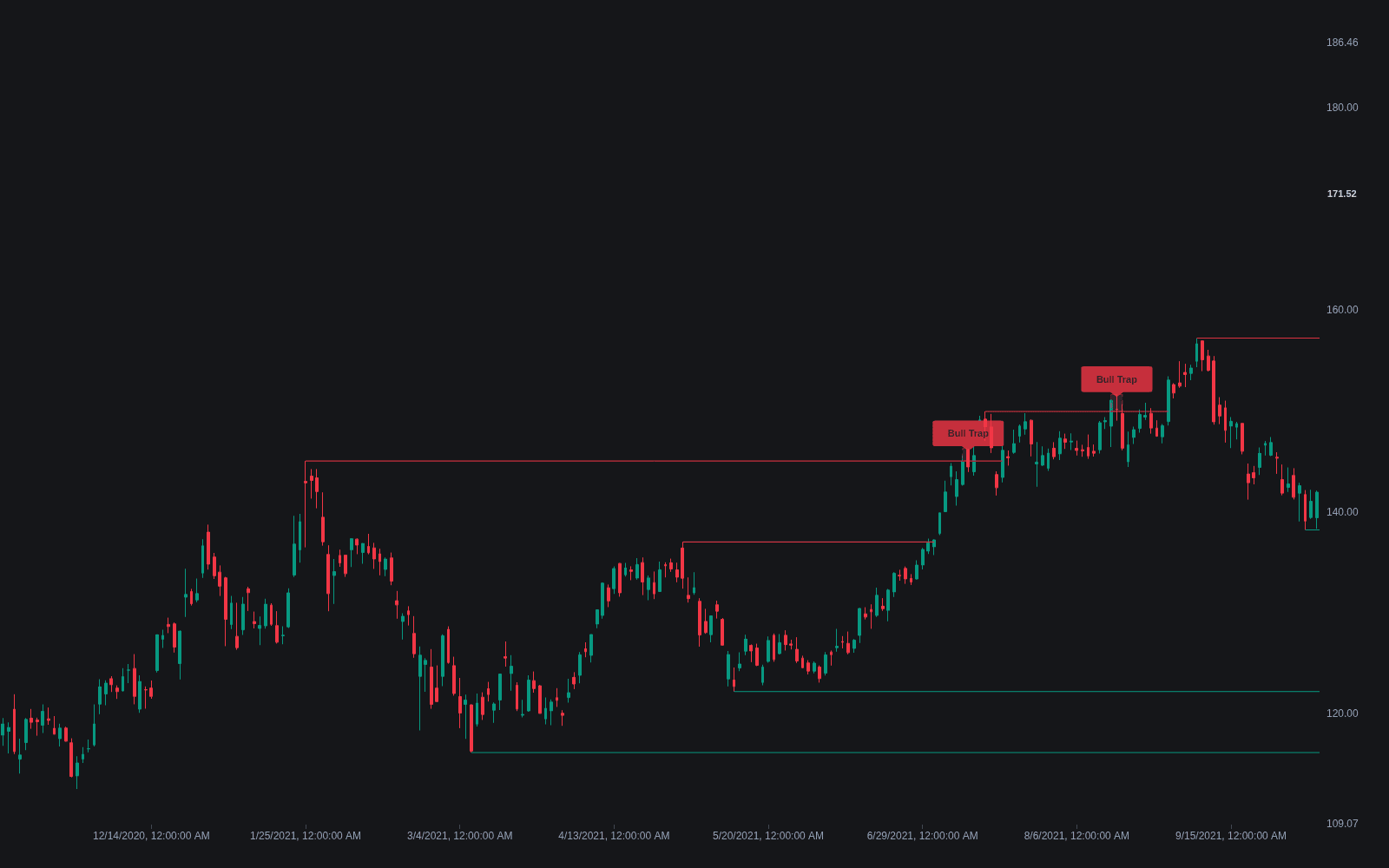
What is a False Breakout?
A false breakout (or fakeout) is a breakout that fails: price pushes through a level the market visibly treats as a boundary, a trading range extreme, a support or resistance level, or a well-watched trendline, then gives the ground back and closes on the original side. The penetration is real; the follow-through never arrives. Instead of new business being done beyond the level, the move stalls, and the re-entry into the prior area traps those who bought the breakout or sold the breakdown.
The mechanics are order-driven. Stops and breakout entries cluster just beyond obvious levels, so the initial push finds ready fuel; if no genuine imbalance stands behind it, that fuel is quickly spent and the unwind of trapped positions powers the snap back. Definitions vary by strictness: some traders call any poke beyond the level that re-enters a false break, while others require a close beyond followed by a close back inside. The same event carries different names across schools: a stop run or liquidity sweep in Smart Money vocabulary, a spring or upthrust below or above a Wyckoff range, and a deviation in crypto range slang.
How to identify a false breakout
A false breakout is only knowable after the failure, so identification is a two-stage watch: first the break, then the give-back.
- 1Mark a level the market visibly respects: a range boundary tested more than once, a prior high or low, or a trendline that traders would realistically trade a break of.
- 2Watch the break: price trades beyond the level, intrabar or on a close depending on your strictness. At this stage it is simply a breakout attempt and nothing more can be said.
- 3Watch for the failure: price cannot hold beyond the level and closes back inside, often within a few bars. The close back inside is the common trigger that reclassifies the break as false.
- 4Weigh the context: light volume on the break, heavy volume on the re-entry, or an immediate swift move away from the level all point to trapped breakout traders rather than a pause before a second attempt.
How traders use it
- As a fade entry: the classic play is to trade the failure back toward the opposite side of the range, with a stop beyond the false-break extreme. Wyckoff springs, Sperandeo's 2B rule, and turtle soup all codify versions of this trade.
- As a filter on breakout systems: requiring confirmation (a retest that holds, a second close beyond, above-average volume) trades a later entry for fewer fakeouts. False breakouts are the failure mode those confirmation rules exist to avoid.
- As information about the range: a failed break of resistance that collapses back implies supply overhead, and a failed breakdown that snaps back implies demand below. Repeated failures on one side feed the accumulation-versus-distribution read of the range.
- As a bias-flip trigger: many range traders treat a false break of one extreme as the cue to target the opposite extreme, since the trapped side's stops now line the path back across the range.
False Breakout vs related concepts
Breakout: A breakout is the genuine article: the level breaks and price is accepted beyond it with follow-through. The false breakout is the same event failing, and the two are indistinguishable at the moment of the break; only the hold or the give-back separates them.
Liquidity Sweep: The Smart Money framing of similar price action, with the emphasis on stops beyond the level being collected rather than on the range failing to break. Sweeps are usually judged on a wick through a swing point; false breakouts cover any level and may spend several bars beyond it before failing.
Swing Failure Pattern: An SFP is the tighter, more specific event: a poke beyond a prior swing high or low that closes back inside on the same or next candle. A false breakout is the broader category, applying to ranges, trendlines, and pattern boundaries over any number of bars.
Concept family
Market Structure
31 concepts mapped · 31 in the Library
False Breakout FAQ
Turn False Breakout into a trading strategy.
Take the implementation from this page into Quant, then build on it, backtest it on real data, and keep refining it in conversation.