Concept
Andrews' Pitchfork
Andrews' Pitchfork, also known as Schiff, modified Schiff, median line, warning lines, is a Trend concept. The Library holds 1 implementation, a working definition you can pull into Quant.
Top Andrews' Pitchfork indicator
The top custom implementation, built on the original standard Andrews' Pitchfork formula.
1 total
From studying Andrews' Pitchfork to trading it: take the implementation below into Quant and backtest it instantly.
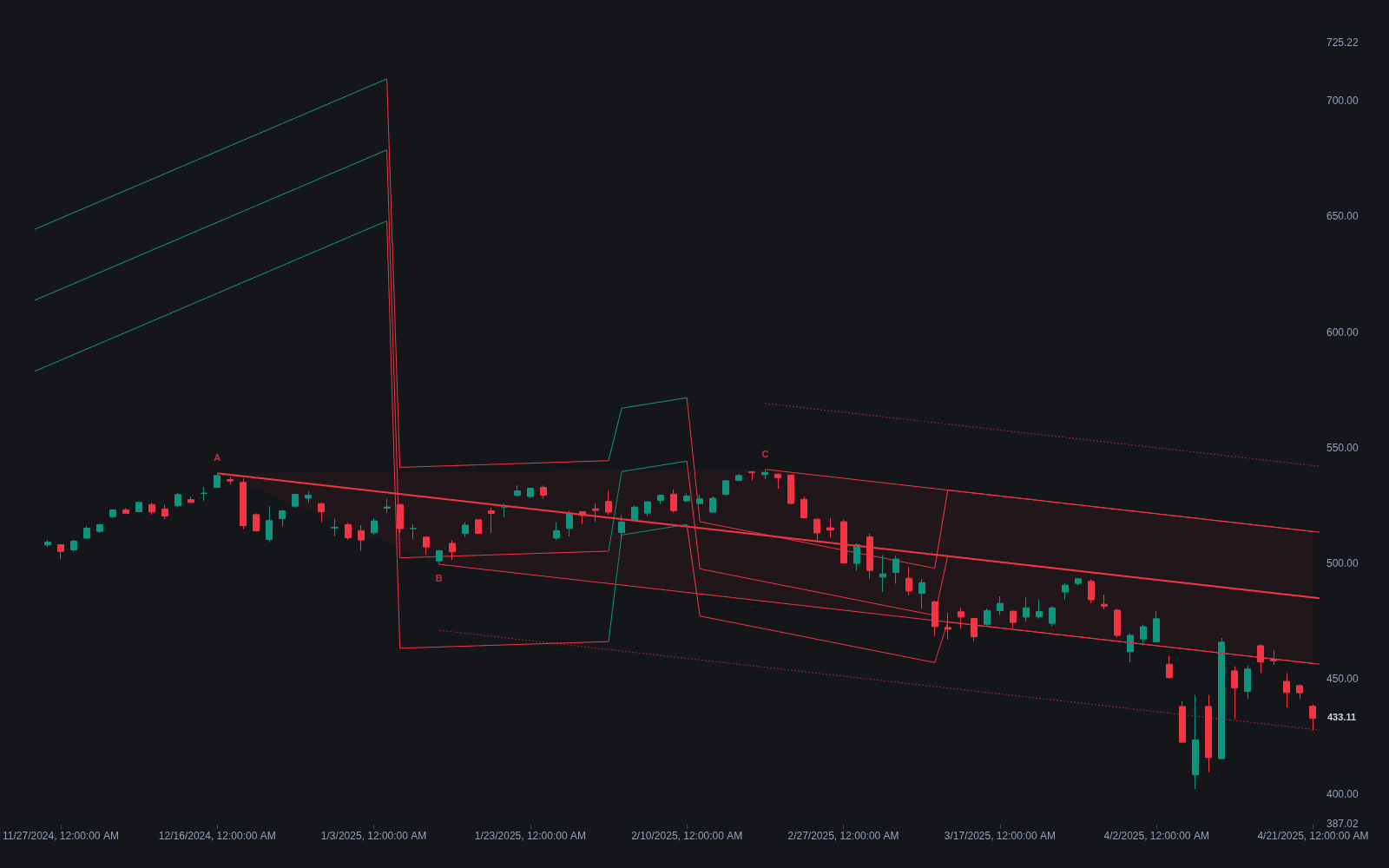
What is Andrews' Pitchfork?
Andrews' Pitchfork is a three-point channel tool built around a median line. From a pivot A at the start of a move and the next swing high and low B and C, the median line runs from A through the midpoint of B-C; two parallels drawn through B and C complete the fork. Alan Andrews' method treats the median line as the trend's center of gravity: price is expected to gravitate back toward it, while the outer tines act like the walls of a parallel channel.
The tool carries its inventor's name. Alan Hall Andrews, an engineer by training, taught the technique in his Action-Reaction Course in the mid-20th century, building on the older action-reaction idea that market swings tend to answer each other symmetrically around a central tendency. His claim was never that price obeys the fork, but that the median line gives a disciplined way to define the trend's center so that behavior around it becomes readable.
That expectation is a tendency, not a rule. Plenty of trends never return to the median line, and in Andrews' own teaching (the Hagopian rule) a reversal before reaching it warns that the move in the other direction may travel further than normal. Variants reposition the anchor to handle steep moves: the Schiff pitchfork shifts A halfway toward B in price, and the modified Schiff shifts it to the midpoint of A-B in both price and time. Warning lines are extra parallels spaced beyond the tines to track price that escapes the fork.
The fork's appeal is that it is pure price geometry. There is no lookback length to tune and no smoothing to choose, unlike an EMA channel or MA envelope; three pivots fully determine every line. That same property is its weakness: pivot selection is subjective, and two chartists can draw materially different forks on the same trend. The discipline that makes it usable is treating a fork that price refuses to respect as wrongly anchored and either re-selecting pivots or standing aside.
How to draw Andrews' Pitchfork
The fork is only as good as the pivots that anchor it, so start from clean, alternating swing points.
- 1Pick pivot A at the origin of the move you want to frame: a significant swing low for an uptrend, or swing high for a downtrend.
- 2Pick pivots B and C: after a low at A, B is the next swing high and C the following swing low; after a high at A, B is the next swing low and C the following swing high. A, B and C must alternate.
- 3Draw the median line from A through the midpoint of segment B-C, then add parallels through B and C to form the tines.
- 4Check the fit: a valid fork should contain the subsequent rotations, with price working between the tines and repeatedly engaging the median line.
- 5If price immediately leaves the fork, the anchors are probably wrong: reselect pivots or switch to a Schiff or modified Schiff variant, which flatten the fork for steep moves.
How it's calculated
A three-pivot channel tool: a median line drawn from an anchor pivot through the midpoint of the next two pivots, framed by parallel tines.
Andrews' median-line study expects price to return toward the median line after pivot C forms; failing to reach it is itself read as information about trend strength.
The Schiff and modified Schiff variants flatten the fork's slope, which suits steep or accelerating trends.
Placement is entirely pivot-dependent, so different pivot choices produce different forks on the same trend.
How traders use it
- Trading rotations toward the median line: entries near a tine with the median line as the working objective, on the logic that trends oscillate around their center.
- Reading trend health: repeated failures to reach the median line signal a weakening trend, and a decisive break outside a tine that holds on retest suggests the trend is changing character or accelerating.
- Extending with warning lines when price runs beyond the fork, keeping the original slope as the frame of reference.
- Pairing tine tests with confirmation: a reaction at the lower tine plus an internal trendline break, or agreement from a moving average crossover, before committing to the rotation trade.
- Framing risk mechanically: stops go beyond the tine or beyond the anchoring pivot, and targets stage at the median line first and the far tine second, so the fork supplies both invalidation and objectives.
Andrews' Pitchfork vs other trend frames
Trendline: A trendline is a single boundary drawn from two pivots and says nothing about where the trend's center or far side sit. The pitchfork commits to a full three-line frame from three pivots, which adds information and adds ways to be wrong.
MA Envelope: An envelope wraps a moving average at a chosen offset, so its center and width follow parameters and update every bar. The fork's lines are fixed by three historical pivots and never recalculate; only your choice of pivots can change them.
Dynamic S/R Via MA: Averages acting as moving support and resistance adapt continuously and carry no directional geometry. The pitchfork fixes a slope from the trend's own structure, so it states where rotations should land if the trend keeps its established pace.
Concept family
Trend
100 concepts mapped · 100 in the Library
Andrews' Pitchfork FAQ
Turn Andrews' Pitchfork into a trading strategy.
Take the implementation from this page into Quant, then build on it, backtest it on real data, and keep refining it in conversation.