Concept
Strategy Switching & Rotation
Strategy Switching & Rotation, also known as session-based, risk-on/off, retirement rules, ensemble allocation, is a Meta & Composition concept. The Library holds 1 implementation, a working definition you can pull into Quant.
Top Strategy Switching & Rotation indicator
The top custom implementation, built on the original standard Strategy Switching & Rotation formula.
1 total
This Strategy Switching & Rotation implementation is strategy-ready: open it in Quant, set your rules, and it backtests automatically.
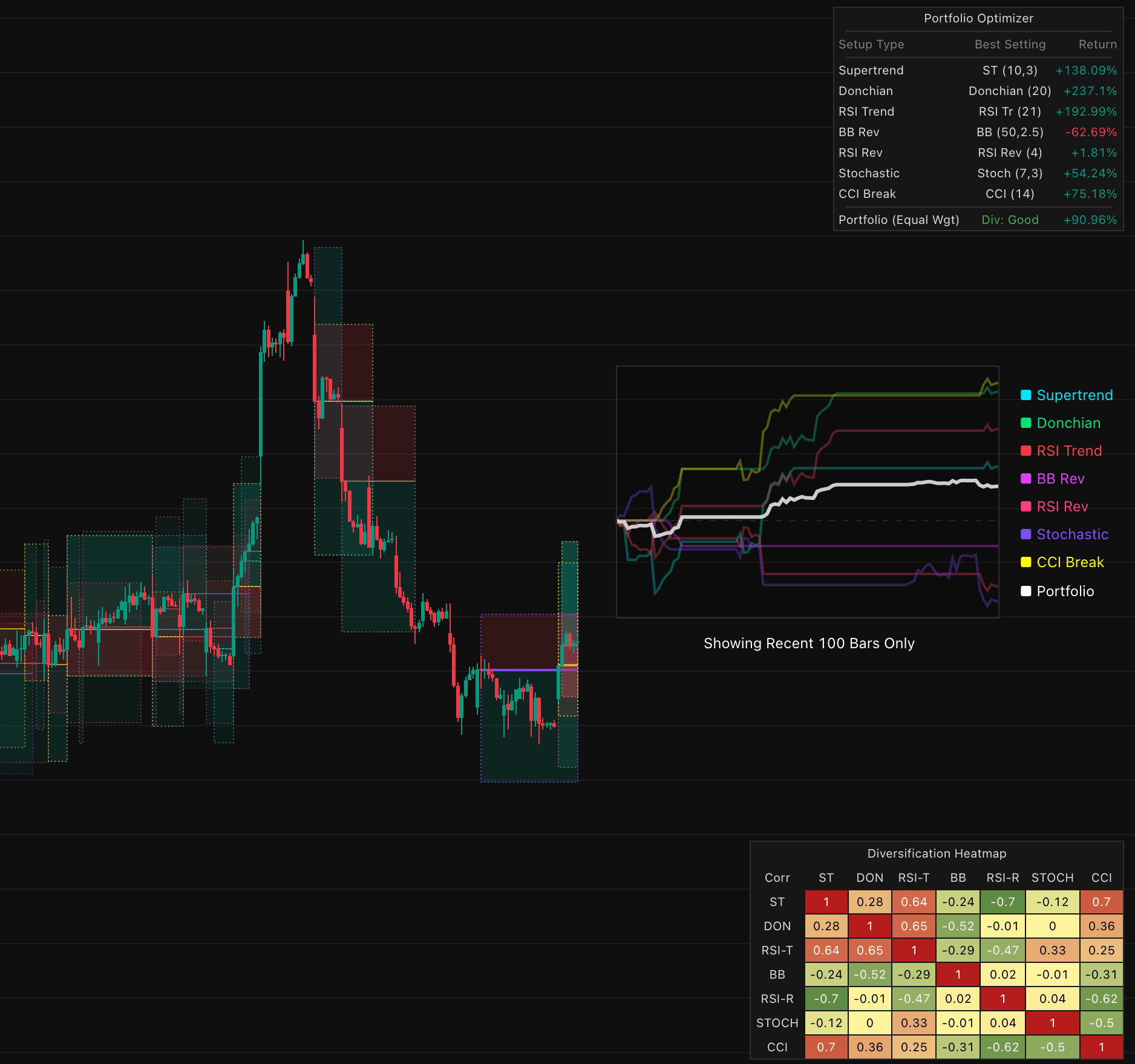
What is Strategy Switching & Rotation?
Strategy switching and rotation is a meta-layer that decides which strategy is allowed to trade, rather than generating entries itself. Instead of one always-on system, a rulebook allocates among several: a trend-follower when conditions trend, a mean-reversion system in ranges, nothing at all when no system's conditions are met. The switch key can be a regime classifier, the volatility state, the calendar (session windows, seasonal filters), a risk-on/risk-off gauge, or each strategy's own rolling performance, as in the so-called retirement rules that bench a system after sustained underperformance.
The idea borrows from two older disciplines. Portfolio managers have long rotated capital across sectors and styles under the banner of tactical asset allocation, and ensemble methods in machine learning formalized the insight that diverse model pools tend to be more robust than any single model. Strategy rotation applies both to a trading account: the roster of systems is the asset list, the regime read is the allocation signal, and the value comes from the systems disagreeing about when they work.
Rotation generalizes the on/off switch into weighting: the strategy roster is treated like a portfolio, with allocation shifted toward whatever the current environment favors (ensemble allocation). The caveat is that the switching layer is itself a strategy with its own failure modes. Regime calls arrive with lag, so switches often fire after a transition has partly played out; whipsaw at regime boundaries can erase the benefit; and every switch rule is another parameter that can be overfit to past regimes. The meta-rules deserve the same out-of-sample scrutiny as the systems beneath them.
Implementation is mostly an architecture problem. Each system needs to be a self-contained unit, in the spirit of the filter-setup-trigger-exit architecture, so the meta-layer can enable, disable, or reweight it without touching its internals. The switch key is typically a trend/range classifier, a volatility percentile, or a composite gauge; rosters that span markets lean on cross-instrument composition to read one instrument's regime from another; and live switching is usually wired through alerts and webhooks rather than manual intervention.
How to identify regime shifts that justify a switch
Switching has no chart pattern of its own; what the chart shows is the regime evidence the meta-layer keys on.
- 1Define each regime measurably before looking: a classifier reading, a volatility percentile band, a session clock, or a risk gauge, not a visual impression.
- 2Plot the classifier beneath price and mark its historical transitions, noting how long each regime persisted; regimes flipping every few bars are too fast to allocate around.
- 3Measure the lag between each visible regime change and the classifier's confirmation; that gap is the cost every switch pays.
- 4Bucket each strategy's results by regime; rotation needs the systems to win in different buckets, not merely to differ on average.
- 5Add hysteresis at the boundary, a minimum dwell or separate entry and exit thresholds, and check that it removes most flip-flops.
How it's calculated
A supervisory layer that decides which of several strategies may trade at any moment and how much capital each one gets.
There is no single canonical formula; this is the shared skeleton behind session switches, risk-on/off filters, performance-based retirement rules, and rotation or ensemble portfolios.
Keys and scores must use only data available before the weights take effect, otherwise the backtest gains lookahead bias.
Every switch pays costs and regime keys confirm late, so the hysteresis term h and cost-aware evaluation decide whether the layer helps at all.
How traders use it
- To key systems to regime: a trend/range classifier enables trend-following logic only in trending tape and hands off to mean-reversion rules in ranges, while volatility-based switches cut size or disable everything when conditions turn disorderly.
- To gate by calendar: an intraday system trades only inside its tested session window and stands down around major scheduled news, encoding the observation that many edges are session-specific.
- To rotate on performance: each system's rolling equity is monitored, allocation is trimmed for systems in drawdowns beyond their historical norm, and restored on recovery, accepting that such rules react late by construction.
- To weight an ensemble: capital is spread across the roster the way custom indices and baskets spread across instruments, favoring members that win in different regimes.
- To keep the layer honest: minimum-dwell and debounce rules borrowed from signal hygiene stop the switch thrashing at regime boundaries, where classifiers are least reliable.
Strategy Switching & Rotation vs related composition ideas
Adaptive Parameterization: Adaptive parameterization keeps one strategy and re-tunes its inputs as conditions change; switching assumes different regimes need structurally different logic and swaps whole strategies. Adaptation is the gentler intervention, rotation the more drastic, and they nest: rotated systems can each be adaptive internally.
Confluence & Scoring Systems: Confluence scoring blends multiple signals into one entry decision on a single trade. Rotation never merges signals: each system keeps its own entries and exits, and the meta-layer only decides which systems hold capital. One composes evidence; the other composes strategies.
Concept family
Meta & Composition
28 concepts mapped · 28 in the Library
Strategy Switching & Rotation FAQ
Turn Strategy Switching & Rotation into a trading strategy.
Take the implementation from this page into Quant, then build on it, backtest it on real data, and keep refining it in conversation.