Concept
Adaptive Parameterization
Adaptive Parameterization is a Meta & Composition concept. The Library holds 3 implementations, each one a working definition you can pull into Quant.
Top Adaptive Parameterization indicators
The top custom implementations, built on the original standard Adaptive Parameterization formula.
3 total
Want to trade Adaptive Parameterization? Any of the 3 implementations below is one prompt away from a backtested strategy in Quant.
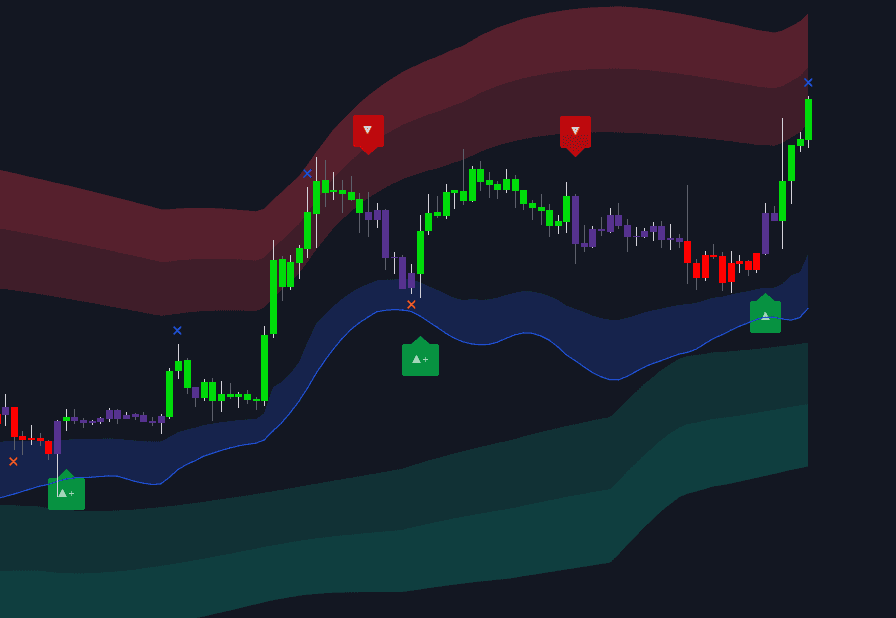
.png&w=3840&q=75)
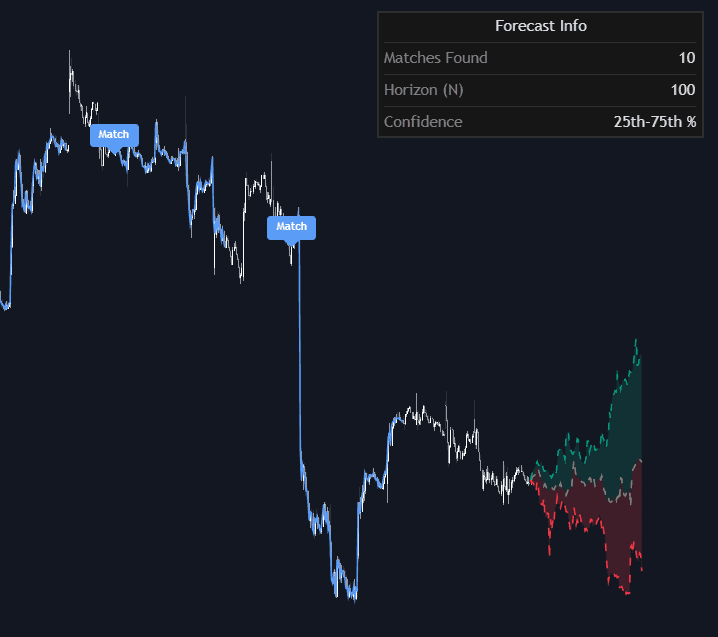
What is Adaptive Parameterization?
Adaptive parameterization is the design principle of letting an indicator's or strategy's parameters (lookback length, smoothing factor, band width, stop distance) change automatically with measured market conditions instead of staying fixed. The lineage is long: Kaufman's KAMA scales its smoothing by an efficiency ratio, Chande's VIDYA adapts by a volatility index, and Ehlers derived lookbacks from the measured dominant cycle.
Every adaptive scheme has two parts: a measurement of current conditions and a mapping from that measurement to the parameter. The measurement is usually trend efficiency (net movement versus total movement), volatility (ATR or standard deviation relative to its own history), or cycle period. The mapping is either continuous, sliding the parameter smoothly between a fast and a slow bound, or discrete, jumping between preset configurations when a regime switch fires.
It matters because a fixed parameter is an implicit bet that the market's character will not change: a length tuned in a quiet range behaves badly in a fast trend. Adaptation targets that mismatch. The honest caveat is that it relocates tuning rather than eliminating it. The bounds, the measurement window, and the mapping are all still parameters, and the adaptation itself lags regime turns just as fixed settings do.
How to calculate an adaptive parameter
Kaufman's efficiency-ratio approach is the clearest template, and most adaptive schemes follow its shape.
- 1Measure the condition you want to adapt to. The Kaufman efficiency ratio, for example, divides the absolute net price change over N bars by the sum of the absolute bar-to-bar changes over the same window: near 1 in a clean trend, near 0 in churn.
- 2Fix the parameter's bounds: the fastest and slowest values it may take, such as smoothing constants equivalent to a short and a long lookback.
- 3Map measurement to parameter. KAMA scales its smoothing constant between the bounds by the efficiency ratio and then squares the result, so choppy conditions push the average hard toward the slow bound while efficient trends push it toward the fast one.
- 4Validate across regimes: confirm the adapted setting behaves sensibly in trend, chop, and transition, that it holds up out of sample, and that the driving measurement itself does not repaint.
How traders use it
- Adaptive moving averages: smoothing tied to efficiency or fractal dimension so the average hugs price in trends and flattens in chop, the KAMA/VIDYA/FRAMA family.
- Adaptive oscillator lengths: an RSI or stochastic length tied to the measured dominant cycle, keeping the oscillator tuned to the market's current rhythm instead of a fixed 14.
- Adaptive risk: stop distances and targets scaled by current volatility rather than fixed point values, so risk breathes with the instrument.
- Discrete regime switching: a trend/range classifier selects between parameter presets, or between whole playbooks, which is adaptation applied at the strategy level.
Adaptive parameterization vs. related concepts
Volatility Regime Switches: A regime switch is discrete adaptation: conditions cross a threshold and the configuration jumps to a preset. Adaptive parameterization is the broader principle and is often continuous, sliding the parameter along a range with no jump.
Trend/range Classifiers: A classifier outputs the regime label; adaptive parameterization is the response to a measurement, which may be that label. One diagnoses, the other prescribes.
Adaptive-lookback MA: An adaptive-lookback moving average is one concrete instance: the lookback is the adapted parameter. The general principle applies the same idea to any knob, from oscillator lengths to band widths to stop multiples.
Strategy Switching & Rotation: Strategy switching swaps which system trades; adaptive parameterization retunes the system that is already trading. Coarse-grained versus fine-grained responses to the same regime problem.
Concept family
Meta & Composition
28 concepts mapped · 28 in the Library
Adaptive Parameterization FAQ
Turn Adaptive Parameterization into a trading strategy.
Take any implementation from this page into Quant, then build on it, backtest it on real data, and keep refining it in conversation.