Concept
Volatility Regime Switches
Volatility Regime Switches are Meta & Composition concepts. The Library holds 1 implementation, a working definition you can pull into Quant.
Top Volatility Regime Switches indicator
The top custom implementation, built on the original standard Volatility Regime Switches formula.
1 total
Want to trade Volatility Regime Switches? The implementation below is one prompt away from a backtested strategy in Quant.
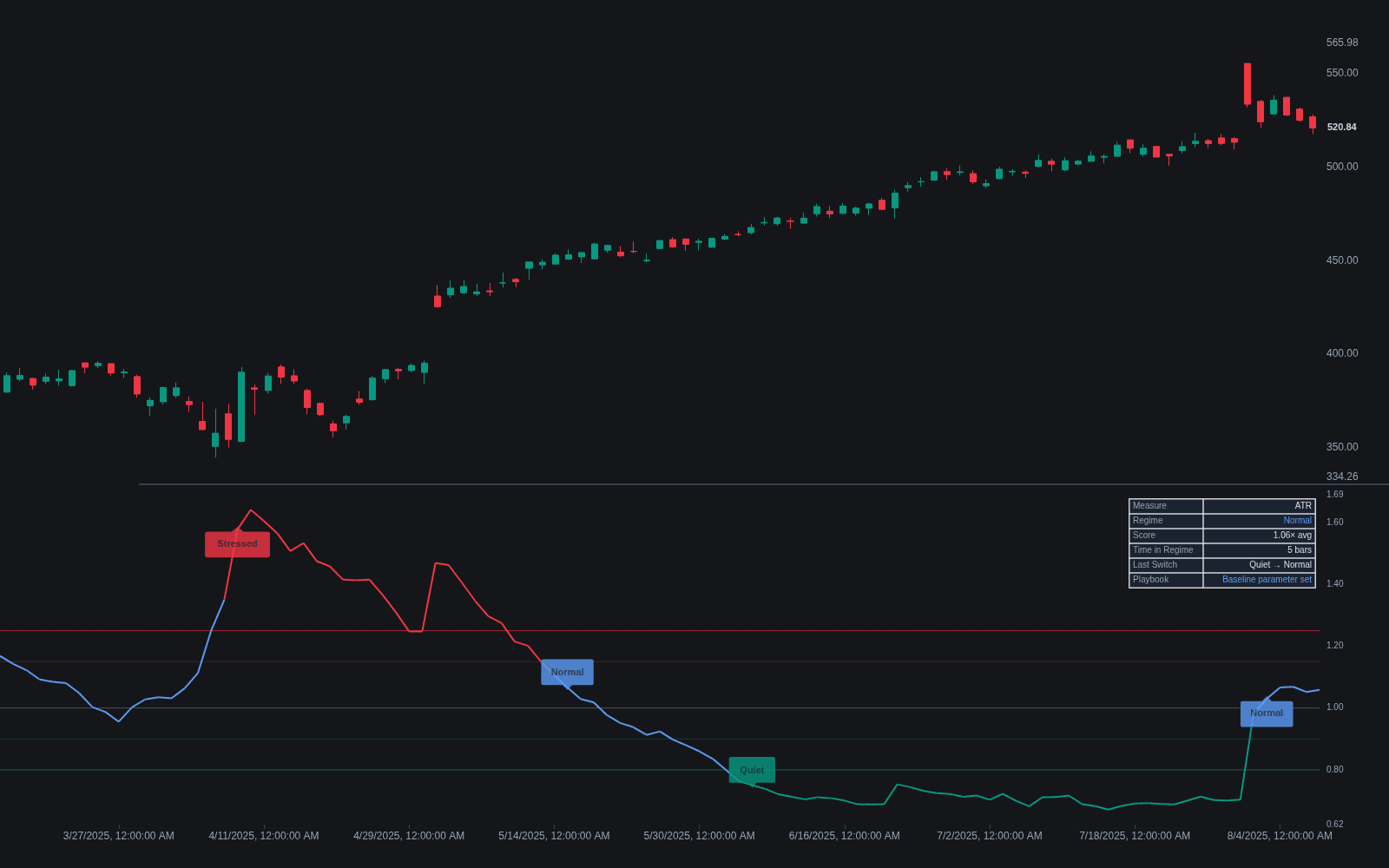
What are Volatility Regime Switches?
A volatility regime switch is a composition rule: measure volatility, classify the reading into a state such as quiet, normal, or stressed, and change the system's behavior when the state changes. The measurement half is standard: ATR against its own average, realized volatility, band width, or a rolling percentile; the labeling task is its own topic, volatility regime classification. The switch is the part that acts on the label, gating entries, swapping parameter sets, or handing control from one sub-strategy to another when the reading crosses a threshold.
The rationale is that most rules are regime-dependent. Trend-following tends to need expansion to pay for its stops, while mean reversion leans on compression; one fixed parameter set rarely suits both. A switch admits that dependence and encodes it explicitly. The cost is a new layer of parameters (thresholds, lookbacks, and the hysteresis or minimum dwell time used to stop the state from flapping on every borderline reading), each of which can be overfit like anything else.
The pattern's roots span econometrics and system design. Regime-switching became a standard econometric tool with James Hamilton's 1989 Markov-switching work; practitioners translated the idea into explicit if-then gates because a hard switch is simple to code, test, and audit. On charting platforms the logic appears as volatility filters attached to classic signals: a volatility-gated Supertrend or a PSAR entry filtered by volatility leaves the base signal untouched while the switch decides whether it may fire.
Architecturally the switch occupies the filter layer of a filter, setup, trigger, exit design: it grants or revokes permission rather than generating entries. A switched system should therefore beat its unswitched baselines out of sample before the added parameters are trusted, and the switch raises the stakes for signal hygiene, because a regime flag that repaints or flips intrabar quietly corrupts every rule downstream.
How to see a volatility regime switch on a chart
The switch is a rule rather than a pattern, but its inputs and effects are visible with ordinary tools.
- 1Plot the system's volatility measure, commonly ATR or short-window realized volatility, with its long-run average or percentile bands in one pane.
- 2Mark threshold crossings; these are the switch events, and the gap between the on and off thresholds is the hysteresis buffer.
- 3Color the chart background by state and check that states persist; single-bar states mean the thresholds are too tight or the input too noisy.
- 4Overlay the strategy's signals and verify behavior changes at the boundaries: entries suppressed in blocked states, wider stops or a different module in stressed ones.
- 5Replay past transitions to confirm the states came from closed bars and would have read the same in real time.
How traders use it
- As a permission filter: block breakout entries until volatility expands through a threshold, or stand aside entirely in stress regimes where the stop distance implied by current ranges no longer fits the sizing rules.
- As stepwise parameter switching: widen trailing stops and slow lookbacks in high-volatility states and tighten them in quiet ones, a discrete cousin of adaptive parameterization, which changes parameters continuously instead.
- As a router between sub-strategies: hand the instrument to a trend module during expansion and a reversion module during compression, with the switch definition carrying the burden of deciding which regime is in force.
- As an alert layer: routing state changes through alerts and webhooks turns the switch into a review prompt rather than an automatic action while the regime logic is still earning trust.
- As half of a two-axis regime map: volatility switches grade how much the market moves while trend/range classifiers grade how it moves; together they split conditions into quadrants that map cleanly onto strategy choice.
Volatility regime switches vs. adjacent composition patterns
Adaptive Parameterization: Adaptive parameterization scales settings continuously with the volatility reading, so behavior changes smoothly and there are no thresholds to whipsaw. A regime switch changes behavior in discrete steps, which is easier to audit and to backtest per state but needs hysteresis at the boundaries.
Trend/range Classifiers: Trend/range classifiers label market character by direction and structure rather than movement size. Many systems gate on both axes at once, since a market can trend quietly, trend violently, or chop in either volatility state.
Filter-setup-trigger-exit Architecture: The filter-setup-trigger-exit pattern is the general blueprint for layered systems; a volatility regime switch is one specific occupant of its filter layer. The architecture says where a gate belongs; the switch is a particular gate.
Concept family
Meta & Composition
28 concepts mapped · 28 in the Library
Volatility Regime Switches FAQ
Turn Volatility Regime Switches into a trading strategy.
Take the implementation from this page into Quant, then build on it, backtest it on real data, and keep refining it in conversation.