Concept
Composite Oscillators
Composite Oscillators, also known as z-scored blends, meta-indicators, Insync Index, are Meta & Composition concepts. The Library holds 8 implementations, each one a working definition you can pull into Quant.
Top Composite Oscillators indicators
The top custom implementations, built on the original standard Composite Oscillators formula.
8 total
Every Composite Oscillators implementation here is strategy-ready: open one in Quant, set your rules, and it backtests automatically.
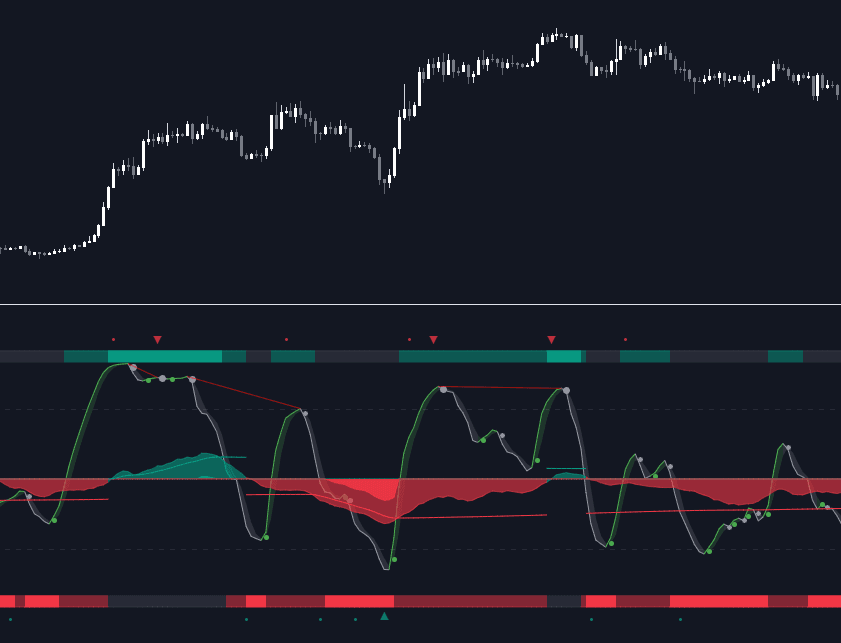
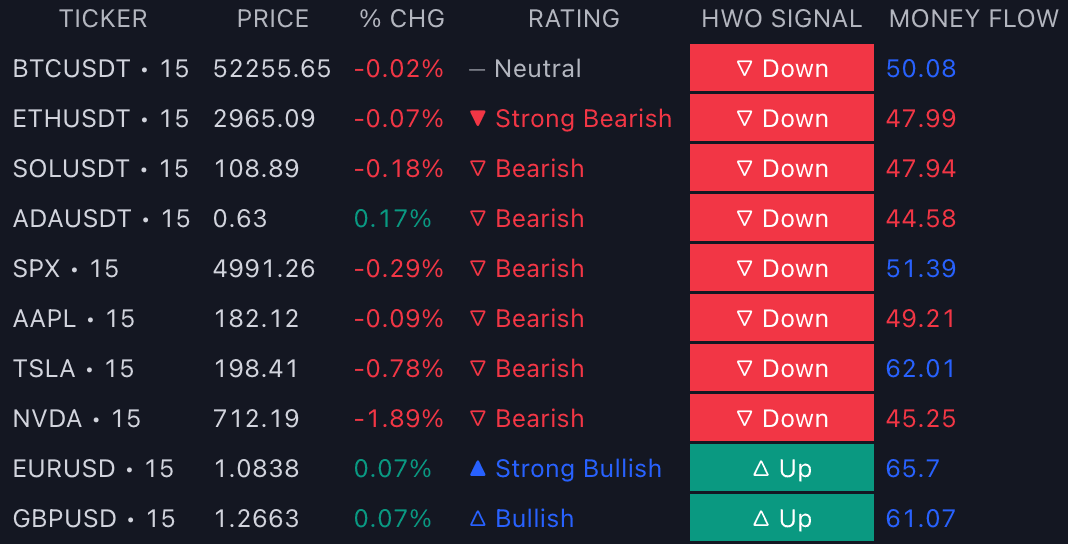
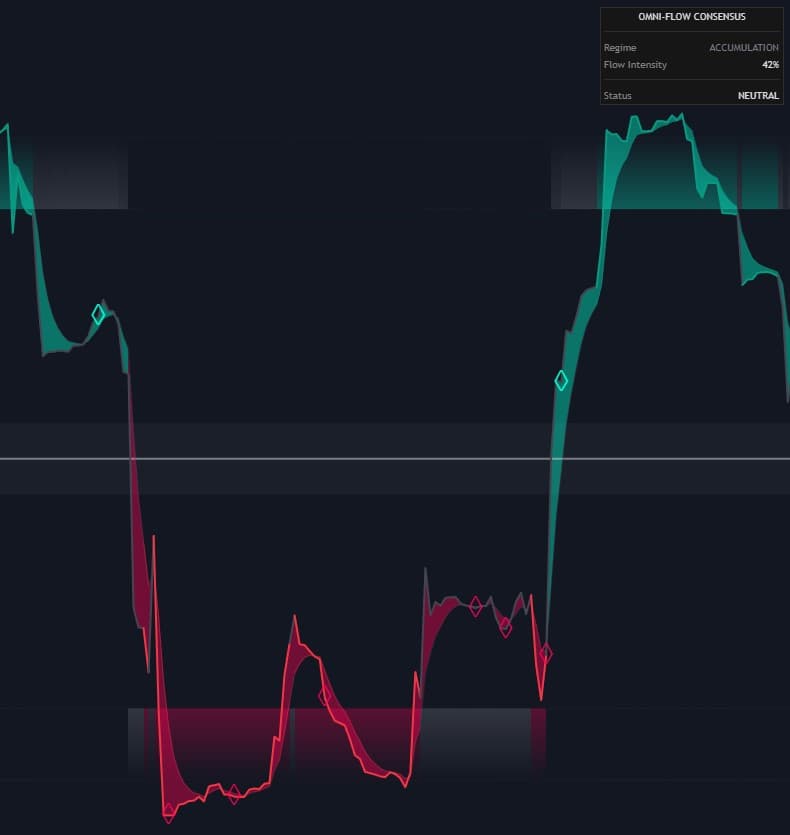
What are Composite Oscillators?
A composite oscillator is a single indicator built by blending several oscillators into one output. Each component, for example RSI, a stochastic, CCI, or a rate of change, is first normalized to a common scale via z-score, percentile rank, or fixed bounds, then combined as an equal or weighted average. The result is one line, usually bounded, that summarizes what a whole panel of oscillators is saying at once. The idea is old: published composites were folding panels of familiar indicators into one bounded reading decades ago, and modern z-scored blends and meta-indicators follow the same template.
The lineage runs through published examples like the mid-1990s Insync Index, which averaged a dozen standard indicators into one 0-100 consensus dial, and through every platform era since: the machinery (normalize, weight, average, bound) has not changed, only the components and the branding. That stability is itself informative, since the design solves a permanent problem, panel overload, rather than encoding any one market theory.
The appeal is consensus with less noise: averaging damps the idiosyncratic whipsaws of any single component, and extremes register only when most components lean the same way. The honest caveat is correlation. Most oscillators are transforms of the same closing prices, so ten components can amount to one signal counted ten times, and their agreement is not independent evidence. Better composites favor components with genuinely different inputs (momentum, volume, volatility, breadth) and are read like any oscillator: overbought/oversold extremes, centerline crosses, and divergences against price. None of those readings is a guarantee; they are conditions, not calls.
Engineering choices decide the instrument's character. Normalization windows set how 'extreme' is defined per component; weights encode a theory of which inputs deserve authority; and the same blend can be run per timeframe and re-aggregated, the MTF-alignment version of the idea. The standing hygiene rules apply doubly, since composites are where double-counting hides: correlated components inflate apparent consensus, and every added input is another parameter surface to overfit, the concerns signal hygiene exists to police.
How to read a composite oscillator
Read it like one oscillator, then interrogate it like a committee.
- 1Learn the roster first: which components, on what inputs, normalized how; the reading means nothing without knowing who is voting.
- 2Read the standard grammar: extremes, centerline crosses, and divergences carry the same meanings as on any bounded oscillator.
- 3Grade extremes by breadth: a reading driven by all components leaning together is the designed signal; one dragged by a single outlier input is noise wearing consensus.
- 4Check input diversity: a blend of ten close-derived momentum measures is one vote amplified, and its 'consensus' deserves single-indicator skepticism.
- 5Watch regime fit: momentum-heavy composites saturate in trends and whipsaw in ranges exactly as their components do; the averaging changes the noise, not the nature.
- 6Audit occasionally against the components: if one input dominates the blend's behavior, the weights are decorative and the composite is that input renamed.
How it's calculated
A single oscillator built by standardizing several component oscillators onto a common scale and averaging them.
When every component is already on the same bounded scale, the z-score step is skipped and the components are averaged directly.
The Insync Index is a published example that combines roughly a dozen standard indicators into one 0 to 100 consensus reading.
Components are usually correlated, so the blend smooths noise rather than adding independent signals.
How traders use it
- As a dashboard replacement: one bounded line stands in for a stack of oscillator panes, with extreme readings flagging the moments when most components agree at once.
- As a smoother: averaging weakly correlated components filters single-indicator whipsaws, so the composite's centerline crosses and threshold breaks flip less often than any one input's.
- As a gate inside a broader confluence and scoring system: setups from another method are taken only while the composite sits on the right side of a chosen threshold.
- For divergence reading: a composite that fails to confirm a new price extreme carries the same message as a single-oscillator regular divergence, with the added claim that the failure is broad rather than one indicator's quirk.
- Across instruments and frames: the same blend computed per symbol or per timeframe and compared side by side turns the composite into a screening score, the cross-instrument version of the consensus dial.
Composite Oscillators vs other aggregation methods
Confluence & Scoring Systems: Scoring systems count discrete conditions (trend up, level held, pattern present) into a checklist total. A composite oscillator averages continuous indicator values into one line; it is an input a scoring system might consume, not a checklist itself.
Ensemble Voting of Signals: Voting aggregates binary outputs: each component says long, short, or flat, and the majority rules. A composite blends the raw continuous readings before any threshold is applied, preserving the magnitude information that votes throw away.
Oscillator of Oscillator: Nesting applies one oscillator to another's output in series, an RSI of a MACD line for instance. A composite works in parallel, averaging many peers side by side rather than transforming one chain more deeply.
More Composite Oscillators implementations
Concept family
Meta & Composition
28 concepts mapped · 28 in the Library
Composite Oscillators FAQ
Turn Composite Oscillators into a trading strategy.
Take any implementation from this page into Quant, then build on it, backtest it on real data, and keep refining it in conversation.