Concept
Signal Hygiene
Signal Hygiene, also known as close/retest/volume confirmation, debounce/cooldown, one-position rules, is a Meta & Composition concept. The Library holds 1 implementation, a working definition you can pull into Quant.
Top Signal Hygiene indicator
The top custom implementation, built on the original standard Signal Hygiene formula.
1 total
The Signal Hygiene implementation below can become a backtested trading strategy — describe your rules and Quant writes the code.
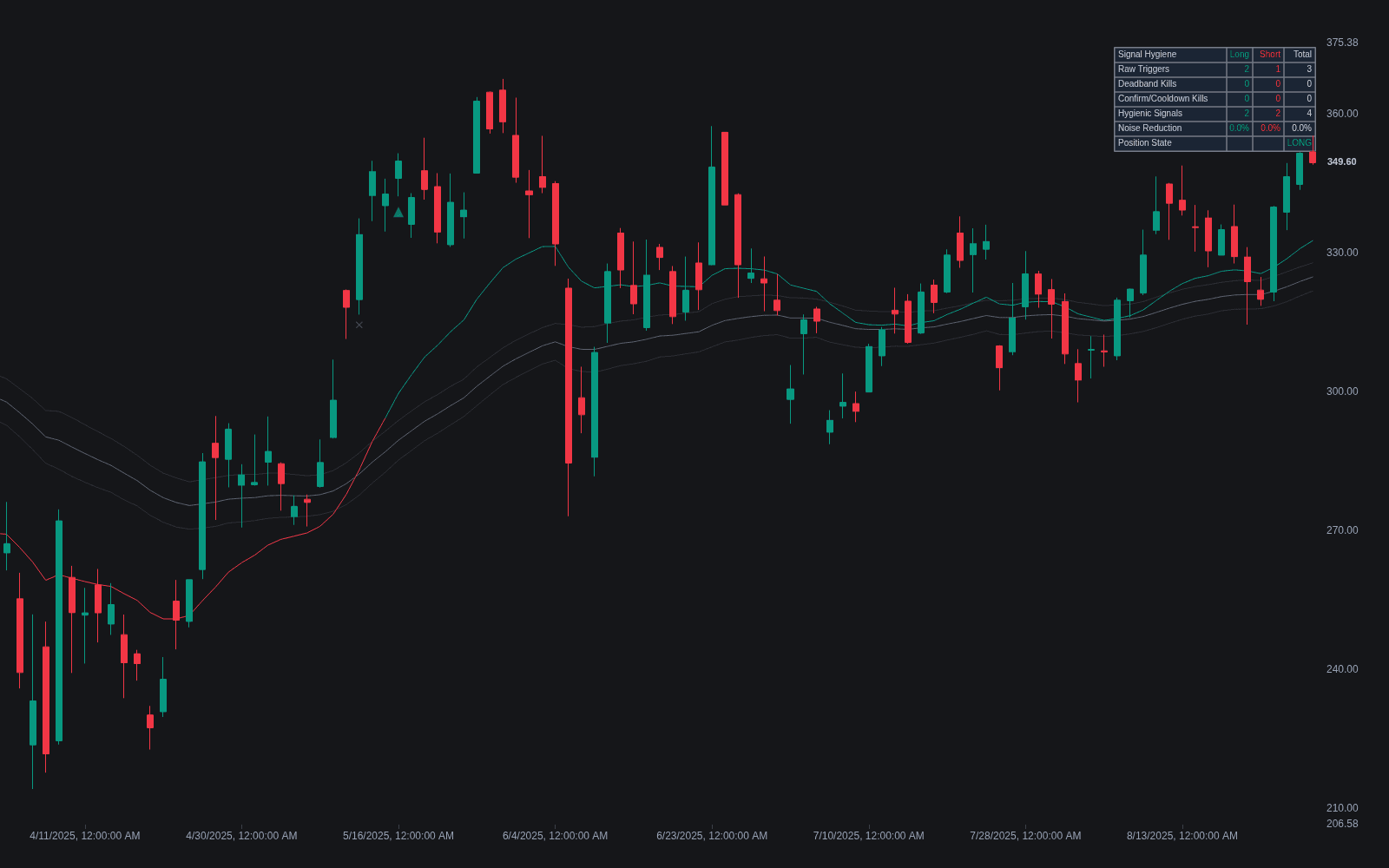
What is Signal Hygiene?
Signal hygiene is the set of engineering rules that turn a raw condition into a signal stream a trader can act on. A crossover, a level break, or a zone touch is instantaneously true or false on every tick; hygiene decides when that truth is allowed to become a signal. The usual layers: confirm on bar close so a printed signal cannot later vanish (the concern repaint-safe engineering formalizes), require follow-through such as a held retest or a volume expansion, debounce so one market event emits one alert rather than a burst, and enforce one-position rules so a new entry cannot fire while the previous trade is open.
The need comes from how raw conditions behave near their thresholds. Price hovering at a moving average can cross, recross, and cross again within a few bars, and each flicker is technically a fresh crossover; without hysteresis or cooldowns, a marginal level can produce a cluster of contradictory alerts. Hygiene adds state and memory: deadbands that demand a minimum penetration before a flip counts, cooldown windows that suppress repeats, and position logic that serializes entries and exits. None of it is free. Every confirmation layer trades earliness for reliability, so hygiene settings are tuning decisions for the specific signal, not defaults to copy across systems.
How to clean a raw signal stream
Most hygiene stacks apply the same layers in the same order, from evaluation timing outward to position logic.
- 1Confirm on close: evaluate the condition on completed bars so a signal, once printed, is final; intrabar evaluation is faster but lets signals appear and vanish as ticks arrive.
- 2Add confirmation filters: require the follow-through that matters for the setup, such as a close beyond the level, a successful retest, above-average relative volume, or agreement from a higher-timeframe trend filter.
- 3Debounce and deduplicate: after a signal fires, suppress same-direction repeats for a fixed cooldown or until the state re-arms, for example an oscillator leaving and re-entering its zone.
- 4Enforce position rules: one signal per position, no re-entries while a trade is open, and no opposite signal until the current one resolves, so the stream maps one-to-one onto executable trades.
How traders use it
- As breakout discipline: requiring the close beyond the level, a held retest, or a volume expansion before the alert counts, so the raw touch of a level is filtered down to the minority of breaks worth acting on.
- As crossover and flip debouncing: deadbands and hysteresis around moving-average or trend-flip thresholds, so a marginal recross does not flip the system's state back and forth on every bar.
- As alert engineering: once-per-bar-close options, cooldown timers, and deduplication keys so alerts and webhooks fire exactly once per event, which matters most when the alert drives automated orders.
- As backtest honesty: applying the same one-position and confirmation rules in testing as in live execution, since a backtest that acts on every raw condition can overstate how many trades were actually available.
Signal Hygiene vs neighboring disciplines
Repaint-safe Engineering: Repaint safety guarantees a printed signal was computed from finalized data and will not change; hygiene assumes that and goes further, deciding how often, how confirmed, and under what position state signals may fire at all.
Filter-setup-trigger-exit Architecture: The architecture defines which layers a strategy has and what each is allowed to decide; signal hygiene is the discipline applied inside the trigger layer so the architecture receives one clean event per opportunity.
Breakout Confirmation: Breakout confirmation is signal hygiene specialized to one event type, the level break; the hygiene toolkit (close confirmation, retests, volume, cooldowns) applies to any signal source, from crossovers to pattern completions.
Concept family
Meta & Composition
28 concepts mapped · 28 in the Library
Signal Hygiene FAQ
Turn Signal Hygiene into a trading strategy.
Take the implementation from this page into Quant, then build on it, backtest it on real data, and keep refining it in conversation.