Concept
Repaint-safe Engineering
Repaint-safe Engineering, also known as bar-close vs intrabar evaluation, live/backtest parity, is a Meta & Composition concept. The Library holds 1 implementation, a working definition you can pull into Quant.
Top Repaint-safe Engineering indicator
The top custom implementation, built on the original standard Repaint-safe Engineering formula.
1 total
This Repaint-safe Engineering implementation is strategy-ready: open it in Quant, set your rules, and it backtests automatically.
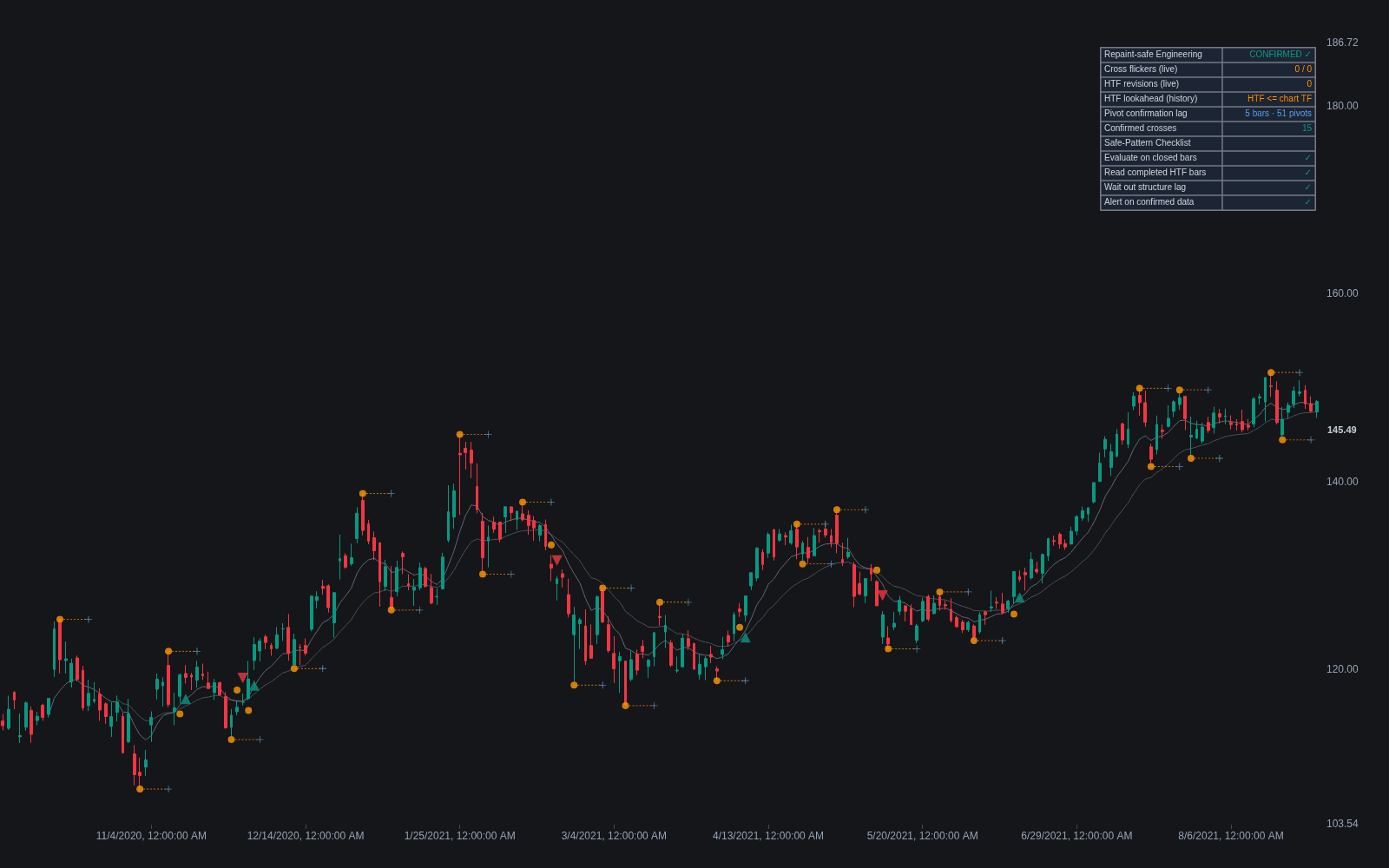
What is Repaint-safe Engineering?
Repaint-safe engineering is the discipline of building indicators and signals so that what history shows is what live trading actually displayed. An indicator "repaints" when its past output changes after the fact: a signal that appeared intrabar vanishes by the close, a multi-timeframe value silently uses the still-forming higher-timeframe bar, or a structure such as a pivot is drawn bars after the price it marks. On a historical chart all of these look clean and prescient, because history only stores the final version. Repaint-safety means engineering, and testing, for live/backtest parity.
The failure modes have distinct fixes. Intrabar evaluation is solved by confirming conditions on closed bars only. Higher-timeframe references are solved by reading only completed higher-timeframe bars, accepting one bar of staleness instead of a value that mutates until the period ends. Retroactive structures (swing pivots, Williams fractals, zigzag legs) are legitimate but must be acted on, and backtested, only after their confirmation delay has elapsed. The common thread is honest accounting: waiting for confirmation costs entry lateness, and repaint-safe design makes that cost explicit rather than hiding it in a backtest that could never have been traded.
Two quieter failure modes complete the taxonomy. Full-history normalization, scaling an oscillator by the chart's overall minimum and maximum or by percentiles computed across all visible data, rewrites every past value each time a new extreme prints, so the historical plot was never available live; the fix is causal normalization over trailing windows. And any fitted component, a regression curve, adaptive coefficients under adaptive parameterization, a periodically retrained model, revises history whenever it refits, so its backtest must replay the fits as they would have existed, not apply the final fit to the past.
Around the engineering sits a verification culture. The convention of firing alerts strictly on bar close, standardized by PineCoders' alert templates and applied in tools like QuantNomad's on-close Parabolic SAR alerts, exists precisely to guarantee that an emitted signal is permanent, and non-repainting variants of popular studies, such as AlgoAlpha's support and resistance implementation, advertise the property as a feature. The decisive test remains empirical: log live outputs as bars close and compare them with the reloaded chart later, because source review catches design intent while the log catches what actually happened.
How to identify repainting risks in an indicator
Repainting hides in specific places. Auditing an indicator means walking those places in order.
- 1Check evaluation timing: do conditions fire intrabar, where they can appear and vanish, or only on confirmed closes?
- 2Check higher-timeframe requests: does any value read the still-forming higher-timeframe bar, or worse, request future-offset data that only exists in backtests?
- 3Check the drawings: pivots, zigzags, and structure labels plotted bars into the past are honest only if signals built on them respect the confirmation delay.
- 4Check normalization: scaling by full-chart extremes or whole-history percentiles rewrites the past every time a new extreme prints.
- 5Check fitted components: regressions, adaptive coefficients, and retrained models revise history on every refit unless the backtest replays fits causally.
- 6Then verify empirically: log alerts or screenshots as bars close over live sessions and diff against the reloaded chart; any discrepancy is repainting, whatever the source claims.
How traders use it
- As alert discipline: conditions are evaluated once per closed bar and fire on bar close, so what reaches alerts and webhooks matches what the chart will still show tomorrow.
- As multi-timeframe hygiene: any higher-timeframe trend filter or level reference reads the last completed higher-timeframe bar, never the forming one, keeping live values identical to their historical reconstruction.
- As backtest honesty: signals derived from lagged structures are shifted by their confirmation delay before performance is measured, and fills are simulated at prices available after the signal existed, not at the bar that produced it in hindsight.
- As the trigger stage of a pipeline: within a filter-setup-trigger-exit architecture, the trigger is where repaint-safety is enforced, because it is the moment orders and alerts leave the chart.
- As composite discipline: in MTF alignment and confluence scoring systems, every component must individually hold parity, because a composite inherits the repainting of its worst member while displaying the credibility of its best.
Repaint-safe Engineering vs related disciplines
Signal Hygiene: Hygiene covers the broader cleanliness of a signal stream: deduplication, debouncing, resolving conflicting signals. Repaint-safety is the temporal slice of it, guaranteeing that a signal, once emitted, is permanent and would have existed live.
Zigzag Structure: A zigzag redraws its most recent leg by design; that is deliberate retrospection, not a bug. The repaint problem arises when such structures are backtested or alerted as if their pivots were known in real time. Repaint-safe use keeps the tool and adds the confirmation delay.
In-sample / Out-of-sample Split: The in-sample/out-of-sample split guards against overfitting parameters to history. Repaint-safety guards against evaluating history with information that did not yet exist. A strategy can pass out-of-sample and still be untradeable if its signals repaint; the two validations are independent.
Concept family
Meta & Composition
28 concepts mapped · 28 in the Library
Repaint-safe Engineering FAQ
Turn Repaint-safe Engineering into a trading strategy.
Take the implementation from this page into Quant, then build on it, backtest it on real data, and keep refining it in conversation.