Concept
Lead-lag Instrument Triggers
Lead-lag Instrument Triggers are Meta & Composition concepts. The Library holds 1 implementation, a working definition you can pull into Quant.
ES→NQ, BTC→alts
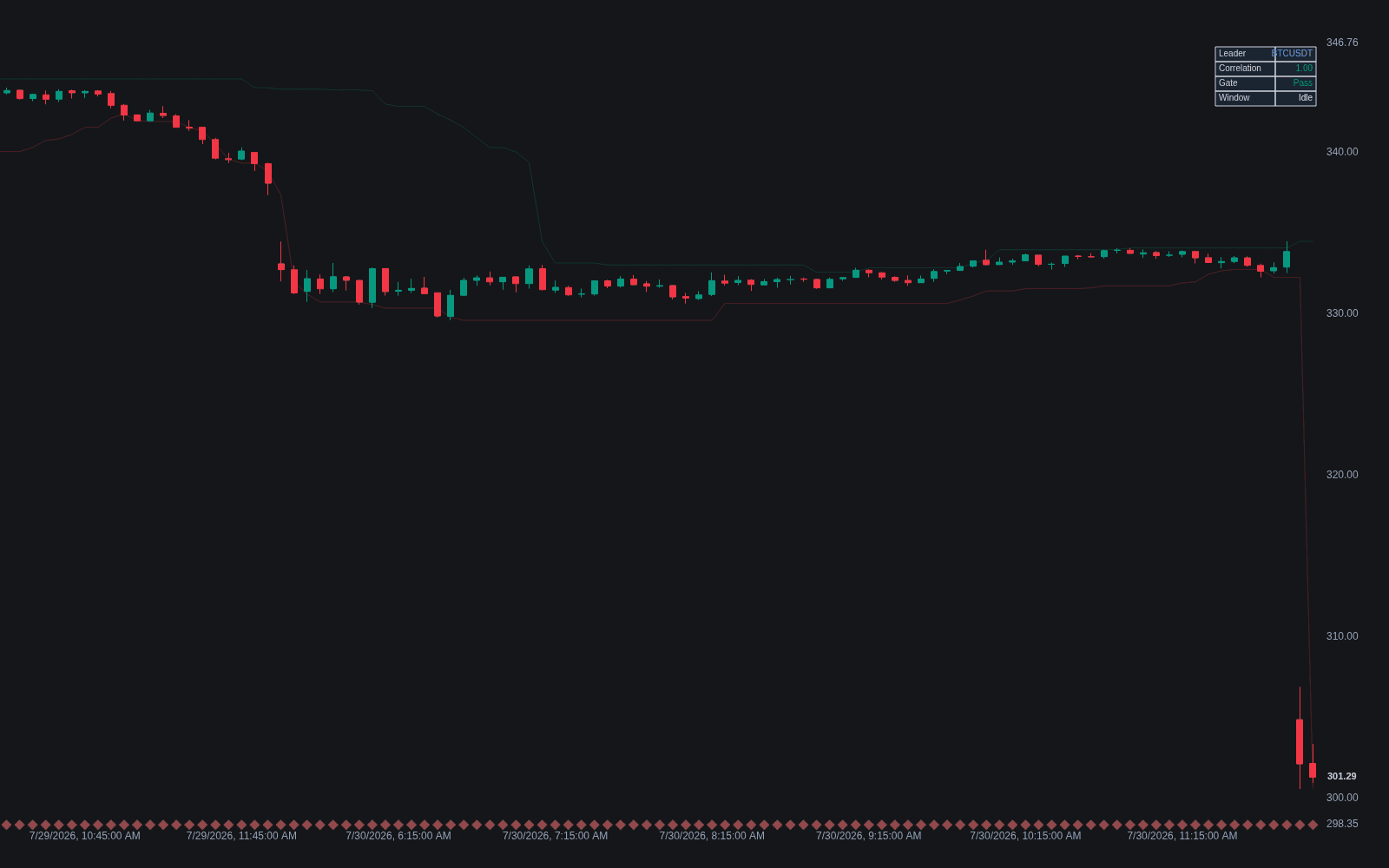
Top Lead-lag Instrument Triggers indicator
The top custom implementation, built on the original standard Lead-lag Instrument Triggers formula.
1 total
This Lead-lag Instrument Triggers implementation is strategy-ready: open it in Quant, set your rules, and it backtests automatically.
What are lead-lag instrument triggers?
Lead-lag instrument triggers are trade signals generated on one instrument from the behavior of a related instrument that tends to move first. The trader watches the leader for a decisive event, a breakout, a failure at a key level, a momentum thrust, and executes on the lagger, betting that the follower has not yet fully priced the move. Classic candidates include index futures pairs such as ES and NQ, a sector leader versus the rest of its sector, and Bitcoin versus altcoins, where major BTC moves often precede correlated swings across smaller coins.
The idea exists because related instruments share common drivers but differ in liquidity, participation, and information flow. The most liquid or most watched instrument frequently absorbs new information first, while thinner or derivative markets adjust with a delay measured in seconds to hours depending on the pair. Formal lead-lag detection, typically via lagged correlation analysis, is the measurement step; the trigger is the trading rule built on top of it.
Traders care because a genuine lead gives an early, externally sourced confirmation that a plain single-chart signal cannot provide. The honest caveat is that lead-lag relationships are unstable: they compress as arbitrage participants exploit them, invert during regime changes, and can vanish entirely. In highly efficient pairs such as major index futures, the exploitable lag at retail timescales is often close to zero, so the leader works better as a filter or confirmation input than as a standalone timing edge.
How traders use it
- Confirmation filtering: only take a breakout on the lagging instrument when the leader has already broken the equivalent level, treating the leader's move as evidence the shared driver is real rather than local noise.
- Divergence fading: when the leader makes a new high and the lagger refuses to follow, or vice versa, some traders read the non-confirmation as early evidence of exhaustion, similar in spirit to intermarket analysis.
- Crypto rotation: after a large BTC impulse, traders scan correlated altcoins that have not yet moved and position for the catch-up leg, accepting that the follow-through is probabilistic and often uneven across coins.
- Regime awareness: relationships such as bonds leading equities or the dollar leading commodities are monitored at higher timeframes to bias direction, not to time entries bar by bar.
- Limitations: measured lags decay over time, transaction costs can exceed the residual edge in liquid pairs, and a leader-lagger label estimated in one regime frequently fails out of sample, so the relationship needs periodic re-validation.
Lead-lag instrument triggers vs. related concepts
Lead-lag Detection: Detection is the statistical measurement of which instrument moves first and by how much. Lead-lag instrument triggers are the trading rules built on that measurement: detection diagnoses, triggers execute.
Cross-instrument Composition: Cross-instrument composition is the broader engineering practice of feeding one instrument's data into another's signals for any purpose. Lead-lag triggers are the specific case where the external input is a presumed leader used for timing.
Pairs Trading Stack: Pairs trading bets on the spread between two related instruments converging, often justified by cointegration. Lead-lag triggers are directional: the leader times an outright position in the lagger rather than a spread.
Concept family
Meta & Composition
28 concepts mapped · 28 in the Library
Lead-lag Instrument Triggers FAQ
Turn Lead-lag Instrument Triggers into a trading strategy.
Take the implementation from this page into Quant, then build on it, backtest it on real data, and keep refining it in conversation.