Concept
MTF Alignment & Confluence Scoring
MTF Alignment & Confluence Scoring, also known as timeframe matrices, is a Meta & Composition concept. The Library holds 2 implementations, each one a working definition you can pull into Quant.
Top MTF Alignment & Confluence Scoring indicators
The top custom implementations, built on the original standard MTF Alignment & Confluence Scoring formula.
2 total
Any of the 2 MTF Alignment & Confluence Scoring implementations below can become a backtested trading strategy — describe your rules and Quant writes the code.
.png&w=3840&q=75)
What is MTF Alignment & Confluence Scoring?
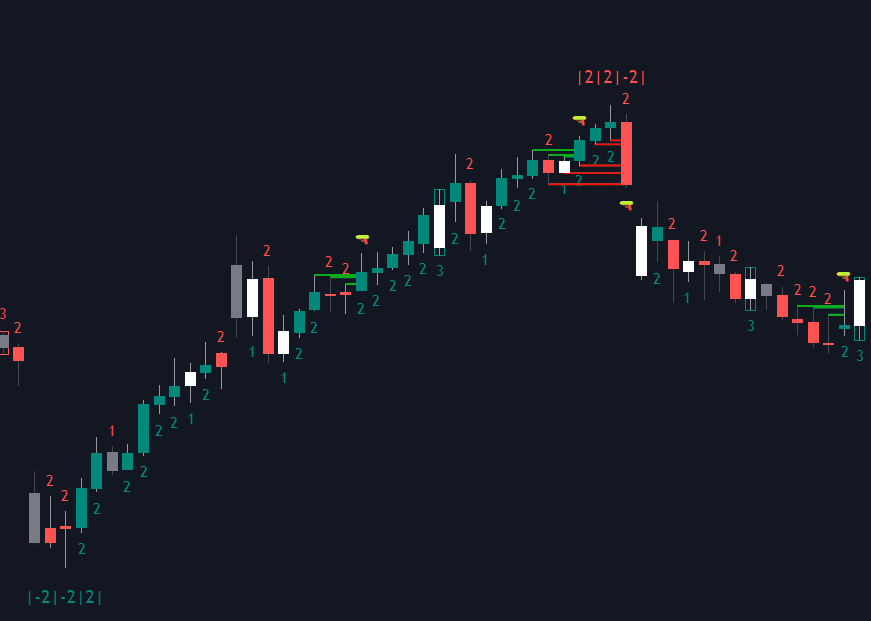
MTF (multi-timeframe) alignment is the practice of evaluating the same condition, such as trend direction, momentum state, or structure bias, on several timeframes at once and reading how many agree. A confluence score or timeframe matrix formalizes it: each row is a timeframe, each cell a bullish or bearish state, and the aggregate (5 of 6 bullish, say) becomes a single tradable reading.
Any per-timeframe condition can feed the matrix: price relative to an EMA, RSI above or below 50, Supertrend direction, or swing-structure bias. The design detail that matters most is spacing. Adjacent timeframes sample nearly the same price path, so a 1m/3m/5m stack agreeing is close to one observation repeated; frames spaced by roughly three to six times (15m/1h/4h/daily) contribute more independent information. Scored alignment quantifies the older discretionary workflow of top-down analysis, where the higher frame sets bias and the lower frame times entries.
It matters because fighting higher-timeframe flow is a common and expensive habit, and an alignment score makes that flow explicit before entry. The honest caveat: alignment is most complete when a trend is mature, so a perfect score can arrive late. Score deterioration is information too, often flagging transition earlier than the highest timeframe's own flip.
How to calculate an MTF alignment score
The same recipe underlies most timeframe matrices and multi-timeframe dashboards.
- 1Pick one condition and a ladder of three to five timeframes spaced by roughly three to six times each, anchored to your holding period; frames that sit next to each other mostly double-count.
- 2Evaluate the condition per timeframe using closed higher-timeframe bars, or accept that live HTF values can change until their bar closes; repaint-safe handling decides whether the score is stable.
- 3Aggregate into a score: a simple count of agreeing frames, or a weighted sum if higher frames deserve more say. Display it as a number (4 of 5 bullish) or as a matrix of per-frame states.
- 4Define behavior at each reading: full alignment permits trend-following entries, mixed readings mean stand aside or reduce size, and a falling score tightens management on open trades.
How traders use it
- As a directional gate: longs are only taken when the frames above the execution timeframe agree, a graded generalization of a single higher-timeframe trend filter.
- As a screener: the same matrix computed across a watchlist surfaces which symbols currently have stacked agreement, so attention goes where alignment already exists.
- As transition detection: a score decaying from 6 of 6 toward 3 of 6 flags a possible regime change earlier than waiting for the highest chart itself to turn.
- As an execution split: the score sets bias while a lower-timeframe signal times the entry, keeping analysis and trigger on separate frames as in classic top-down workflows.
MTF alignment vs. related concepts
Top-down Analysis: Top-down is the discretionary workflow: start at the weekly, walk down, form a narrative. MTF alignment scoring compresses the same agreement check into a computed number or matrix that can gate signals automatically.
Higher-timeframe Trend Filter: An HTF trend filter is one binary gate from one higher frame. Alignment scoring generalizes it to many frames and returns a graded reading instead of pass/fail.
Multi-timeframe Structure Alignment: Structure alignment tracks swing structure specifically (higher highs and lows, breaks of structure) across frames. MTF confluence scoring is condition-agnostic: any indicator or state can fill the matrix.
HTF-level Proximity Filters: Proximity filters gate signals by location, distance to a higher-timeframe level. Alignment scoring gates by state, directional agreement across frames. One asks where price is, the other asks which way everything points.
Concept family
Meta & Composition
28 concepts mapped · 28 in the Library
MTF Alignment & Confluence Scoring FAQ
Turn MTF Alignment & Confluence Scoring into a trading strategy.
Take any implementation from this page into Quant, then build on it, backtest it on real data, and keep refining it in conversation.