Concept
Renko
Renko is a Meta & Composition concept. The Library holds 1 implementation, a working definition you can pull into Quant.
Top Renko indicator
The top custom implementation, built on the original standard Renko formula.
1 total
From studying Renko to trading it: take the implementation below into Quant and backtest it instantly.
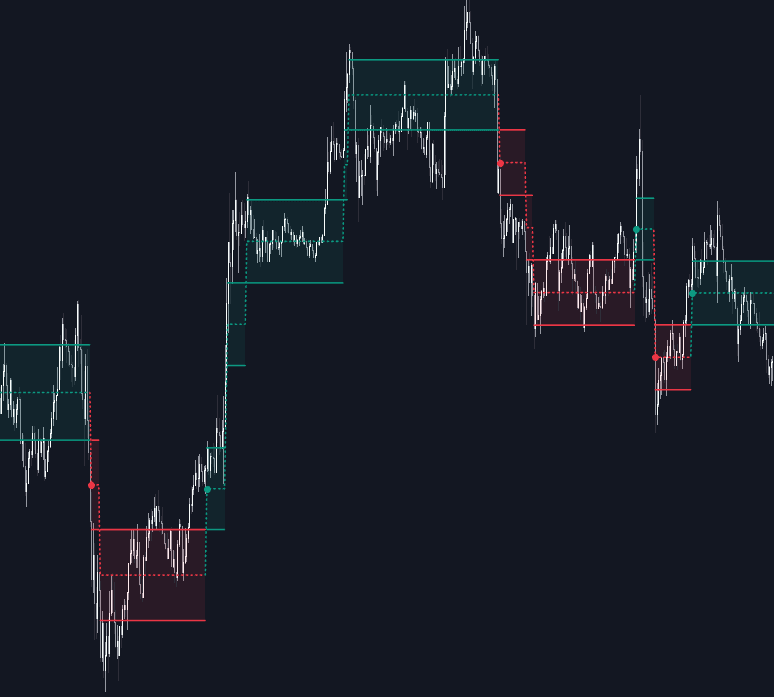
What is Renko?
Renko is a price-only chart type that rebuilds the market as a series of fixed-size bricks (from the Japanese renga, brick) instead of time-based bars. A new brick prints only when price travels one full brick size beyond the last brick in the trend direction; a reversal brick, in the standard construction, requires two brick sizes, one to negate the current brick and one to print in the opposite color. Nothing prints while price stays inside those thresholds, so the horizontal axis counts brick events rather than uniform time: a volatile hour can generate many bricks while a quiet week generates none. Brick size is the governing parameter, set as a fixed increment or scaled to volatility, commonly from an ATR reading.
The construction acts as a noise filter with memory: moves smaller than the brick threshold vanish, so trends render as unbroken staircases of same-colored bricks and consolidation compresses into a few alternating bricks. The cost is discarded information and structural lag. Most implementations build bricks from closing prices, so intrabar extremes are invisible unless the variant adds wicks, and a reversal cannot appear until price has already traveled two brick sizes against the trend. Renko signals therefore look cleaner in hindsight than they are in execution, which is worth keeping front of mind when judging any renko-based system.
How to construct a Renko chart
Every renko chart follows the same brick logic; the choices are the brick size and the price source.
- 1Choose the brick size: a fixed price increment for stable instruments, or a volatility-derived value such as an ATR-based size. Larger bricks filter more noise but confirm every turn later, and ATR-based sizes recalculate over time, so bricks drawn today may not match bricks drawn next week.
- 2Print continuation bricks: each time the source price (usually the close) reaches one full brick size beyond the last brick's extreme, add a new brick in that direction; partial moves add nothing.
- 3Apply the reversal rule: an opposite-colored brick prints only after price moves two full brick sizes against the last brick, so minor pullbacks never appear on the chart.
- 4Note what was discarded: uniform time, intrabar wicks, and volume alignment are all transformed or lost, so cross-check renko structures against the time-based chart before trading them.
How it's calculated
Rebuilds price as fixed-height bricks that print only when price travels a set distance, removing time and sub-threshold noise from the chart.
Close-based bricks ignore intrabar extremes, so fast spikes can pass without printing; high/low-based variants react sooner.
ATR-sized bricks recompute as ATR changes, which can redraw historical bricks and alter backtests.
Because time is removed, indicators computed on Renko bars differ from their time-bar values, and every direction change costs 2 × B.
How traders use it
- As a trend filter: a run of same-colored bricks is a simple visual trend regime read, and traders often require brick-color agreement before taking signals generated on the regular time-based chart.
- As a structure cleaner: because consolidation compresses, ranges, breakout levels, and support and resistance often stand out more clearly on renko than on a cluttered time chart.
- As an input series for indicators: RSI, MACD, or moving averages computed on brick closes tend to whipsaw less, at the price of added lag and of results that do not translate one-to-one back to time-based execution.
- As an exit mechanism: waiting for a reversal brick is effectively a trailing exit two brick sizes behind the last brick's leading edge (volatility-scaled when the brick size derives from ATR), comparable to other members of the trailing-stop family.
Renko vs other chart transforms
Heikin Ashi: Heikin Ashi keeps one candle per time period and smooths by averaging OHLC values; renko abandons the time axis entirely and prints only when price covers a full brick size.
Point & Figure: Point & Figure is renko's closest relative: also price-only with a box size, but it stacks Xs and Os in columns and conventionally uses a three-box reversal, versus renko's one brick per box move and two-brick reversal.
Alternative Bar Types: Renko is one member of a wider family of non-time bar constructions (range, kagi, line break, tick, and volume bars) that all resample price by activity rather than by the clock.
Concept family
Meta & Composition
28 concepts mapped · 28 in the Library
Renko FAQ
Turn Renko into a trading strategy.
Take the implementation from this page into Quant, then build on it, backtest it on real data, and keep refining it in conversation.