Concept
Session VWAP
Session VWAP, also known as VWAP cross, is a Volume & Order Flow concept. The Library holds 1 implementation, a working definition you can pull into Quant.
The standard Session VWAP indicator
Session VWAP exactly as classically defined: the faithful reference build of the original formula, free to run in Quant.
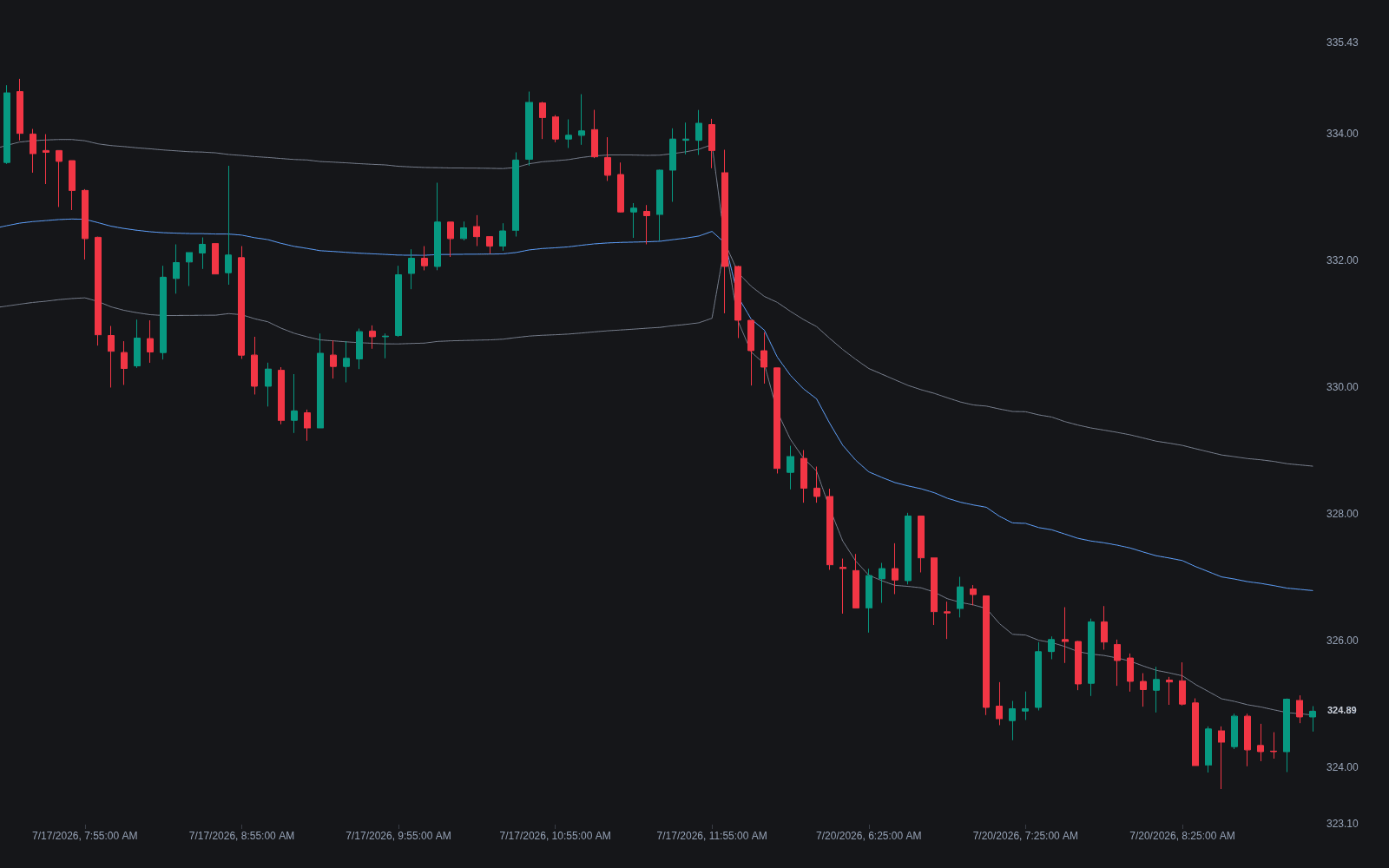
What is Session VWAP?
Session VWAP is the volume-weighted average price of everything traded since the session open, reset at the start of each new session. Each bar contributes its price (commonly the typical price, the average of high, low, and close) multiplied by its volume; the running sum of those products divided by the running sum of volume is the VWAP line. Because busy bars carry more weight than quiet ones, the line tracks where volume actually changed hands, not just where price wandered.
The anchor is what makes it a session VWAP: the calculation starts fresh at the open of each trading session, or at a conventional day boundary on 24-hour markets. Early in the day the line is sensitive, swinging with each print; as cumulative volume builds it gains inertia and flattens. Many charts add standard-deviation bands around the line to show how stretched price is from the session's average.
Session VWAP matters because it is the benchmark many institutional execution desks are measured against: an algorithm tasked with buying near VWAP will slice orders around it all day, which gives the line practical gravity intraday. Price holding above it says the average buyer since the open is in profit; trading below it says the opposite. It is still an average, though. It lags, and it is not guaranteed to act as support or resistance on any given touch.
How to calculate Session VWAP
Session VWAP is cumulative arithmetic, which is why the line behaves differently in the first hour than in the last.
- 1Define the session anchor: the exchange open for equities and futures, or a conventional day boundary (often midnight UTC) for 24-hour markets. The calculation resets here.
- 2For each bar since the anchor, multiply a representative price by the bar's volume. The typical price, (high + low + close) / 3, is the common choice on bar data.
- 3Keep two running totals: the sum of price times volume, and the sum of volume. Session VWAP on any bar is the first total divided by the second.
- 4Plot the ratio bar by bar. It moves freely early, stiffens as volume accumulates, and jumps back to price at the next session open.
How it's calculated
The volume-weighted average price of the current session, restarting at each session open.
VWAP and its bands reset at the first bar of each new session; weekly, monthly, or custom anchors use the same formula with a different starting bar s.
Some platforms use the close or HL2 in place of typical price.
A VWAP cross is the close crossing the session VWAP line.
How traders use it
- As an intraday bias line: many strategies take longs only above session VWAP and shorts only below it, on the logic that the average participant since the open is positioned with the trade. The cross itself (the 'VWAP cross') is also traded as a trigger, though crosses in quiet midday tape whipsaw.
- As a mean-reversion anchor: in balanced sessions price rotates around VWAP, so stretched excursions get faded back toward it. Whether fading or following is appropriate is a regime question, covered under VWAP mean-reversion vs trend regimes.
- As an execution benchmark: desks and systematic traders compare fills against session VWAP to judge slippage, and scale into positions around the line rather than chasing extended prices.
- In confluence with session structure: VWAP read alongside the opening range, the session midpoint, and prior period levels frames the intraday auction; agreement between independent references carries more weight than any single line.
Session VWAP vs other VWAP variants
Anchored VWAP: Same cumulative math, different starting point: an anchored VWAP begins at a user-chosen event such as a swing low, an earnings gap, or a breakout bar. Session VWAP is the special case where the anchor is always the session open.
Rolling VWAP: A rolling VWAP never resets; it maintains a sliding window over the last N bars. It behaves like a volume-weighted moving average, while session VWAP is cumulative from a fixed anchor and gains inertia as the day ages.
Periodic VWAPs: Weekly, monthly, quarterly, and yearly VWAPs apply the same reset logic on longer calendars. Swing traders read them the way day traders read the session line; the different anchors disagree constantly, which is the point of plotting several.
VWMA: A volume-weighted moving average weights only the last N bars and slides forward, so it has no anchor and no reset. VWAP variants answer 'average price since a moment'; VWMA answers 'volume-weighted average of recent bars.'
Concept family
Volume & Order Flow
88 concepts mapped · 88 in the Library
Session VWAP FAQ
Turn Session VWAP into a trading strategy.
Take the implementation from this page into Quant, then build on it, backtest it on real data, and keep refining it in conversation.