Concept
Cypher
Cypher is a Elliott & Harmonics concept. The Library holds 1 implementation, a working definition you can pull into Quant.
Top Cypher indicator
The top custom implementation, built on the original standard Cypher formula.
1 total
From studying Cypher to trading it: take the implementation below into Quant and backtest it instantly.
What is a Cypher?
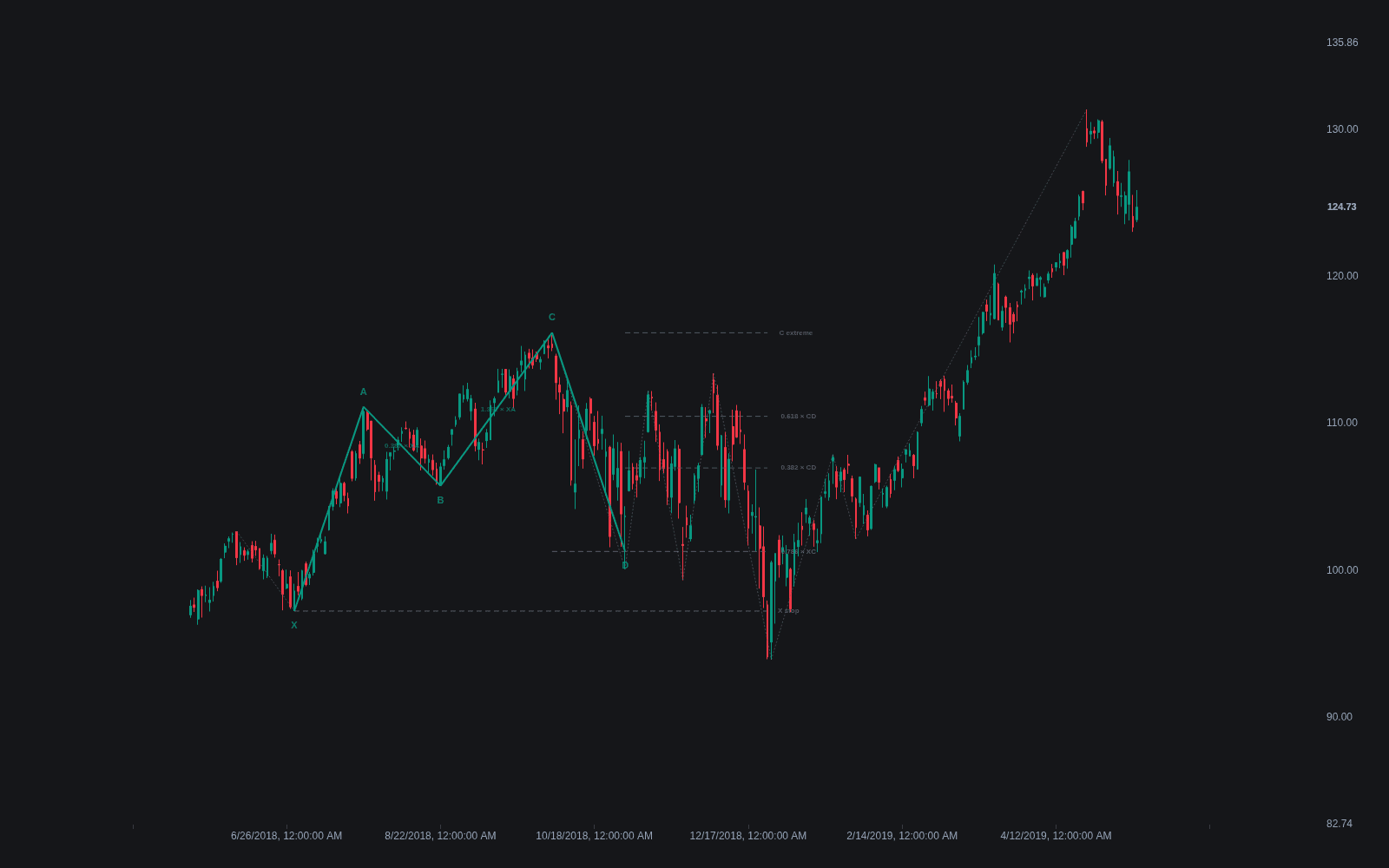
The Cypher is a five-point XABCD pattern attributed to Darren Oglesbee, and it breaks the mold of the Gartley-descended harmonic patterns in one structural way: its C point extends beyond A. After the initial XA leg, B retraces 0.382 to 0.618 of XA, but instead of C holding inside the AB range, price pushes past the A extreme to a 1.272 to 1.414 extension of XA. The D completion is then measured from the full XC swing, landing at its 0.786 retracement.
That anchoring difference matters more than it first appears. Classic patterns key their completion off the XA leg; the Cypher keys off XC, the entire expanded swing. The practical effect is that the Cypher describes a market making a higher high (or lower low) at C that fails to hold, with the 0.786 pullback of the whole advance offering the entry back in the C direction. In common usage the Cypher is traded as a continuation-leaning pattern: the expectation is a resumption toward the C extreme rather than a full reversal of the structure.
The Cypher emerged from the online harmonic trading community rather than the Carney or Pesavento books, and ratio tables vary slightly across platforms, particularly on the allowed B range. What implementations agree on is the skeleton: B inside XA, C beyond A at 1.272 to 1.414 of XA, and D at 0.786 of XC defining the potential reversal zone.
How to identify a Cypher pattern on a chart
The C-beyond-A geometry is the visual tell; the XC-based measurement is the part most often done wrong.
- 1Mark the XA impulse and confirm B retraces into the 0.382 to 0.618 range of XA; a deeper B disqualifies the pattern in most rule sets.
- 2Watch for C to extend past the A extreme, reaching 1.272 to 1.414 of the XA swing; a C that stays inside XA points to Gartley-family patterns instead.
- 3Draw the retracement over the full XC swing, from the X origin to the C extreme, and mark the 0.786 level as the D completion.
- 4Let price trade into 0.786 of XC and look for reaction in the direction of the C leg; the X level is the natural structural invalidation behind the zone.
- 5Grade the setup higher when the 0.786 XC level coincides with other independent references, such as prior structure or a higher-timeframe level.
How traders use it
- As a failed-breakout entry: the pattern frames a push beyond A that retraces deeply, with the 0.786 XC level used to rejoin the direction of the C leg at defined risk.
- With stops behind X: because D sits at 0.786 of the full swing, the X origin provides a nearby structural stop, keeping risk small relative to targets back toward C.
- With staged targets: common practice takes partial profit at the 0.382 retracement of the CD leg and holds remainder toward the 0.618 retracement or the C extreme.
- With scanner caution: platforms differ on exact Cypher tolerances, so two tools can disagree on the same swings; checking the raw measurements beats trusting the label.
- With honest limits: the pattern's popularity rests on community-reported results rather than published statistics, so it warrants the same defined-risk skepticism as every completion pattern.
Cypher vs confusable patterns
Shark: The Shark also sends C beyond A, but completes deep, at 0.886 to 1.13 of an earlier swing, and Carney treats it as a precursor to the 5-0. The Cypher completes shallower, at 0.786 of XC, and leans continuation.
Gartley: Both use a 0.786 completion, but the Gartley measures it from XA with C held inside the AB range. The Cypher's C exceeds A and its 0.786 is measured from the larger XC swing.
Butterfly: The Butterfly's extension happens at D, which completes beyond X after a deep 0.786 B. The Cypher's extension happens at C, while its D stays inside the structure.
Concept family
Elliott & Harmonics
33 concepts mapped · 33 in the Library
Cypher FAQ
Turn Cypher into a trading strategy.
Take the implementation from this page into Quant, then build on it, backtest it on real data, and keep refining it in conversation.