Concept
Impulse
Impulse is a Elliott & Harmonics concept. The Library holds 1 implementation, a working definition you can pull into Quant.
1-2-3-4-5
Top Impulse indicator
The top custom implementation, built on the original standard Impulse formula.
1 total
This Impulse implementation is strategy-ready: open it in Quant, set your rules, and it backtests automatically.
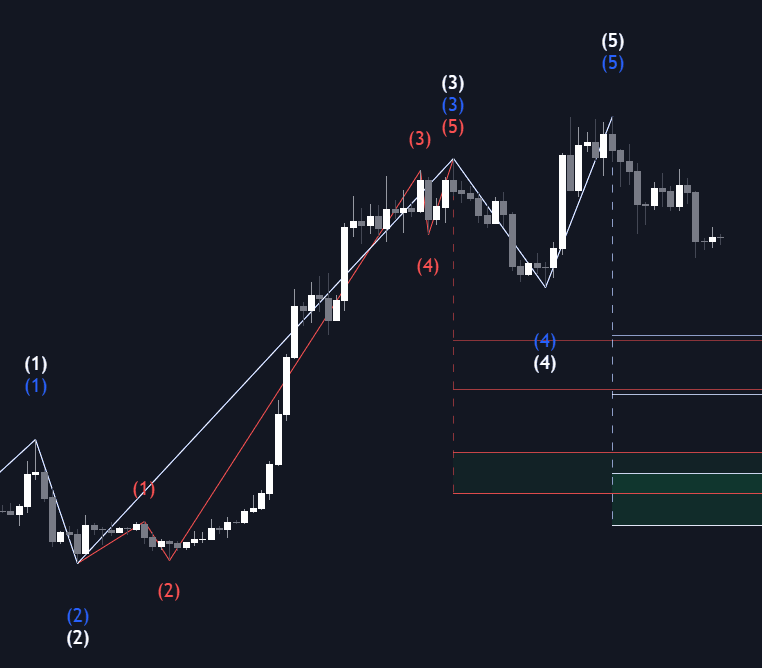
What is an Impulse?
An impulse is the five-wave engine of Elliott wave theory: a move in the direction of the next larger trend that subdivides 1-2-3-4-5, with waves 1, 3, and 5 advancing and waves 2 and 4 retracing. Ralph Nelson Elliott bound the form with three hard rules: wave 2 never retraces all of wave 1, wave 3 is never the shortest advancing wave, and wave 4 does not overlap wave 1's price territory. Waves 1, 3, and 5 are themselves motive waves that subdivide into smaller fives, the fractal nesting that lets one count run across degrees.
The impulse is the theory's trend statement, which is why it matters beyond labeling. A completed five-wave advance implies the larger degree points up and that the following corrective wave is countertrend, something to position into rather than flee. Just as important, the hard rules make every impulse label falsifiable: each count carries exact prices where it dies, which separates wave work from free-form pattern reading. In practice, one of the three advancing waves typically extends, running far beyond the other two.
How to identify an impulse
An impulse is verified by counting five swings and then trying to break the count against the rules.
- 1Find five swings in the trend direction: three advances (1, 3, 5) separated by two retracements (2 and 4), each advance making clear directional progress.
- 2Test the rules: wave 2 must hold above the start of wave 1, wave 3 must not be the shortest advance, and wave 4 must stay out of wave 1's price range.
- 3Check subdivision: waves 1, 3, and 5 should themselves resemble smaller five-wave moves, while waves 2 and 4 subdivide in threes.
- 4Cross-check proportions: typical impulses show one extended advancing wave and retracements near common fib ratios; if every wave needs an unusual proportion, suspect the label.
How traders use it
- As directional bias: a clean five-wave advance off a low is read as evidence the larger trend has turned up, so subsequent three-wave pullbacks are treated as entry opportunities rather than reversals.
- As a falsifiable count: each rule doubles as an invalidation level. A presumed wave 2 that trades below the start of wave 1, or a wave 4 that trades into wave 1's range, kills the label and often anchors the stop.
- For targets: fib wave relationships project wave 3 and wave 5 objectives from the earlier waves, most commonly 1.618 times wave 1 for wave 3.
- For exhaustion: a wave 5 that makes a new price extreme on weaker momentum than wave 3 is the classic divergence context used to anticipate the coming correction.
Impulse vs related concepts
Motive Wave: Motive is the umbrella term for waves that travel with the larger trend. Every impulse is motive, but so are diagonals, wedge-shaped forms that permit the wave overlap an impulse forbids. A wave is an impulse only when it obeys all the impulse rules.
Impulse Leg: An impulse leg is the generic market-structure term for any fast directional swing, with no wave count implied. Elliott's impulse is a strict five-wave grammar with rules; an impulse leg only needs speed and direction.
Corrective Wave: The counterpart: corrective waves move against the one-larger trend and subdivide in threes. If a countertrend move develops five clean waves, Elliott practice re-labels it as wave A of a larger correction or the first wave of a new trend, because an impulse-shaped five is never a whole correction by itself.
Concept family
Elliott & Harmonics
33 concepts mapped · 33 in the Library
Impulse FAQ
Turn Impulse into a trading strategy.
Take the implementation from this page into Quant, then build on it, backtest it on real data, and keep refining it in conversation.