Concept
RSI BAMM
RSI BAMM is a Elliott & Harmonics concept. The Library holds 1 implementation, a working definition you can pull into Quant.
Carney
Top RSI BAMM indicator
The top custom implementation, built on the original standard RSI BAMM formula.
1 total
The RSI BAMM implementation below can become a backtested trading strategy — describe your rules and Quant writes the code.
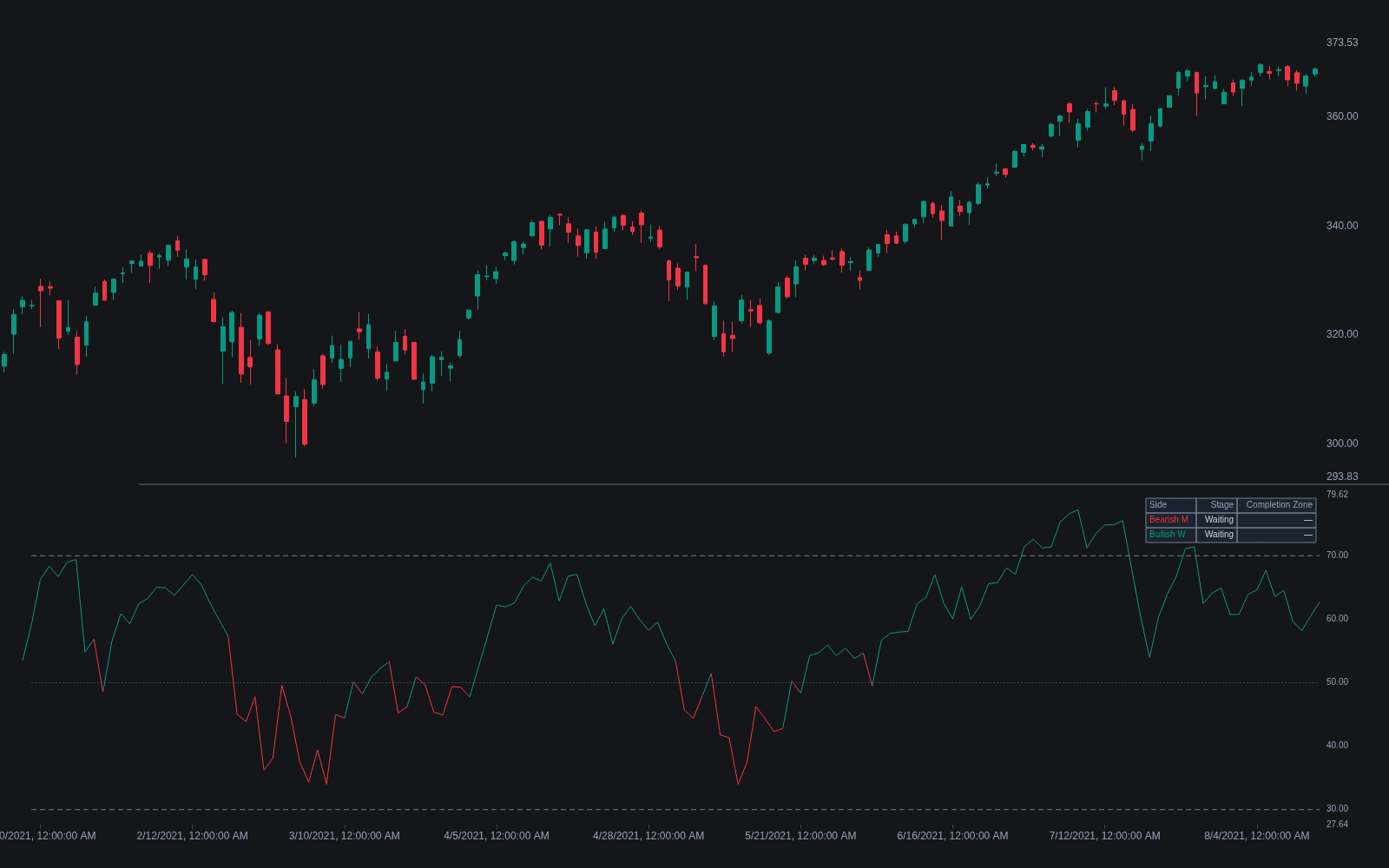
What is RSI BAMM?
RSI BAMM is Scott Carney's methodology for pairing a structural reading of the RSI with a harmonic price completion, extending his earlier BAMM concept from pure price geometry into momentum. The core idea: when RSI reaches an extreme and then builds a specific two-test structure, an M shape at highs or a W shape at lows, the second, weaker test of the extreme implies that price is making its final push. That implied final leg becomes the magnet move, and Carney projects its terminus with a harmonic measurement, typically a 0.886 retracement or 1.13 extension in the spirit of the Bat family.
The sequence runs in stages. First, RSI registers an initial extreme, commonly beyond 70 or under 30, establishing that momentum is stretched. Price and RSI then pull back without resolving the trend. The market makes a second push to new price extremes while RSI fails to exceed its first reading, printing the divergent second shoulder of the M or W. In Carney's framing, that RSI failure is the trigger: it marks the start of the final price leg, and the harmonic completion projected from the price structure tells you where that leg is likely to end.
The appeal is that the two inputs answer different questions. Momentum divergence alone says a move is tiring but not where it stops; a harmonic zone alone says where to look but not whether the arrival is exhausted. RSI BAMM requires both to line up, which reduces signal frequency in exchange for a more complete picture. It remains a discretionary framework: the RSI structure takes judgment to grade, and no alignment of the two removes the need for stops.
How traders use it
- As a confluence requirement: practitioners take completion-zone trades only when the RSI structure has printed its divergent second test, passing on zones that price reaches while momentum is still confirming new extremes.
- As an early-warning sequence: the first RSI extreme starts the clock, letting the trader project the likely completion area well before price arrives and prepare orders, stops, and size in advance.
- For entry timing at the zone: the trigger most users wait for is the combination of price in the harmonic area and RSI rolling over from its failed second test, rather than either condition alone.
- For exit management: Carney ties trade progress to RSI recrossing intermediate thresholds after entry, giving a momentum-based reason to tighten or exit that is independent of price targets.
- With honest limits: RSI can stay pinned at extremes in strong trends, printing multiple failed second tests before any reversal; the method identifies candidates for exhaustion, and position sizing has to assume some candidates fail.
RSI BAMM vs related tools
BAMM: Plain BAMM is defined on price alone: the break of a Bat's B point implies travel to the 0.886 completion. RSI BAMM substitutes an RSI structure for part of the price evidence, using the indicator's failed second test as the trigger for the final leg.
Regular divergence: Ordinary divergence compares price and indicator extremes and stops there. RSI BAMM demands a particular staged RSI shape and then adds a measured price completion, so it is a full setup sequence rather than a single observation.
RSI failure swing: Wilder's failure swing is defined entirely on the RSI line, with no reference to price levels. RSI BAMM's whole point is the marriage of the RSI structure to a harmonic price zone that locates the expected terminus.
Concept family
Elliott & Harmonics
33 concepts mapped · 33 in the Library
RSI BAMM FAQ
Turn RSI BAMM into a trading strategy.
Take the implementation from this page into Quant, then build on it, backtest it on real data, and keep refining it in conversation.