Concept
Triangle
Triangle is a Elliott & Harmonics concept. The Library holds 1 implementation, a working definition you can pull into Quant.
contracting/expanding/barrier/running
Top Triangle indicator
The top custom implementation, built on the original standard Triangle formula.
1 total
The Triangle implementation below can become a backtested trading strategy — describe your rules and Quant writes the code.
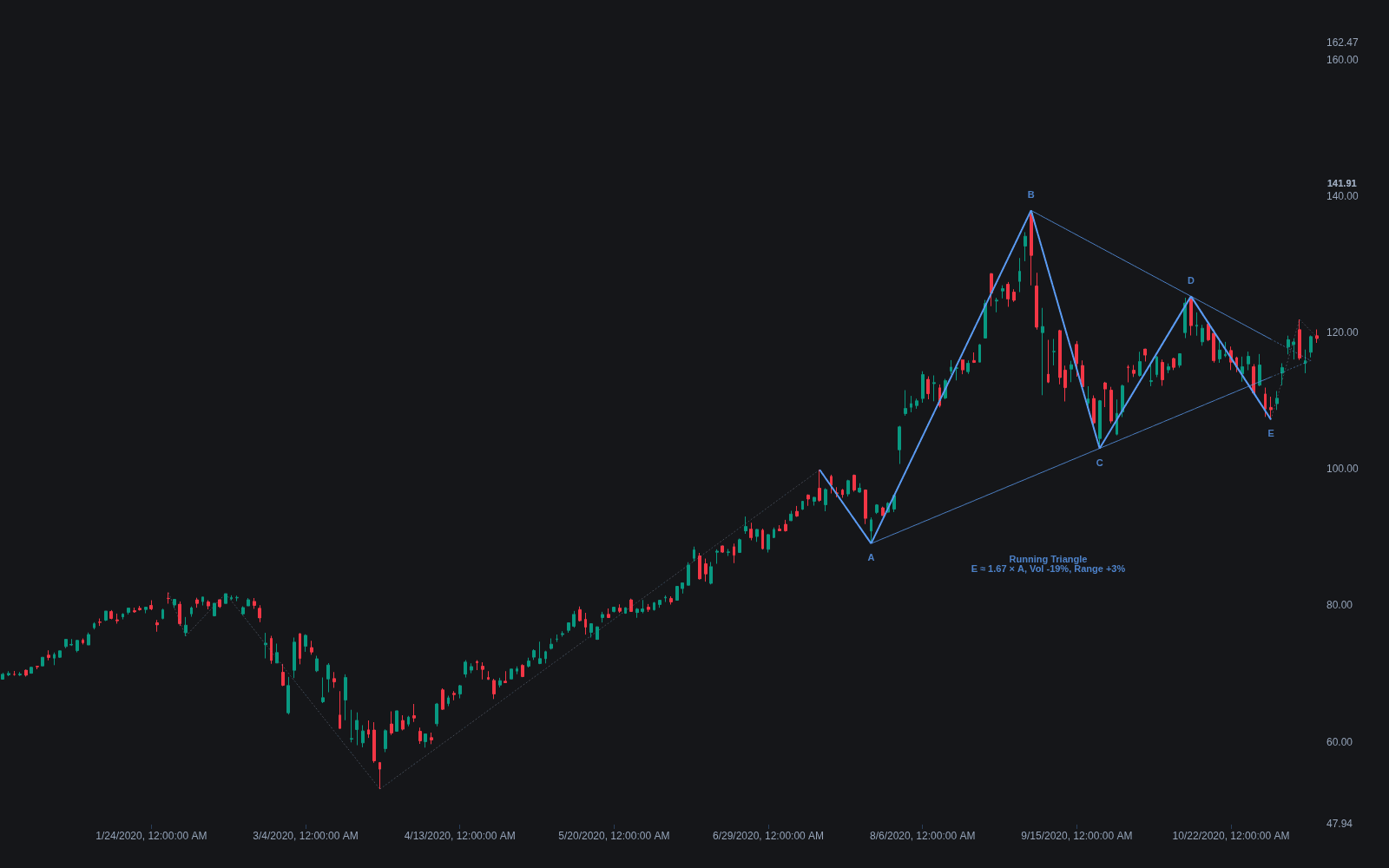
What is a triangle in Elliott wave analysis?
In Elliott wave analysis, a triangle is a five-legged sideways corrective structure, labeled A-B-C-D-E, in which every leg subdivides into three waves. It is a precise grammatical object, distinct from the classical chart-pattern triangle drawn from any converging trendlines: the Elliott triangle demands exactly five contacts, three-wave internals, and a specific set of allowed positions within the larger count, appearing in the wave 4, wave B, or final position of a combination, but never as wave 2 on its own.
The recognized variants describe how the boundary lines behave. In a contracting triangle, the most common form, each leg is shorter than the last and the boundaries converge. In a barrier triangle, one boundary is roughly horizontal while the other slopes toward it. In an expanding triangle, rare and difficult to trade, each leg exceeds the previous one and the boundaries diverge. A running triangle has its B wave exceeding the start of wave A, tilting the structure in the direction of the larger trend, which many analysts read as a sign of trend strength.
Traders care because triangles carry a strong positional message: they appear in the position immediately before the final actionable wave of the larger sequence. A triangle in wave 4 precedes the fifth wave; a triangle in wave B precedes the C wave. The energy compressed during the five overlapping legs tends to be released in a thrust out of the pattern, and the fact that the move after the triangle is typically the last leg of its sequence makes the structure as useful for exits as for entries.
How to identify an Elliott triangle
The count of legs and their internal structure separate a genuine triangle from ordinary converging congestion.
- 1Count exactly five legs, A through E, each subdividing into three waves; a leg that subdivides into five breaks the pattern.
- 2Draw the A-C and B-D boundary lines and classify the variant: contracting, barrier, expanding, or running by the depth of wave B.
- 3Check position in the larger count: wave 4, wave B, or the final position of a combination. A standalone wave 2 triangle violates convention.
- 4Expect volume and volatility to shrink as a contracting triangle matures, and note that wave E frequently undershoots or briefly overshoots the boundary line before the thrust.
- 5Treat a decisive five-wave move out of the pattern as the thrust, and a return deep into the triangle's body as evidence the count was wrong.
How traders use it
- For thrust trades: a completed E wave sets up entry in the direction of the larger trend, with a common measuring convention projecting the triangle's widest part from the breakout area.
- As a sequence warning: because the post-triangle move is usually the final wave of its degree, traders treat the thrust as a move to take profits into rather than the start of a fresh campaign.
- For patience during wave 4: recognizing a developing triangle explains weeks of overlapping chop and discourages both premature breakout entries and abandoning the trend position.
- In alternation logic: a sharp wave 2 raises the odds that wave 4 forms a triangle or other sideways structure, per the Elliott guidelines.
- With honest limits: real-time E-wave identification is notoriously hard, since every leg looks like a breakout attempt, and expanding triangles in particular resist practical trading.
Elliott triangle vs neighboring concepts
Ascending / Descending / Symmetrical Triangle: The classical patterns need only converging trendlines and can break either way. The Elliott triangle requires five three-wave legs, restricted positions, and implies the thrust direction from the larger count.
Flat: A flat has three legs ending in a five-wave C. A triangle has five legs, all threes, and typically compresses volatility far more before releasing it.
Broadening Formation: The classical broadening formation resembles the expanding triangle variant, but the Elliott version adds the five-legs-of-threes requirement and positional constraints the classical pattern lacks.
Concept family
Elliott & Harmonics
33 concepts mapped · 33 in the Library
Triangle FAQ
Turn Triangle into a trading strategy.
Take the implementation from this page into Quant, then build on it, backtest it on real data, and keep refining it in conversation.