Concept
BAMM
BAMM, also known as Bat Action Magnet Move, is a Elliott & Harmonics concept. The Library holds 1 implementation, a working definition you can pull into Quant.
Top BAMM indicator
The top custom implementation, built on the original standard BAMM formula.
1 total
From studying BAMM to trading it: take the implementation below into Quant and backtest it instantly.
What is BAMM?
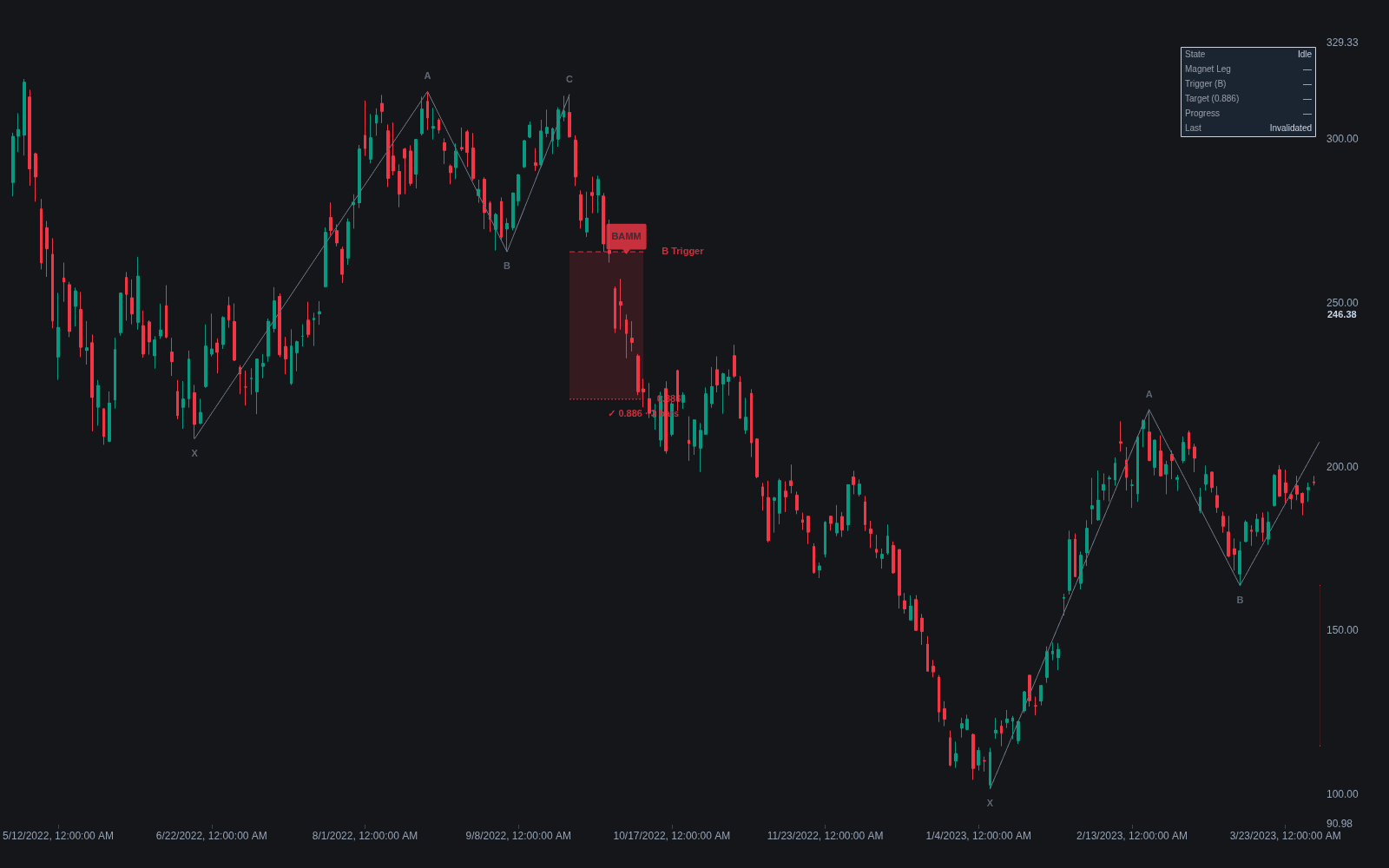
BAMM, the Bat Action Magnet Move, is Scott Carney's name for a specific price behavior inside a developing Bat pattern: once price breaks the B point of the structure, it tends to accelerate toward the 0.886 retracement completion as if drawn to it. The concept reframes the final CD leg of the Bat, instead of passively waiting at D, the harmonic trader treats the violation of B as an actionable event that projects where price is likely headed next.
The idea exists because harmonic patterns are usually traded only at completion, which leaves the often substantial CD leg unexploited. BAMM turns that leg into a trade of its own: the break of B becomes an entry in the direction of D, with the 0.886 level of the XA leg serving as the target rather than the reversal entry. It also sharpens the reversal trade at D, because a market that has just been magnetized through the CD leg arrives at the potential reversal zone with measurable momentum, and the quality of the reaction there says a great deal about whether the completion will hold.
Carney later extended the same logic to momentum readings in the RSI BAMM methodology, where an indicator structure substitutes for part of the price structure. The core insight is shared: certain incomplete structures imply a probable destination, and the trip to that destination is tradable information, not just waiting time. As always, magnet is a metaphor for tendency; nothing about the move is assured.
How to identify a BAMM setup on a chart
The setup is the front half of a Bat plus a trigger, so the measurements come first.
- 1Establish a candidate Bat: an XA leg, a B retracement at or under 0.50 of XA, and a C point holding within the AB range.
- 2Mark the B level as the trigger line and project the 0.886 retracement of XA as the destination.
- 3Watch for price to break decisively through B in the direction of D; that violation is the BAMM event.
- 4Treat the move from the break to the 0.886 level as the tradable leg, with the completion zone as the target rather than the entry.
- 5At the 0.886 arrival, switch frameworks: the magnet trade is over, and the standard completion-zone reaction assessment begins.
How traders use it
- As a CD-leg trade: traders short (or buy) the break of B and target the 0.886 completion, capturing the leg that pattern traders normally sit out.
- As advance warning for the reversal trade: a BAMM in progress tells the trader where the reversal zone will be well before price arrives, leaving time to plan entries, stops, and position size.
- As a filter on completion quality: when the CD leg arrives at 0.886 in a fast, extended state, many practitioners demand stronger reaction evidence before taking the reversal, since momentum arrivals overrun zones more often.
- With honest limits: not every B-point break resolves at 0.886; some keep going, which is why the companion Alt Bat completing at a 1.13 extension exists in Carney's framework, and why the magnet target is traded with stops rather than certainty.
BAMM vs related concepts
Bat: The Bat is the completed five-point pattern traded at its D point. BAMM is the behavior of the unfinished pattern: the break of B implying travel toward that same D.
RSI BAMM: RSI BAMM applies the magnet logic to a momentum indicator, pairing an RSI structure with a price completion. Plain BAMM is defined entirely on price geometry.
PRZ execution: PRZ execution governs what to do once price reaches the completion zone. BAMM covers the leg before arrival; the two hand off to each other at the 0.886 level.
Concept family
Elliott & Harmonics
33 concepts mapped · 33 in the Library
BAMM FAQ
Turn BAMM into a trading strategy.
Take the implementation from this page into Quant, then build on it, backtest it on real data, and keep refining it in conversation.