Concept
Truncation
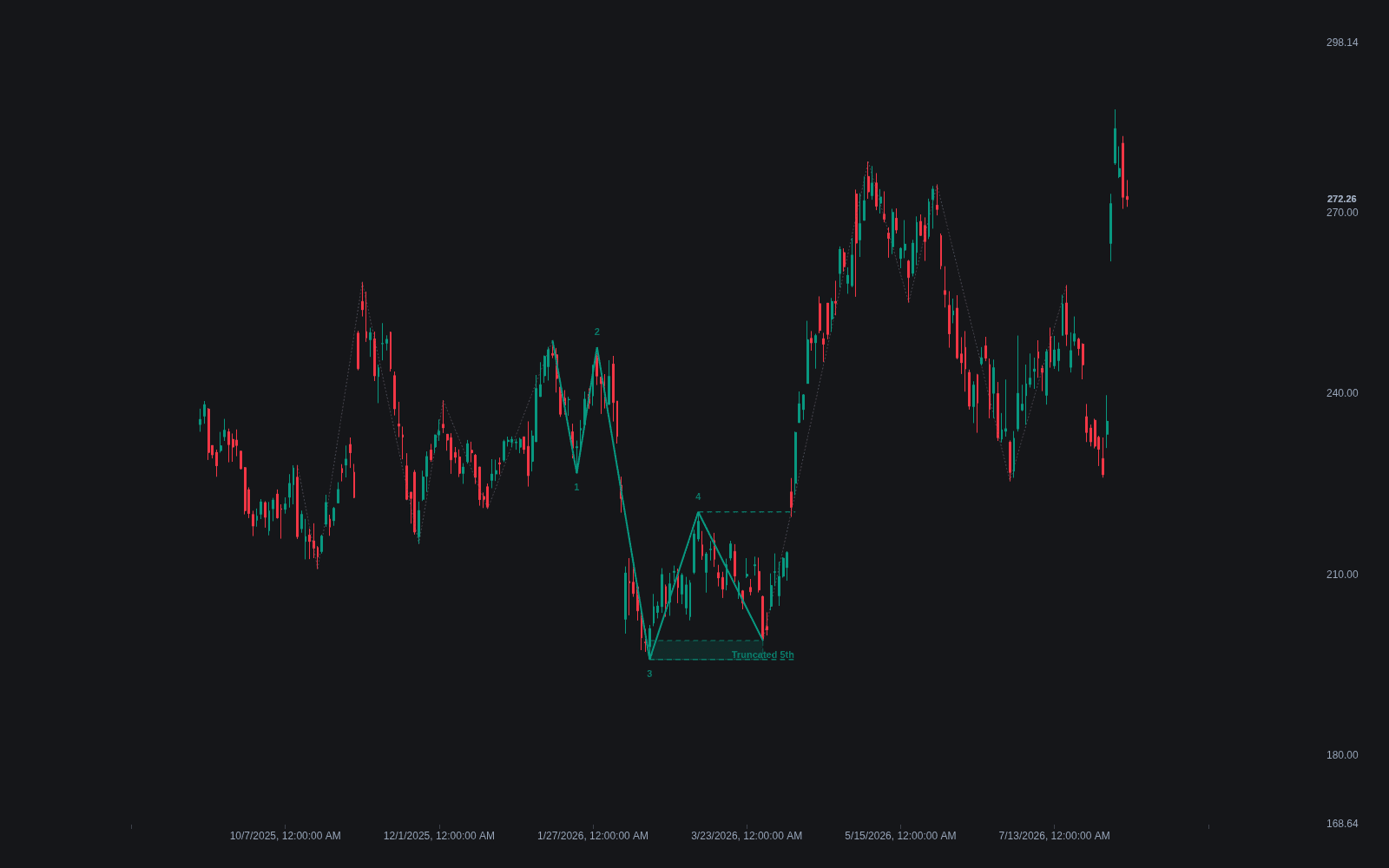
Truncation, also known as failed 5th, is a Elliott & Harmonics concept. The Library holds 1 implementation, a working definition you can pull into Quant.
Top Truncation indicator
The top custom implementation, built on the original standard Truncation formula.
1 total
This Truncation implementation is strategy-ready: open it in Quant, set your rules, and it backtests automatically.
What is truncation?
Truncation, often called a failed fifth, occurs when the fifth wave of an impulse fails to exceed the extreme of the third wave. The market completes a recognizable five-wave subdivision, but the final wave falls short: in an uptrend, wave 5 tops below the wave 3 high; in a downtrend, it bottoms above the wave 3 low. The structure is complete in form yet fails in extent, which is what makes it both meaningful and easy to miss.
The accepted interpretation is exhaustion. Truncation tends to follow an exceptionally strong or extended third wave, the reasoning being that the third wave consumed so much of the available directional pressure that the fifth could not carry price to a new extreme. Elliott literature treats truncation as an ordinary, if uncommon, feature of impulse structure rather than a rule violation, but it demands that wave 5 still contain a complete five-wave subdivision of its own; without that internal count, the better label is usually that the correction has already begun.
Traders care because a truncated fifth changes the shape of the top or bottom. Instead of a momentum-divergent new extreme, the reversal begins from a lower high or higher low, which on a bare price chart looks like a double top or bottom. Counts that insist on a new extreme before turning bearish or bullish will miss the reversal entirely, and truncation is the standard Elliott explanation for markets that roll over without the expected final push.
How to identify truncation
The burden of proof is high, because a shortfall alone is not evidence of a completed impulse.
- 1Confirm a clear, countable impulse through wave 4, preferably one with an extended or unusually powerful third wave.
- 2Verify that the move after wave 4 subdivides into a complete five-wave structure of its own; this internal count is what separates truncation from a correction already underway.
- 3Check that this fifth wave stops short of the wave 3 extreme, in an uptrend a lower high, in a downtrend a higher low.
- 4Look for corroborating exhaustion: momentum divergence versus wave 3, fading volume, or a completed ending diagonal form within the fifth.
- 5Demand confirmation from the reversal itself: an impulsive move back through the wave 4 territory supports the truncation count, while a push to new extremes refutes it.
How traders use it
- As a reversal alert without new extremes: analysts who accept a truncation count can position for the new trend earlier than those waiting for a final high or low that never comes.
- To read underlying strength or weakness: a truncated fifth at a top implies sellers overwhelmed the market before buyers could finish, often preceding forceful declines; the mirror applies at bottoms.
- For count repair: when a market reverses hard from a lower high, truncation lets an analyst preserve a coherent impulse count rather than forcing an awkward corrective relabeling.
- As a caution flag on itself: because truncation legitimizes counts without new extremes, it is easy to abuse. Many practitioners accept it only after an extended third wave and with a full internal five in wave 5.
- With honest limits: truncation is confirmed only in hindsight, once the reversal is underway, so it serves better as an explanation and risk framework than as a standalone entry signal.
Truncation vs similar-looking events
Double Top / Bottom: On price alone the two can look identical. The double top is defined by two comparable highs and a neckline break; truncation is defined by a complete five-wave subdivision that stops short of the third wave's extreme.
Diagonals: An ending diagonal is a terminal fifth wave that usually does reach new extremes before reversing. Truncation is a fifth that fails to reach them. Both signal exhaustion, through opposite behavior at the extreme.
Elliott Hard Rules: Truncation breaks no hard rule; the rules constrain wave 2, wave 3, and wave 4 overlap, not the fifth wave's extent. It is an allowed structural variation, not a violation.
Concept family
Elliott & Harmonics
33 concepts mapped · 33 in the Library
Truncation FAQ
Turn Truncation into a trading strategy.
Take the implementation from this page into Quant, then build on it, backtest it on real data, and keep refining it in conversation.