Concept
Wave Extension
Wave Extension is a Elliott & Harmonics concept. The Library holds 1 implementation, a working definition you can pull into Quant.
Top Wave Extension indicator
The top custom implementation, built on the original standard Wave Extension formula.
1 total
From studying Wave Extension to trading it: take the implementation below into Quant and backtest it instantly.
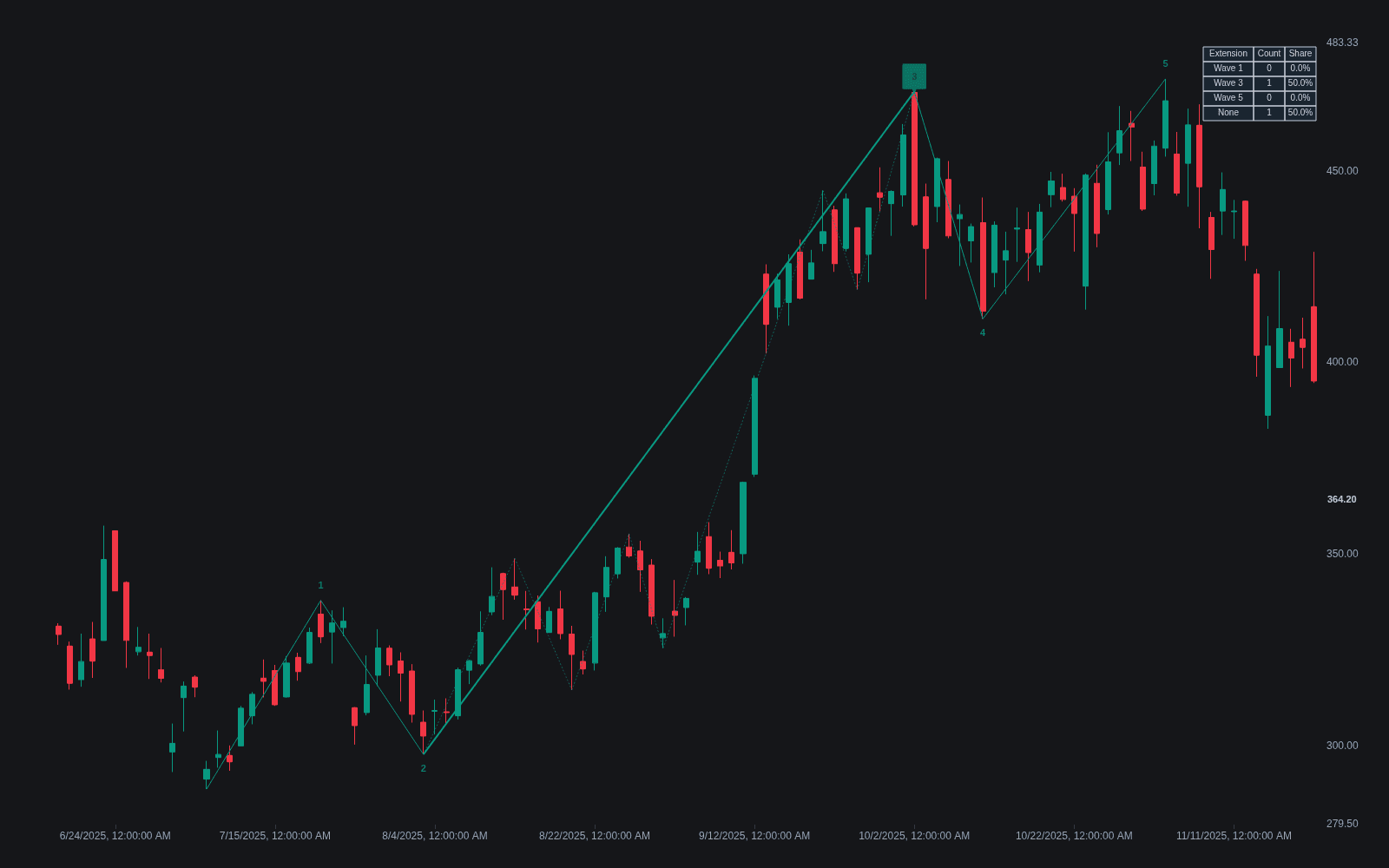
What is a wave extension?
A wave extension is an elongated impulse inside a five-wave advance: one of the three motive waves (1, 3, or 5) travels much farther than the other two and shows an exaggerated internal subdivision, so its own five sub-waves are nearly as large as the waves of the next higher degree. In Elliott Wave Theory, extensions matter because most impulses contain exactly one, and knowing which wave extended tells you where you are in the count and roughly how much of the move remains.
The classic observation, going back to R.N. Elliott's original work and formalized in Frost and Prechter's Elliott Wave Principle, is that third-wave extensions dominate in stock indices, while fifth-wave extensions appear more often in commodities. Extensions interact with the hard rules: wave 3 can never be the shortest motive wave, so if waves 1 and 3 are about equal in length, the odds favor an extended fifth. A useful companion guideline states that the two non-extended waves tend toward equality in price and time, one of the standard Fib wave relationships used to project targets.
Extensions are also where miscounting happens most. Because an extended wave subdivides visibly, its sub-waves are easily mistaken for waves of the higher degree, inflating the count. The wave degree hierarchy exists partly to manage this: an extension is normal behavior at one degree that merely looks like an extra pair of waves at the degree above. Practitioners care because an extension changes expectations, a market in an extended third tends to run through Fibonacci targets that would cap an ordinary wave.
How to identify a wave extension on a chart
An extension is a relative judgment inside a count, so identification starts from a plausible five-wave structure.
- 1Label a candidate impulse and compare the lengths of waves 1, 3, and 5; an extension often reaches 1.618 times the length of the next largest motive wave or more, though the label is ultimately about disproportion, not a fixed cutoff.
- 2Check the internal structure: the extended wave should subdivide into a clear five of its own, with sub-waves large enough to be counted at the same visual scale as the parent waves.
- 3Apply the rule filter: if your labeling makes wave 3 the shortest of the three motive waves, the count is invalid regardless of how the extension looks.
- 4If waves 1 and 3 are near equal in length, treat an extended fifth as the live scenario and be slow to call a top on the first sign of hesitation.
- 5After a fifth-wave extension, expect the subsequent correction to be sharp and to return roughly to the price territory of the extension's second sub-wave, a common Frost and Prechter guideline.
How traders use it
- To set projections: once a third wave is identified as extending, traders often project wave 5 at equality with wave 1 or at 0.618 of the distance from the start of wave 1 to the end of wave 3, rather than expecting another oversized leg.
- As a patience filter: recognizing an extension in progress argues against fading strength, because extended waves habitually blow through single-level Fibonacci targets.
- For risk placement after the move: fifth-wave extensions are often followed by fast retracements, so profit-taking and stop tightening are commonly accelerated once an extended fifth shows signs of completion.
- As a count validator: if no wave in a supposed impulse extended, many analysts re-examine whether the structure is really an impulse at all, since most textbook impulses contain one extension. This remains a guideline, not a rule.
Wave extension vs neighboring ideas
Truncation: A truncation is the opposite failure mode: wave 5 fails to exceed the end of wave 3. An extension is a wave that travels much farther than normal; both alter expectations for the move that follows.
Fib extension: A Fib extension is a measuring tool that projects levels beyond a prior swing. A wave extension is a structural label for an elongated wave; the tool is often used to set targets for it, but the two terms are unrelated in meaning.
Diagonals: Diagonals are wedge-shaped motive structures with overlapping waves that appear in the first or last position. Extensions keep normal impulse form; they are longer, not differently shaped.
Concept family
Elliott & Harmonics
33 concepts mapped · 33 in the Library
Wave Extension FAQ
Turn Wave Extension into a trading strategy.
Take the implementation from this page into Quant, then build on it, backtest it on real data, and keep refining it in conversation.