Concept
Exotic Harmonics
Exotic Harmonics, also known as White Swan, Black Swan, Nen Star, are Elliott & Harmonics concepts. The Library holds 1 implementation, a working definition you can pull into Quant.
Top Exotic Harmonics indicator
The top custom implementation, built on the original standard Exotic Harmonics formula.
1 total
From studying Exotic Harmonics to trading it: take the implementation below into Quant and backtest it instantly.
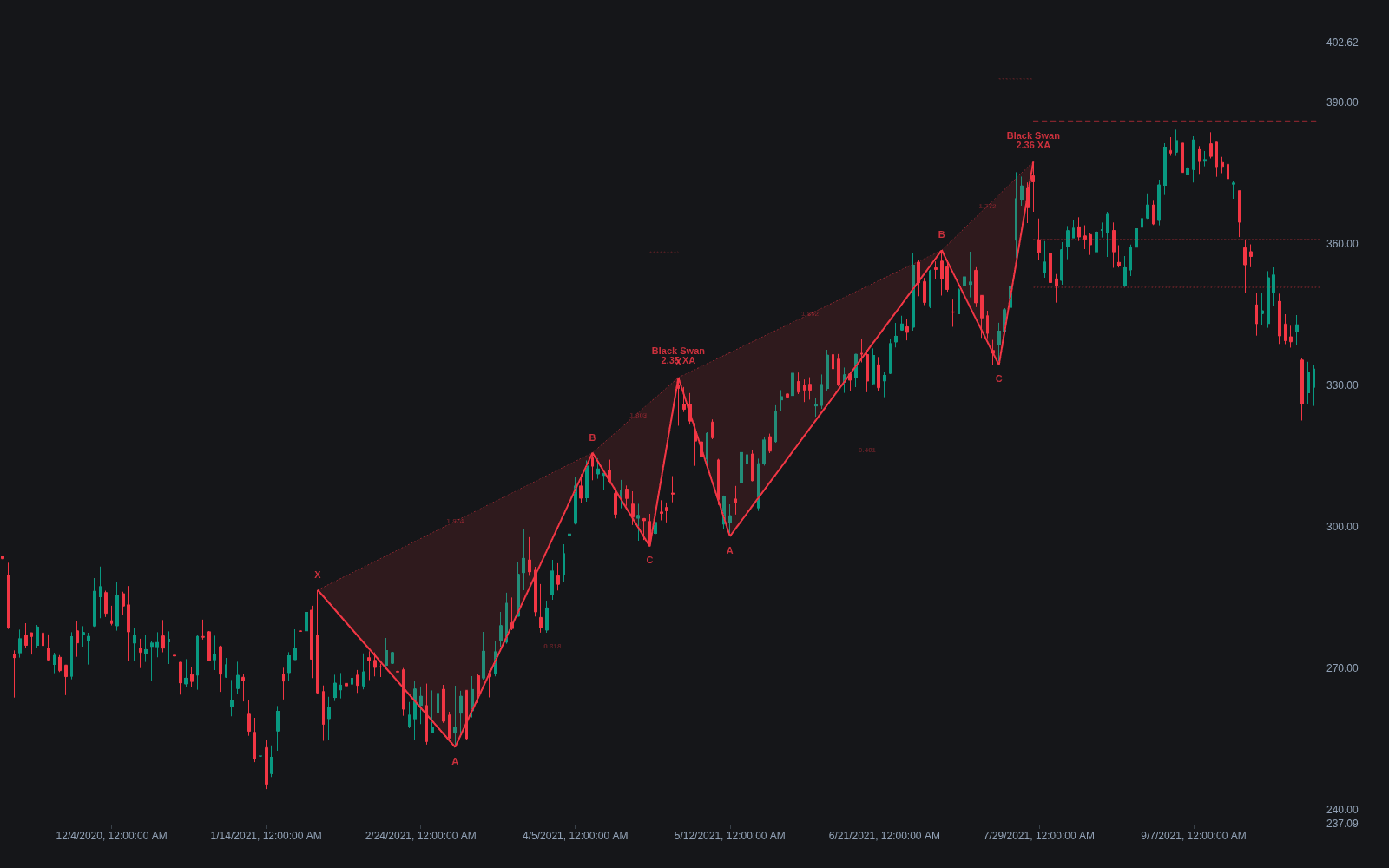
What are Exotic Harmonics?
Exotic harmonics is the catch-all label for harmonic patterns outside the classic catalog: five-point XABCD structures such as the Nen Star, White Swan, and Black Swan (the last two commonly described as inverses of each other). Like the Gartley and its better-known relatives, each is defined by its own set of Fibonacci ratios linking the XA, AB, BC, and CD legs, and each completes in a potential reversal zone where those projections converge.
What separates them from the classics is provenance and standardization. The classic set traces to H.M. Gartley's 1935 work and the later ratio formalizations of Scott Carney and others; the exotics grew out of online harmonic-trading communities and the pattern-recognition tools built there, and no canonical specification exists. Ratio windows for the same named pattern vary by source, examples are rarer, and published study of their behavior is thin, so the burden shifts to the trader to fix one definition and demand confirmation at completion.
Structurally the exotics follow the same grammar as the rest of the harmonic patterns family. Five pivots define four legs; B's retracement of XA does most of the work of telling patterns apart; and D either completes inside the XA leg, as in the Gartley and Bat, or beyond X, as in the Butterfly and Crab. Most exotics embed an ABCD in their final three legs, and a completion is taken more seriously when that internal projection lands where the XA-derived ratios do.
The tradition sits adjacent to, but apart from, Elliott wave theory: both lean on Fibonacci relationships between swings, and a harmonic completion often coincides with the end of a corrective wave in someone's count, but harmonics impose no rules of sequence or degree. The multiplication of named exotics carries an honest cost: the more shapes a catalog admits, the more likely some pattern fits any chart, so selectivity and out-of-sample skepticism matter more here than anywhere in harmonic work.
How to Identify an Exotic Harmonic on a Chart
The workflow mirrors classic harmonic identification, with extra care about whose definition you are using.
- 1Anchor five pivots: label meaningful swing points X, A, B, C, and D, using the same swing criteria you would apply to a Gartley.
- 2Measure the legs: check B's retracement of XA and C's retracement of AB with a Fibonacci tool, then project D from both the BC extension and the XA relationship.
- 3Match one fixed specification: adopt a single source's ratio windows for the pattern and apply them consistently; authors and scanners disagree at the margins.
- 4Look for confluence at D: the case strengthens when the embedded ABCD projection, the XA-derived level, and prior structure land in the same zone.
- 5Demand a reaction and predefine invalidation: treat the completion as a watch zone, wait for rejection candles, divergence, or a structural shift, and decide in advance how far beyond D price may trade before the idea is dead.
How traders use it
- As completion setups: when the final leg reaches the projected ratio confluence, the overlap marks a zone to watch for reversal evidence such as rejection candles or divergence, not an automatic entry.
- As extended scanner coverage: exotic definitions classify XABCD geometry whose ratios fall outside the Gartley, Bat, Butterfly, and Crab windows, which is why recognition tools often include them alongside the classics.
- With defined invalidation: completion zones fail regularly, so exotics are typically traded with a stop beyond the completion extreme and initial targets at retracements of the final leg, the same risk template used for classic harmonics.
- As confluence filters: many traders act only on completions that coincide with independent evidence, such as a higher-timeframe level, a Three Drives sequence resolving nearby, or Fibonacci wave relationships from a separate swing analysis.
- As a research discipline: with published statistics scarce, users log their own completions and outcomes per definition, building the evidence base the literature does not provide.
Exotic Harmonics vs the Classic Catalog
Gartley: The 1935 archetype, with decades of documentation and broadly agreed ratios. Exotics follow its five-point grammar with community-sourced specifications that vary by author.
Butterfly: A classic extension pattern completing beyond X, the territory several exotics such as the swans also occupy. The difference is standardization and track record, not geometry.
Three Drives: Drops the XABCD frame for three successive, ratio-related pushes to an extreme. Despite the unusual geometry it belongs to the established canon, with a longer published history than the exotics; it is a distinct structure, not a variant.
Concept family
Elliott & Harmonics
33 concepts mapped · 33 in the Library
Exotic Harmonics FAQ
Turn Exotic Harmonics into a trading strategy.
Take the implementation from this page into Quant, then build on it, backtest it on real data, and keep refining it in conversation.