Concept
Flat
Flat is a Elliott & Harmonics concept. The Library holds 1 implementation, a working definition you can pull into Quant.
regular/expanded/running
Top Flat indicator
The top custom implementation, built on the original standard Flat formula.
1 total
This Flat implementation is strategy-ready: open it in Quant, set your rules, and it backtests automatically.
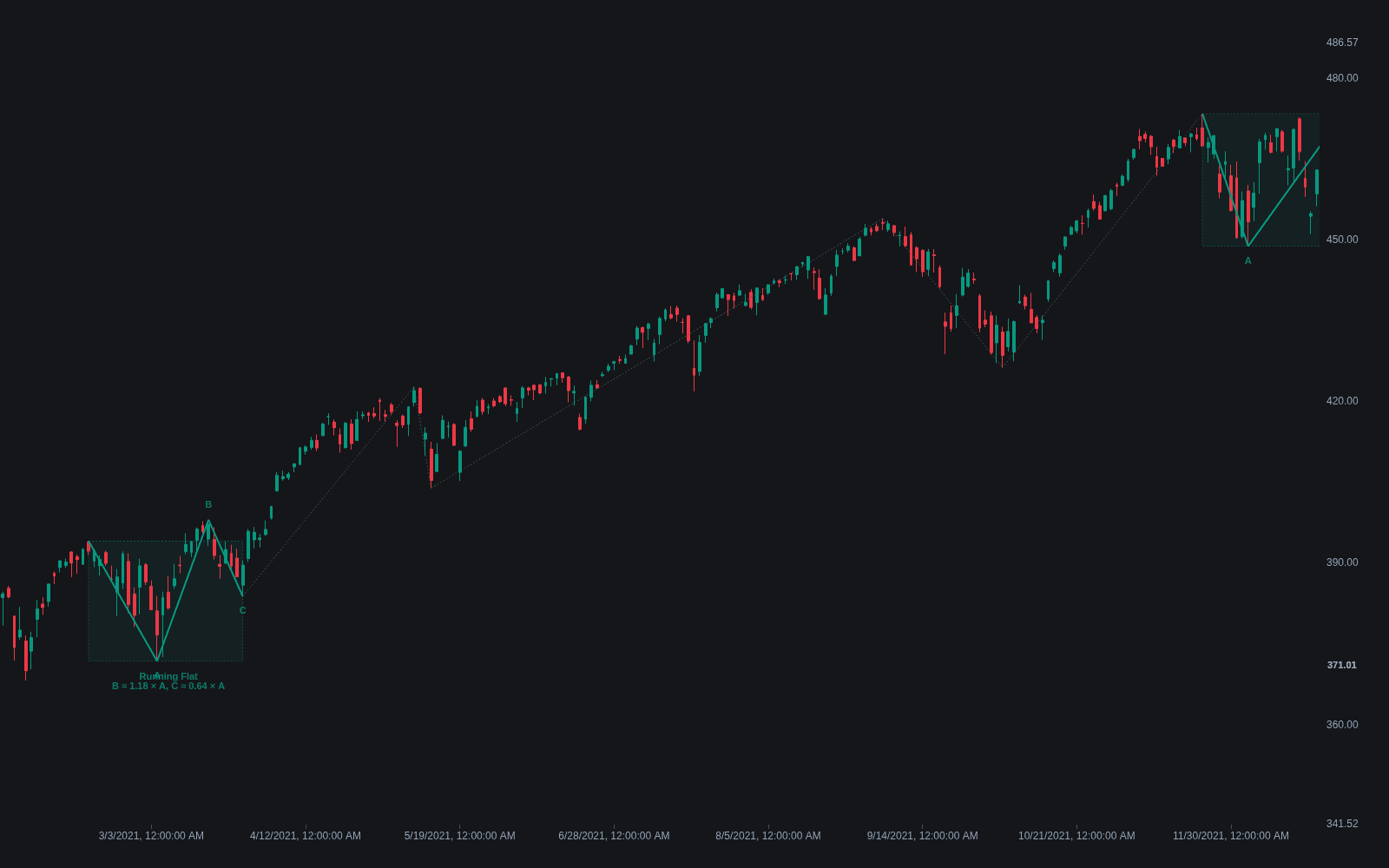
What is a flat?
A flat is a sideways corrective structure in Elliott wave analysis, subdividing 3-3-5: wave A is a three, wave B is a three that retraces most or all of A, and wave C is a five. The name reflects the shape, since the structure tends to travel sideways rather than sharply against the trend. Flats typically appear where the larger trend is strong, most often in the wave 4 or wave B position, where the market pauses without giving up much ground.
Three variants are distinguished by how far wave B carries. In a regular flat, B retraces roughly to the start of A and C ends slightly beyond A's extreme. In an expanded flat, the most common variant in many markets, B exceeds the start of A and C then travels beyond A's extreme, producing a structure whose edges widen and famously trap traders on both sides. In a running flat, B exceeds the start of A but C fails to reach A's extreme, leaving the whole correction tilted in the direction of the larger trend; it is rare and usually signals unusual trend strength.
Traders care because the flat's B wave is a machine for generating false signals. An expanded flat's B wave makes a new price extreme against the recent swing, looking like trend resumption, right before the five-wave C leg goes the other way. Knowing the 3-3-5 blueprint helps a practitioner treat a three-wave push to marginal new extremes with suspicion rather than chase it, and to expect the C wave that a corrective wave of this type implies.
How to identify a flat
The diagnostic sequence is three up (or down), three back, five to finish, with the B-wave depth determining the variant.
- 1Locate a correction that begins with a clearly three-wave A leg; a five-wave A argues for a zigzag instead.
- 2Measure wave B: retracement of at least the large majority of A is required under common conventions, and beyond 100 percent indicates the expanded or running variants.
- 3Expect wave C to subdivide into five waves and to show more impulsive character than A and B.
- 4Classify the variant: regular (B near A's start, C slightly beyond A), expanded (B beyond A's start, C beyond A's extreme), or running (B beyond A's start, C short of A's extreme).
- 5Check context: flats favor wave 4 and wave B positions, and via the guideline of alternation often follow a sharp wave 2 elsewhere in the same impulse.
How traders use it
- To avoid B-wave traps: a three-wave push to a marginal new high or low, especially on weak internals, is treated as a possible expanded-flat B rather than confirmed continuation.
- For C-wave entries: once B completes, traders position for the five-wave C leg, often using Fibonacci extensions of A projected from B (commonly around 1.0 to 1.618) as targets.
- Through alternation: if wave 2 was a sharp zigzag, Elliott guidelines suggest wave 4 may be a flat or other sideways structure, shaping expectations before the correction unfolds.
- As a trend-strength read: running flats, where even the C wave cannot reach A's extreme, are taken as evidence of a market so strong the correction could not complete normally. They are rare, and counts relying on them deserve extra skepticism.
- With honest limits: in real time, a developing flat is hard to distinguish from the start of a reversal or a combination, so most practitioners wait for the C wave's five-wave character before committing.
Flats vs other corrections
Zigzag: A zigzag subdivides 5-3-5, moves sharply against the trend, and has a shallow B wave. A flat subdivides 3-3-5, moves sideways, and has a deep B wave.
Triangle: A triangle has five legs, each a three, inside converging or diverging boundaries. A flat has only three legs and its final leg is a five, giving it a more decisive ending.
Combination Corrections: A flat is a single corrective unit; combinations chain multiple units together with X waves. A flat that keeps extending sideways may be relabeled as one component of a combination.
Concept family
Elliott & Harmonics
33 concepts mapped · 33 in the Library
Flat FAQ
Turn Flat into a trading strategy.
Take the implementation from this page into Quant, then build on it, backtest it on real data, and keep refining it in conversation.