Concept
Three Drives
Three Drives, also known as three-push pattern, are Elliott & Harmonics concepts. The Library holds 1 implementation, a working definition you can pull into Quant.
Top Three Drives indicator
The top custom implementation, built on the original standard Three Drives formula.
1 total
The Three Drives implementation below can become a backtested trading strategy — describe your rules and Quant writes the code.
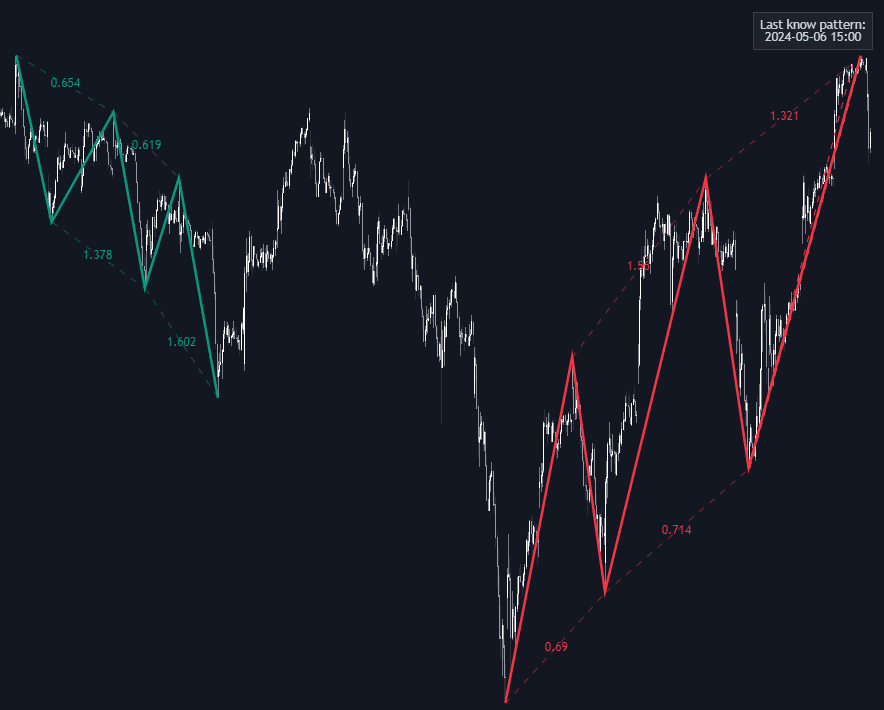
What is the Three Drives pattern?
The Three Drives is a harmonic exhaustion pattern: three successive, symmetrical pushes to new extremes, each separated by a corrective pullback of similar depth. In the common reading each pullback retraces about 0.618 of the prior drive, and each new drive completes at a 1.27 or 1.618 extension of that pullback, so the second and third drives finish at measurable projections. Symmetry is the defining requirement: the drives should be comparable in price length and, ideally, in the time each one takes.
The three-pushes idea predates its ratios: variants circulated in twentieth-century trading lore and 1990s systems literature under names like the three-pushes-to-a-high setup, before harmonic authors attached the measurement grid from the harmonic ratio set and fixed the modern definition. The formalization is the point: with ratios attached, the third drive's completion becomes a projectable zone rather than an after-the-fact observation.
Three-pushes structures appear in older technical literature, and harmonic-pattern authors later formalized the ratios. Completion of the third drive is treated as a candidate terminal point for the entire move: a location to watch for reversal, not a reversal in itself. A clear fourth push beyond the projection means the pattern failed, not that it is late.
The pattern sits at a junction of frameworks. Its completion zone is a potential reversal zone by construction, the overlap of extension projections; its shape rhymes with Elliott's terminal structures, three pushes with weakening internals reading like a fifth wave or an ending diagonal in motive-wave language; and its trade plan is standard harmonic practice, fade the completion with stops beyond it, sized for the reality that symmetric exhaustion setups fail into strong trends without apology.
How to identify a Three Drives pattern
The bearish case (three drives up into a top) is described; mirror it for three drives down.
- 1Establish the context: a directional move mature enough to have printed two prior pushes with corrections between them.
- 2Check the pullbacks: each correction retracing roughly 0.618 of the prior drive, comparable to one another in depth and duration.
- 3Project the completions: each new drive finishing near the 1.27 to 1.618 extension of the preceding pullback, with the third drive's projection defining the terminal zone.
- 4Demand symmetry: drives of similar price length and, ideally, similar duration; conspicuous asymmetry is the standard disqualifier.
- 5Watch the internals into drive three: slowing momentum or divergence at the projection strengthens the exhaustion case.
- 6Define failure in advance: a sustained fourth push beyond the completion zone voids the pattern rather than extending it.
How traders use it
- To fade the third push: traders project the 1.27 to 1.618 extension of the second pullback, wait for the third drive to tag it, ideally with slowing momentum or divergence, and position for reversal with stops beyond the projection.
- To time exits: a trader riding the trend can treat the completed third drive as a signal to take profit, on the logic that the move's symmetry is fully expressed.
- As context for other setups: a reversal candle or sweep carries more weight printed at a third-drive completion than in the middle of a leg.
- As a PRZ construction: the third drive's overlapping projections are traded with full harmonic discipline, entries on reaction evidence inside the zone, invalidation past its far edge, first targets back at the final pullback.
- In dialogue with wave counts: when a Three Drives completion coincides with a plausible fifth-wave termination under Elliott guidelines, the two frameworks' agreement about exhaustion is itself the signal many analysts wait for.
Three Drives vs related patterns
ABCD: An ABCD is a single two-leg symmetry; Three Drives chains three extensions with two corrections, and detectors sometimes resolve it as overlapping extended ABCDs.
Wolfe Waves: Wolfe Waves also count a swing sequence into a terminal fifth point, but completion is defined by trendline geometry and the pattern projects its own price objective; Three Drives is defined by Fibonacci symmetry.
Motive Wave: A motive wave is Elliott's five-wave engine, with rules about subdivision and overlap; Three Drives is a ratio-and-symmetry template with no wave grammar. The same terminal price action often satisfies both, read through different tests.
Concept family
Elliott & Harmonics
33 concepts mapped · 33 in the Library
Three Drives FAQ
Turn Three Drives into a trading strategy.
Take the implementation from this page into Quant, then build on it, backtest it on real data, and keep refining it in conversation.