Concept
Shark
Shark is a Elliott & Harmonics concept. The Library holds 1 implementation, a working definition you can pull into Quant.
Top Shark indicator
The top custom implementation, built on the original standard Shark formula.
1 total
This Shark implementation is strategy-ready: open it in Quant, set your rules, and it backtests automatically.
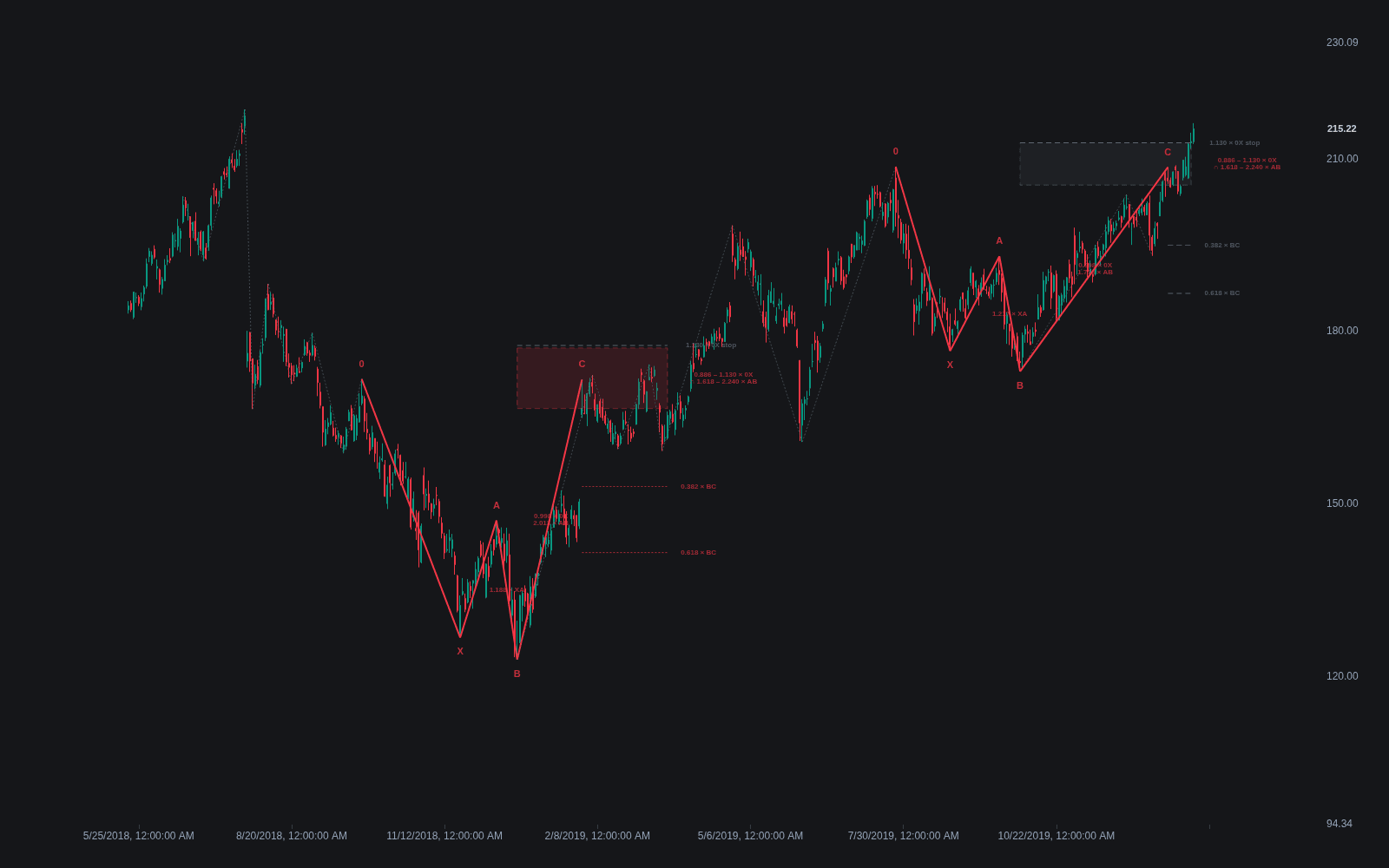
What is a Shark?
The Shark is a five-point harmonic pattern introduced by Scott Carney in 2011, and it breaks the naming convention of its siblings: its pivots are labeled 0, X, A, B, C rather than X, A, B, C, D, because the structure completes at C rather than at a D point. After an initial 0X leg and an XA reaction, the AB leg fails to hold the prior pivot and extends to between 1.13 and 1.618 of XA. The final BC leg then drives beyond the origin of the move, completing between the 0.886 retracement and the 1.13 extension of the 0X leg, commonly confluent with a 1.618 to 2.24 extension of the AB swing.
What makes the Shark distinct among harmonic patterns is that its middle section is a failed structure: the extension of AB beyond X looks like a breakout or a run of the prior extreme, and the pattern treats that overextension as the setup rather than the signal. The completion zone between 0.886 and 1.13 of 0X is wider than the single-ratio completions of the Gartley or Bat, so Carney's treatment leans on active management, taking profit quickly rather than holding for a full reversal.
The Shark also has a defined afterlife: in Carney's framework a completed Shark frequently becomes the first section of a 5-0 pattern, with the reaction off the Shark's completion forming the 50 percent retracement leg that defines the 5-0. Traders who track one therefore often keep the other on the chart.
How to identify a Shark pattern on a chart
Like every harmonic structure, the Shark is measured with a Fibonacci tool rather than recognized by shape alone.
- 1Anchor 0 and X at a clear swing and mark the XA reaction; these two legs are the baseline for every later ratio.
- 2Check the B point: the move from A must extend beyond X, landing between 1.13 and 1.618 of the XA leg. A B that holds inside X belongs to the retracement family instead.
- 3Project the completion at C two ways: the 0.886 retracement to 1.13 extension of the 0X leg, and the 1.618 to 2.24 extension of AB. Overlap between the two defines the potential reversal zone.
- 4Watch behavior in the zone rather than resting blind orders across it; the 0.886 to 1.13 band is wide, and Carney's own treatment emphasizes reaction, not location alone.
- 5Treat sustained trade beyond the 1.13 extension of 0X as invalidation, and reassess the move as a continuation rather than a late completion.
How traders use it
- As a countertrend entry against an overextended push: traders project the 0.886 to 1.13 zone in advance, wait for price to trade into it, and demand rejection before positioning back toward the origin of the move.
- With fast profit-taking: because the completion zone is wide and the pattern often precedes further ranging, common practice takes partial profits at the 0.382 to 0.618 retracement of the final leg rather than holding for a full reversal.
- As a 5-0 precursor: a completed Shark that reacts about 50 percent of its BC leg sets up the 5-0, so some traders manage the first trade with the second structure already mapped.
- As a failed-breakout frame: the AB extension beyond X resembles a stop run of the prior extreme, so Shark completions are sometimes paired with sweep or failed-breakout logic for confirmation. No completion is a certainty; strong trends run straight through the zone.
Shark vs neighboring harmonic patterns
Crab: Both complete on a deep extension, but the Crab is a standard XABCD structure finishing at a 1.618 extension of XA, while the Shark uses 0XABC labeling, requires the AB leg to extend beyond X, and completes against the 0X leg at 0.886 to 1.13.
Cypher: The Cypher also features a C point extending beyond A, but it completes at a 0.786 retracement of the XC swing and keeps XABCD labeling; the Shark completes against the 0X leg and was defined by Carney rather than by Darren Oglesbee.
5-0: The 5-0 begins where the Shark ends: its defining feature is a 50 percent retracement of the final Shark-like leg, so the two are often analyzed as one sequence rather than competing labels.
Concept family
Elliott & Harmonics
33 concepts mapped · 33 in the Library
Shark FAQ
Turn Shark into a trading strategy.
Take the implementation from this page into Quant, then build on it, backtest it on real data, and keep refining it in conversation.