Concept
Corrective Wave
Corrective Wave is a Elliott & Harmonics concept. The Library holds 1 implementation, a working definition you can pull into Quant.
Top Corrective Wave indicator
The top custom implementation, built on the original standard Corrective Wave formula.
1 total
The Corrective Wave implementation below can become a backtested trading strategy — describe your rules and Quant writes the code.
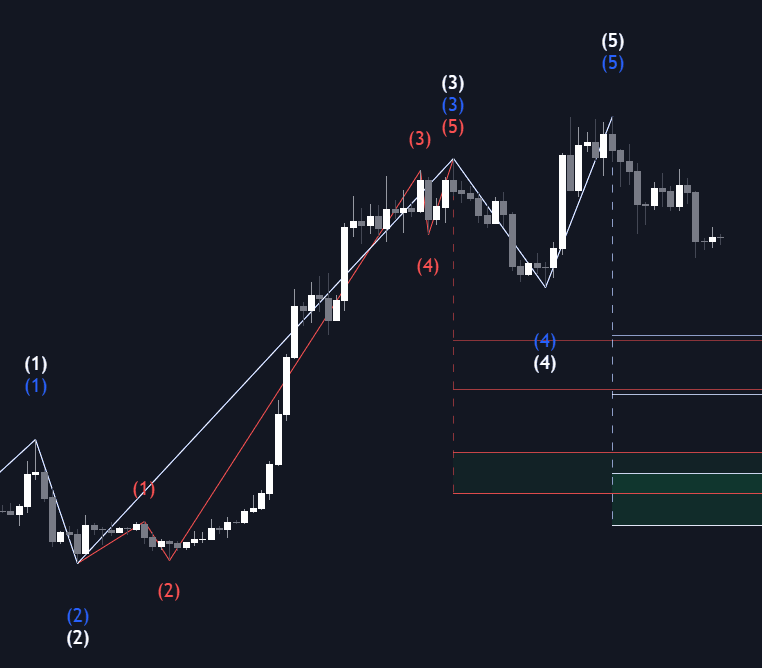
What is a Corrective Wave?
A corrective wave is Elliott wave theory's countertrend unit: the move that partially retraces a preceding motive wave and travels against the trend one degree larger. Corrections subdivide in threes rather than fives, with legs labeled A-B-C (or W-X-Y for compound forms), and they come in a small taxonomy: zigzags (sharp, subdividing 5-3-5), flats (sideways, 3-3-5), triangles (usually contracting, five legs of three each), and combinations that chain these together. The three-not-five grammar is the point: a countertrend move that completes an impulse-style five is, in Elliott practice, never a whole correction on its own.
The vocabulary comes from Ralph Nelson Elliott, who set out the wave principle in The Wave Principle (1938) and Nature's Law (1946) after cataloguing decades of American stock index charts. Elliott observed that markets progress in five-wave motive structures and retrace in three-wave corrective ones, and that the 5-3 alternation repeats at every degree of trend. A.J. Frost and Robert Prechter's Elliott Wave Principle (1978) codified the corrective taxonomy most practitioners use today, from zigzags to combinations (see Elliott wave theory).
Corrections matter because they are where trend-continuation trades are located and where counts most often go wrong. The literature offers guidelines rather than rules here: wave 2s tend to be deep and sharp, wave 4s shallow and sideways, and the two tend to alternate in character (see Elliott guidelines), with depth commonly measured as a Fibonacci retracement of the prior impulse. Because corrective forms are varied and nest into combinations, they are widely regarded as the hardest part of the count, and practitioners hold alternate labels until the next motive wave settles the question.
Corrections also carry the count's discipline. Of the wave principle's few hard rules, two concern corrections: wave 2 may never retrace beyond the start of wave 1, and wave 4 may not overlap wave 1's territory in a standard impulse. Everything else, depth bands, alternation, the tendency of triangles to precede a final wave, is guideline rather than law, which is why wave analysts treat corrective labels as risk definitions as much as forecasts.
How to identify a corrective wave on a chart
Corrections are recognized by their internal threes, their overlapping character, and their position after a completed trend leg. Work from swing highs and lows.
- 1Locate the preceding five-wave move: a correction is defined relative to the motive wave it retraces, so mark that move's start and end first.
- 2Watch for the change of character: corrective price action is typically overlapping and choppy, with swings subdividing in threes, unlike the directional behavior of impulses.
- 3Label the first two swings A and B, then test the forms: a sharp, deep A with a partial B suggests a zigzag; a B returning near A's origin suggests a flat; converging, shrinking swings suggest a triangle.
- 4Measure depth against guideline bands, roughly 0.382 to 0.618 of the prior wave, deeper for second waves and zigzags, shallower for fourth waves and sideways forms.
- 5Confirm completion in hindsight, not in advance: a fresh five-wave move in the trend direction, breaking the correction's boundary, is the evidence that the correction has ended.
How traders use it
- As entry context: once an impulse is in place, the following three-wave correction is the classic spot to join the trend, with the C leg completing into common retracement bands.
- For expectation setting: classifying the form early shapes the playbook, since zigzags run deep, flats chop sideways, and a triangle is conventionally read as the pause before the larger move's final wave.
- As a re-labeling trigger: a countertrend move that subdivides in five forces the count to change, to either wave A of a larger correction or wave 1 of a new trend, which is often the earliest structural warning that a trend is ending.
- For stop logic: corrective labels carry their own invalidations, since a wave 2 label dies below the start of wave 1 and a wave 4 label dies on overlap with wave 1.
- For pattern confluence: a completed zigzag traces the same three-swing geometry as an ABCD, so corrective completions are often cross-checked against harmonic ratio projections before a continuation entry.
Corrective Wave vs related concepts
Motive Wave: Motive waves travel with the one-larger trend and subdivide in fives; corrective waves travel against it and subdivide in threes. This pairing is the core grammar of the wave principle.
Impulse: An impulse is the strictest five-wave motive form, the structure corrections retrace. The two are graded differently: an impulse is judged by hard rules, while a correction is judged mostly by guidelines, which is why corrective counts carry more alternates.
ABCD: The harmonic ABCD and Elliott's A-B-C describe similar three-swing geometry, but ABCD is defined purely by ratio symmetry between its legs, while a corrective wave is defined by its role and position inside a larger wave count.
Concept family
Elliott & Harmonics
33 concepts mapped · 33 in the Library
Corrective Wave FAQ
Turn Corrective Wave into a trading strategy.
Take the implementation from this page into Quant, then build on it, backtest it on real data, and keep refining it in conversation.