Concept
Anti-patterns
Anti-patterns are Elliott & Harmonics concepts. The Library holds 1 implementation, a working definition you can pull into Quant.
anti-Gartley/anti-Bat…
Top Anti-patterns indicator
The top custom implementation, built on the original standard Anti-patterns formula.
1 total
Want to trade Anti-patterns? The implementation below is one prompt away from a backtested strategy in Quant.
What are anti-patterns?
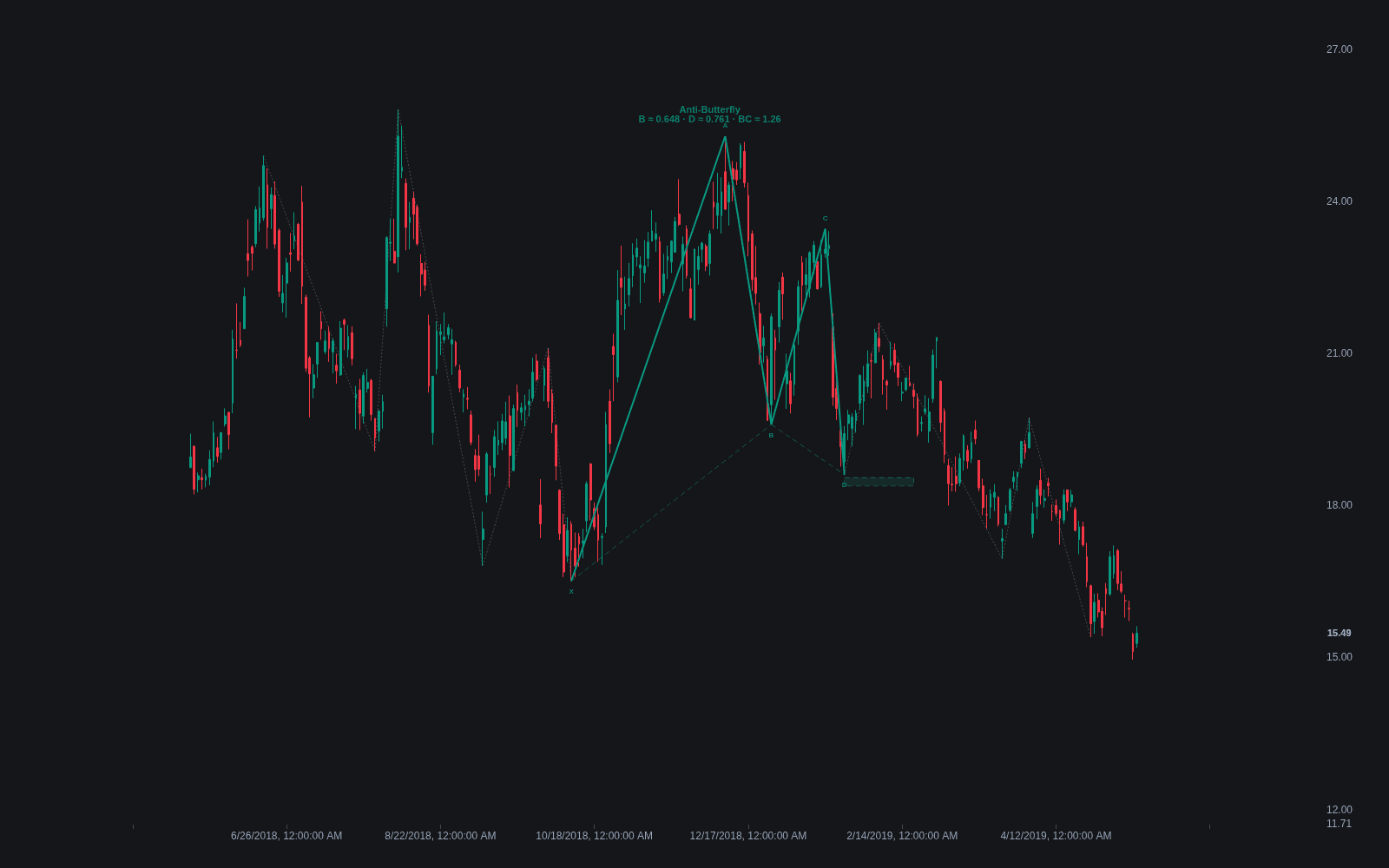
Anti-patterns are mirrored-ratio counterparts of the classic XABCD harmonic patterns: the anti-Gartley, anti-Bat, anti-Butterfly, anti-Crab, and anti-Cypher. Each is built by taking the parent pattern's defining ratios and replacing them with their reciprocals, so a retracement in the original becomes the corresponding extension in the anti version and vice versa. Where a Gartley completes at a 0.786 retracement of XA, the anti-Gartley completes near the reciprocal 1.272 extension; where a Bat finishes at 0.886, the anti-Bat looks toward roughly 1.128.
The intuition is directional. A classic Gartley is a deep pullback that resolves back in the direction of the initial XA leg, a countertrend completion. Its anti version describes the mirror situation: a shallow structure whose D point completes beyond the origin, so the expected resolution runs with the emerging move rather than against it. For that reason anti-patterns are often framed as continuation or early-trend structures, catching the turn back into a new trend after a failed attempt to resume the old one.
Attribution is looser here than for the named originals. The reciprocal-ratio idea circulates broadly in the harmonic community and appears in various pattern suites and scanners with slightly different ratio tables, so treat any specific set of numbers as one implementation among several. What stays constant is the construction rule, mirror the parent's ratios, and the completion logic: D defines a potential reversal zone to be traded on reaction, exactly as with the parent patterns.
How to identify an anti-pattern on a chart
Identification is the same measurement discipline as the classic patterns, with the ratio table inverted.
- 1Label the XABCD swings as usual, anchoring X at the origin of the structure and confirming clean, measurable legs.
- 2Measure the B retracement of XA: anti-patterns typically carry deeper B points than their parents, since the parent's shallow B mirrors into a deep one (the anti-Gartley's B, for example, sits near 0.618 to 0.786).
- 3Project D from the reciprocal of the parent's completion ratio: near 1.272 of XA for the anti-Gartley, near 1.128 for the anti-Bat, with the anti-Butterfly completing inside XA around 0.786.
- 4Cross-check with a BC projection as you would for the parent pattern, and prefer zones where multiple measurements agree.
- 5Trade the reaction at D, not the arrival: the same confirmation-and-invalidation logic used for classic completions applies unchanged.
How traders use it
- As continuation entries: because most anti versions complete in the direction of the newer move, traders use them to join an emerging trend after a corrective structure fails, rather than to fade an established one.
- As a fallback classification: scanners that miss a valid classic pattern will sometimes catch its anti counterpart in the same price data viewed from the opposite anchor, which helps explain overlapping alerts on the same swings.
- With ratio-table awareness: different platforms encode slightly different anti ratios, so practitioners verify what a given tool actually measures before trusting its labels.
- With honest limits: anti-patterns have even less published performance evidence than the classics, so most users treat them as location and invalidation frameworks, sized accordingly.
Anti-patterns vs neighboring pattern sets
Gartley: The Gartley completes at a deep retracement inside XA and trades against the CD leg back toward the old trend; its anti version completes near the reciprocal 1.272 extension and resolves with the newer move.
Butterfly: The Butterfly is already an extension pattern completing beyond X, so its anti version inverts into a retracement completion near 0.786. Confusing a Butterfly with an anti-Gartley is common since both involve 1.27-area measurements from different anchors.
Exotic harmonics: Exotic harmonics are additional named patterns with their own ratio sets. Anti-patterns are not new shapes at all; they are the classic shapes with reciprocal ratios, which keeps their geometry familiar.
Concept family
Elliott & Harmonics
33 concepts mapped · 33 in the Library
Anti-patterns FAQ
Turn Anti-patterns into a trading strategy.
Take the implementation from this page into Quant, then build on it, backtest it on real data, and keep refining it in conversation.