Concept
Motive Wave
Motive Wave is a Elliott & Harmonics concept. The Library holds 1 implementation, a working definition you can pull into Quant.
Top Motive Wave indicator
The top custom implementation, built on the original standard Motive Wave formula.
1 total
The Motive Wave implementation below can become a backtested trading strategy — describe your rules and Quant writes the code.
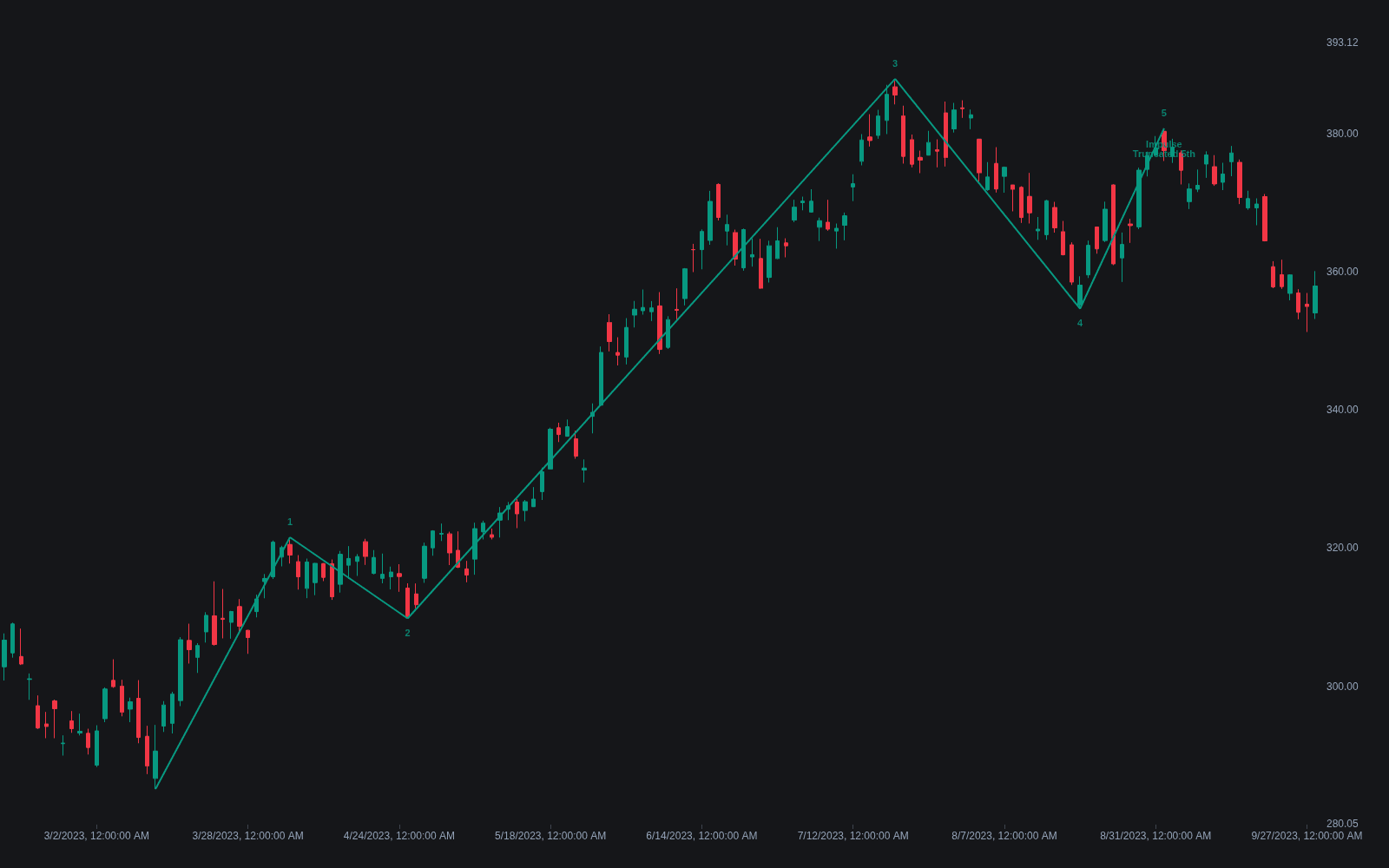
What is a Motive Wave?
A motive wave is Elliott Wave theory's trend engine: a five-wave structure, labeled 1 through 5, that moves in the direction of the trend one degree larger. Waves 1, 3, and 5 advance the move while waves 2 and 4 interrupt it. Motive waves come in two forms: the impulse, the strict version in which wave 4 never overlaps wave 1, and the diagonal, a wedge-shaped variant in which waves 1 and 4 typically do overlap.
The vocabulary comes from Ralph Nelson Elliott's work of the 1930s, published in The Wave Principle in 1938 and systematized for modern readers by Frost and Prechter's 1978 Elliott Wave Principle, which fixed the motive-versus-corrective terminology in common use. The theory's claim is structural: crowd-driven trends advance in fives and retrace in threes, nested across degrees.
The label carries a forecast: when a motive wave completes, the theory expects a corrective wave against it, typically a three-wave form, rather than an immediate continuation, so identifying motive structure is how Elliott analysts locate themselves inside a larger cycle. Counts remain interpretive; two analysts can label the same chart differently while both staying inside the rules.
Internals give the counts their texture. In an impulse the actionary waves (1, 3, 5) subdivide into fives and the interruptions (2, 4) into threes; one actionary wave usually extends, subdividing visibly larger than its peers, and in equities that is most often wave 3. Diagonals come in leading and ending varieties and mark exhaustion when they terminate a larger move. Measurement leans on the standard wave relationships: thirds commonly relating to wave one near 1.618, fifths often echoing wave one, the ruler-work that turns a count into targets.
How to identify a motive wave on a chart
The count must survive the rules, not merely resemble five swings.
- 1Find a five-swing progression with the larger trend: three advancing waves separated by two countertrend interruptions.
- 2Test the hard rules: wave 2 may not retrace past the start of wave 1, wave 3 may not be the shortest actionary wave, and in an impulse wave 4 may not enter wave 1's territory.
- 3Check the subdivisions: actionary waves should themselves read as fives at the next degree down, interruptions as threes.
- 4Locate the extension: identify which actionary wave subdivided largest, since its identity changes the expectations for the remaining waves.
- 5Classify the form: no overlap and straight structure is an impulse; overlapping, wedge-shaped structure is a diagonal, with an ending diagonal warning of exhaustion.
- 6Measure before trusting: the count gains credibility when the waves land near standard ratio relationships, and loses it when every measurement needs a special case.
How traders use it
- To set directional bias: while a motive wave is judged incomplete, pullbacks are treated as corrective, so traders look to rejoin the larger direction around waves 2 and 4 instead of fading wave 3.
- To anticipate turns: a finished fifth wave, especially one accompanied by momentum divergence, flags that the motive phase may be over and a corrective phase beginning.
- To discipline counts: any labeling that violates the hard rules (wave 2 retracing past the start of wave 1, wave 3 the shortest, wave 4 overlapping wave 1 in an impulse) is discarded and recounted rather than bent.
- To project targets: wave relationships convert a maturing count into levels, wave-3 objectives near 1.618 of wave 1, wave-5 objectives echoing wave 1 or relating to the whole 1-through-3 travel, always as zones rather than promises.
- To coordinate with pattern frameworks: ending diagonals and fifth-wave terminations frequently land inside harmonic completion areas, so some traders read a potential reversal zone agreeing with a finished count as two languages describing one exhaustion.
Motive Wave vs related Elliott terms
Impulse: Every impulse is a motive wave, but not the reverse: impulse adds the no-overlap rule and requires the actionary subwaves to be motive themselves. Diagonals are motive waves that fail the impulse tests.
Corrective Wave: Corrective waves run against the one-larger-degree trend and typically subdivide into three waves or combinations; motive waves run with the larger trend and subdivide into five.
Elliott Wave Theory: The theory is the whole framework: degrees, alternation, personality guidelines, and the motive-corrective cycle. The motive wave is its unit of trend, the building block the rest of the architecture positions and measures.
Concept family
Elliott & Harmonics
33 concepts mapped · 33 in the Library
Motive Wave FAQ
Turn Motive Wave into a trading strategy.
Take the implementation from this page into Quant, then build on it, backtest it on real data, and keep refining it in conversation.