Concept
Trend Regime Label
Trend Regime Label is a Trend concept. The Library holds 4 implementations, each one a working definition you can pull into Quant.
up/down/range
Top Trend Regime Label indicators
The top custom implementations, built on the original standard Trend Regime Label formula.
4 total
Any of the 4 Trend Regime Label implementations below can become a backtested trading strategy — describe your rules and Quant writes the code.
.png&w=3840&q=75)
What is a Trend Regime Label?
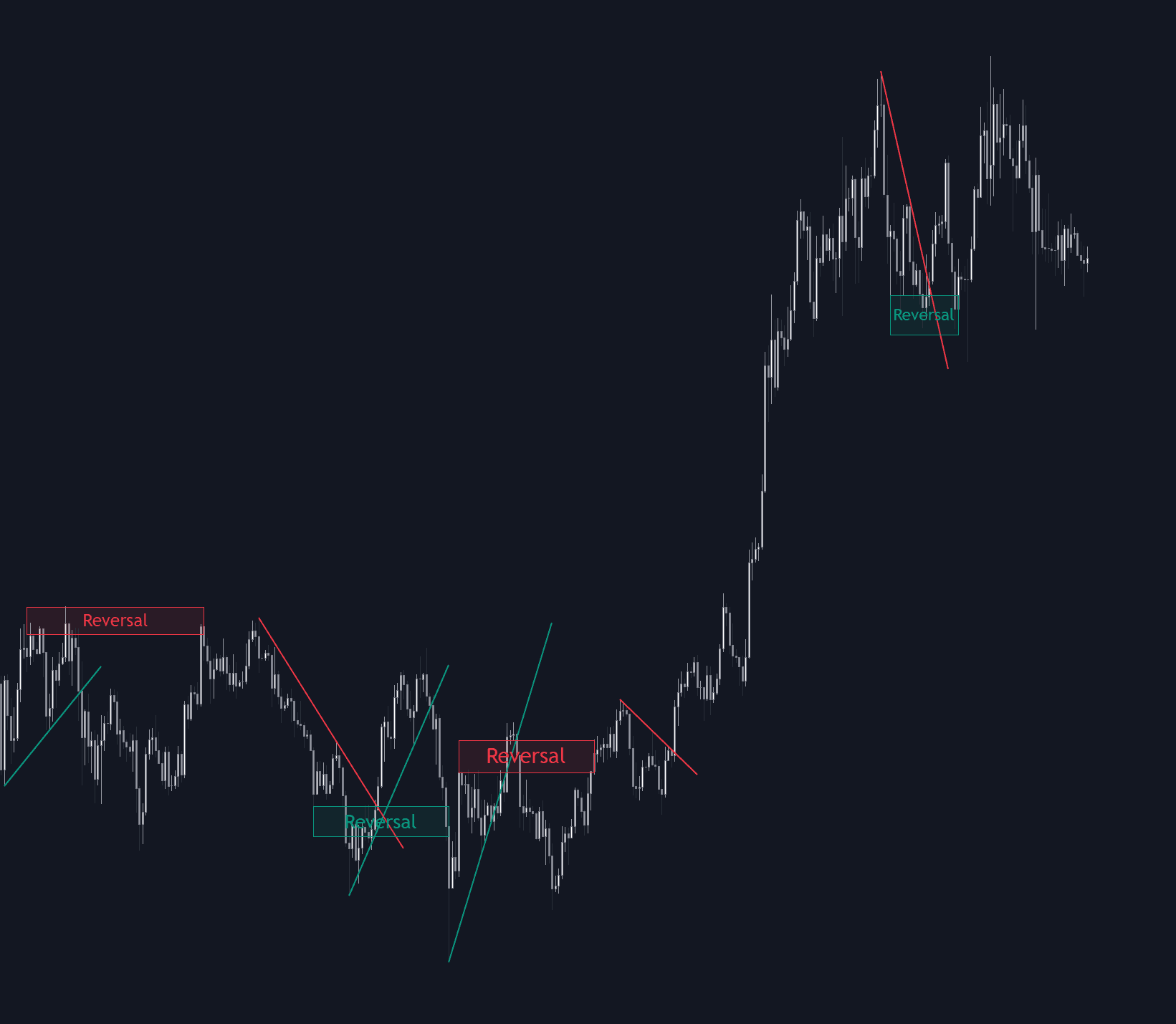
A trend regime label is a discrete classification stamped on each bar: uptrend, downtrend, or range, sometimes with strength grades. Instead of publishing another continuous line, a labeling scheme collapses trend evidence (slope, directional movement, structure) into a categorical state that other logic can branch on. It is the market-analysis equivalent of a switch statement: the label itself is rarely traded; it decides which playbook applies.
Labels can be computed from almost any trend evidence. Common bases include price relative to a long moving average and that average's slope, ADX/DMI thresholds for trending versus not (with the DI lines giving direction), the Kaufman efficiency ratio, swing sequences of higher highs and lows, and statistical approaches such as change-point detection or Markov-switching models. Every scheme faces the same tension between responsiveness and stability, so hysteresis, separate conditions for entering and leaving a state, is standard.
The label matters because most tools are conditional. Mean-reversion signals perform in ranges and get run over in trends; breakout and trend-following logic does the opposite. A regime label is the routing layer that decides which signals are live, which parameters apply, and how aggressively to trail. Getting that routing roughly right is often worth more than refining any single signal it routes.
How to build a Trend Regime Label
Any label comes down to three decisions: the evidence, the state boundaries, and the anti-whipsaw mechanics.
- 1Pick the evidence: for example price versus a rising or falling 200-period average, ADX with the DI lines, an efficiency ratio, or the current swing sequence of higher highs and lows versus the reverse.
- 2Define the states and thresholds: a common three-state scheme reads uptrend when price is above a rising long average with ADX above roughly 20 to 25 and +DI leading, the mirror for downtrend, and range otherwise.
- 3Add hysteresis or dwell time: require the new condition to hold for several bars, or use a stricter threshold to enter a state than to stay in it, so the label does not flip on every borderline bar.
- 4Validate before trusting it: count label flips per hundred bars and check on out-of-sample data that trending labels actually contain trends. A label that echoes noise routes every downstream decision wrongly.
How traders use it
- As a signal gate: trend-following entries fire only under trending labels and mean-reversion only under range labels, which removes each family's worst environment by construction.
- As a parameter switch: adaptive systems lengthen lookbacks and widen stops in trending states, then shorten and tighten them in ranges, without the user re-tuning by hand.
- As position-management context: the same trade might trail loosely under a strong-trend label and take profits at the first target under a range label.
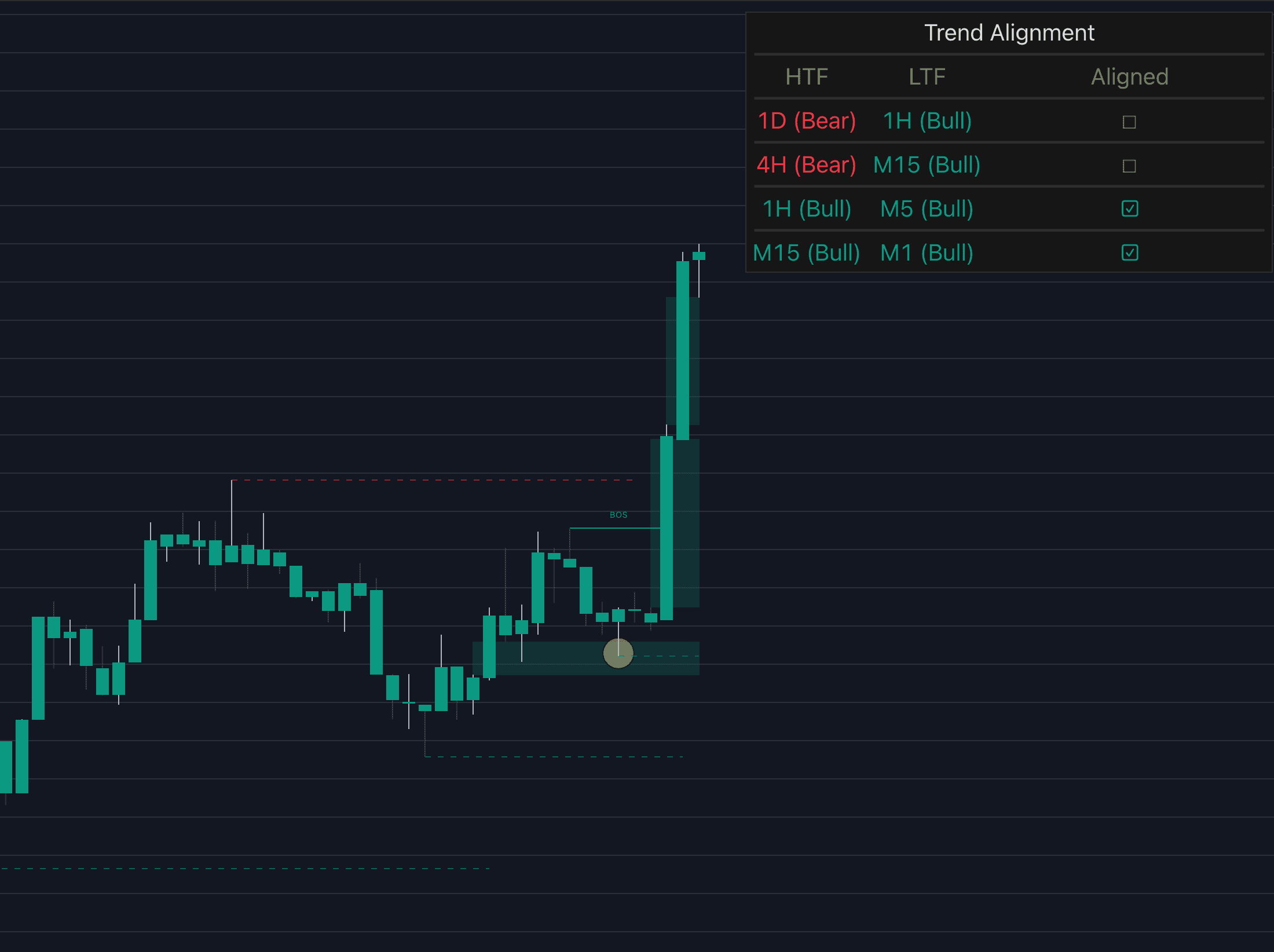
- As a scanning and alignment layer: multi-timeframe regime tables surface markets where daily and intraday labels agree, the mechanical form of top-down analysis.
Trend Regime Label vs neighboring concepts
Trend/range Classifiers: Nearly synonymous in practice: classifier names the method (rules, clustering, machine learning) while the label is its categorical output. Classifier discussion centers on how states get assigned; the label concept covers what systems do with them.
ADX / DMI System: ADX is a continuous trend-strength reading; it becomes a regime label only once thresholded, for instance trending above 25. The label is the discretized decision, and ADX is one popular input to it.
Higher-timeframe Trend Filter: An HTF filter imports directional bias from a slower timeframe and usually has two states, long-allowed or short-allowed. A regime label can live on any timeframe and adds the crucial third state: no trend at all.
Volatility Regime Classification: The volatility analogue: quiet versus expanding rather than up, down, or range. The two are independent axes, and mature systems often condition on both, since a quiet uptrend trades differently from a volatile one.
More Trend Regime Label implementations
Concept family
Trend
100 concepts mapped · 100 in the Library
Trend Regime Label FAQ
Turn Trend Regime Label into a trading strategy.
Take any implementation from this page into Quant, then build on it, backtest it on real data, and keep refining it in conversation.