Concept
Higher-timeframe Trend Filter
Higher-timeframe Trend Filter is a Trend concept. The Library holds 1 implementation, a working definition you can pull into Quant.
Top Higher-timeframe Trend Filter indicator
The top custom implementation, built on the original standard Higher-timeframe Trend Filter formula.
1 total
From studying Higher-timeframe Trend Filter to trading it: take the implementation below into Quant and backtest it instantly.
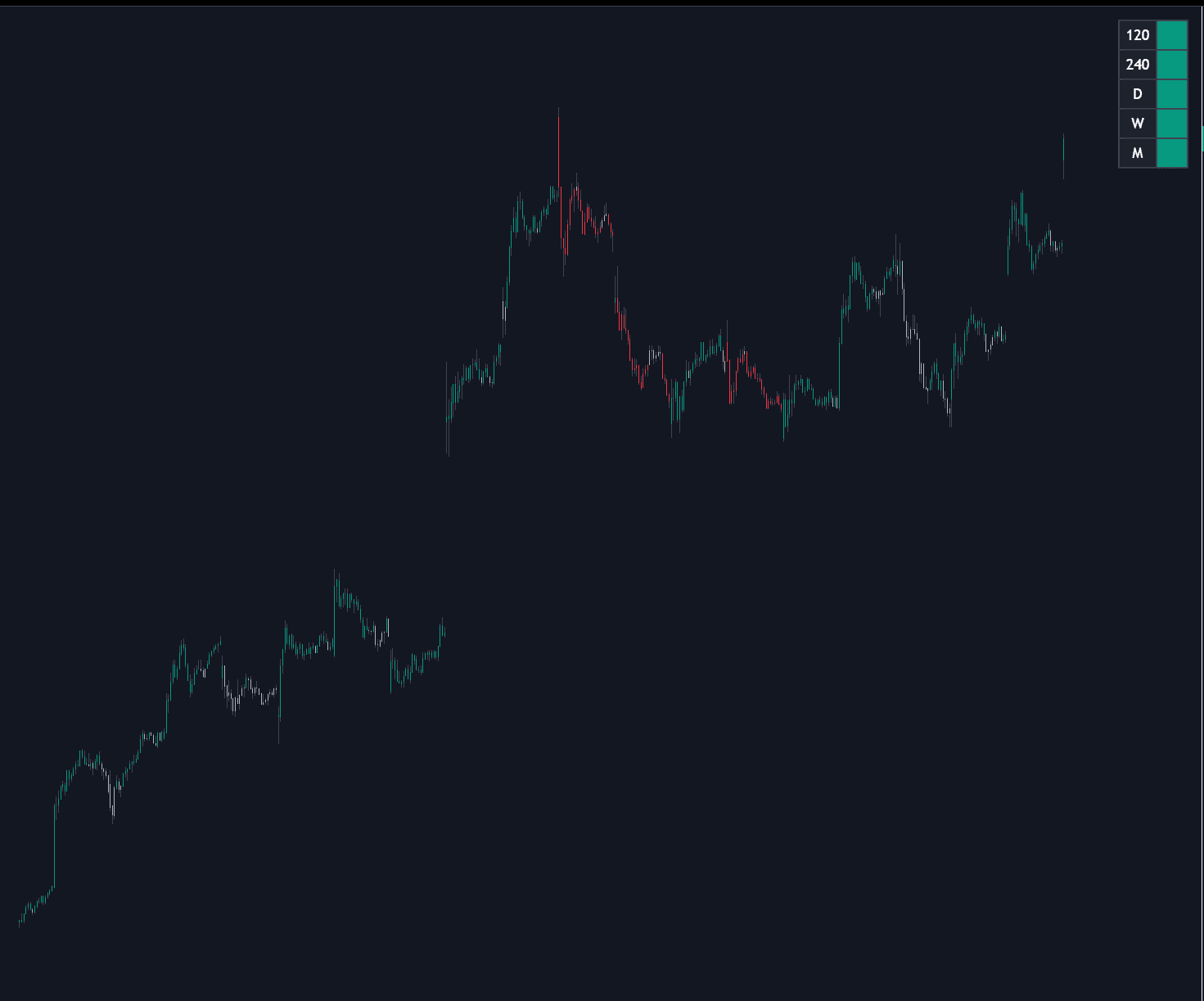
What is a Higher-timeframe Trend Filter?
A higher-timeframe trend filter is a permission rule: signals generated on the timeframe you trade are taken only when they agree with the trend one or more steps above. The filter reduces the higher timeframe to a simple directional state (long-permitted, short-permitted, sometimes neutral) using something computable: price relative to a long EMA, the slope of that average, Supertrend direction, an ADX/DMI reading, or the most recent break of structure. Entries come from below; permission comes from above.
Common pairings keep a ratio of roughly four to six between the timeframes: 15-minute entries filtered by the 1-hour, hourly entries by the 4-hour or the daily, daily by the weekly. One implementation detail matters more than the indicator choice: a higher-timeframe value is only final when its bar closes. A filter that reads the live, still-forming bar repaints, and backtests built on it overstate how clean the filter looked in real time.
The filter matters because counter-trend entries are a common way otherwise reasonable signals lose money. Gating them by the higher timeframe cuts trade count and, in trending conditions, often removes many of the worst losers. The cost is just as real: every such filter lags at turning points, keeps you out at the start of new trends, and offers little in broad ranges where the higher timeframe has no usable direction. It is a trade-off, not a guarantee.
How to build a higher-timeframe trend filter
The filter is a rule set, so building one is mostly a matter of making three decisions explicit and then respecting bar closes.
- 1Pick the pair of timeframes. A higher timeframe four to six times the trading timeframe is the common convention: 15-minute with 1-hour, hourly with 4-hour or daily, daily with weekly. Closer ratios duplicate the entry chart; distant ones barely update.
- 2Reduce the higher timeframe to a state. Price above or below a long average, the average's slope, Supertrend direction, or the last structural break all work; a single simple state is easier to debug than a composite.
- 3Gate the signals. Take long entries only while the state is up, shorts only while it is down, and either stand aside or reduce size when it is neutral.
- 4Evaluate on closed bars only. Reference the last completed higher-timeframe value, not the live one, so the historical reading matches what you would actually have seen in real time.
How traders use it
- As a directional gate on entry signals: crossovers, oscillator triggers, or breakout setups on the trading timeframe fire only in the higher timeframe's direction, converting a two-sided system into a trend-following one.
- In pullback frameworks: the higher timeframe defines the trend worth joining and the lower timeframe times the entry as the retracement ends. The filter is what keeps a pullback trade from quietly becoming a counter-trend trade.
- As a graded weight rather than an on/off switch: agreement across several higher timeframes scales position size or signal confidence up and down instead of blocking trades outright.
- In backtesting, as a toggle: running the same system filtered and unfiltered quantifies what the filter actually buys (fewer trades against fewer bad losers) instead of assuming it helps.
Higher-timeframe Trend Filter vs. related concepts
Top-down Analysis: Top-down analysis is the broad discretionary process of reading several timeframes from weekly down to intraday. A higher-timeframe trend filter is its narrowest mechanical slice: one higher timeframe, reduced to one directional state, applied as a rule.
Multi-timeframe Structure Alignment: Structure alignment specifically checks that swing structure (higher highs and lows, structural breaks) agrees across timeframes. A trend filter can use any directional proxy, indicator or structure, and usually collapses it to a single yes or no.
MTF Alignment & Confluence Scoring: Confluence scoring grades agreement across many timeframes into a number. The trend filter is the binary special case: one higher timeframe, pass or fail.
Trend Regime Label: A regime label classifies a timeframe's own state (trending up, trending down, ranging). The filter borrows that classification from a higher timeframe and uses it as permission for lower-timeframe entries.
Concept family
Trend
100 concepts mapped · 100 in the Library
Higher-timeframe Trend Filter FAQ
Turn Higher-timeframe Trend Filter into a trading strategy.
Take the implementation from this page into Quant, then build on it, backtest it on real data, and keep refining it in conversation.