Concept
Kaufman Efficiency Ratio
Kaufman Efficiency Ratio is a Trend concept. The Library holds 1 implementation, a working definition you can pull into Quant.
Top Kaufman Efficiency Ratio indicator
The top custom implementation, built on the original standard Kaufman Efficiency Ratio formula.
1 total
This Kaufman Efficiency Ratio implementation is strategy-ready: open it in Quant, set your rules, and it backtests automatically.
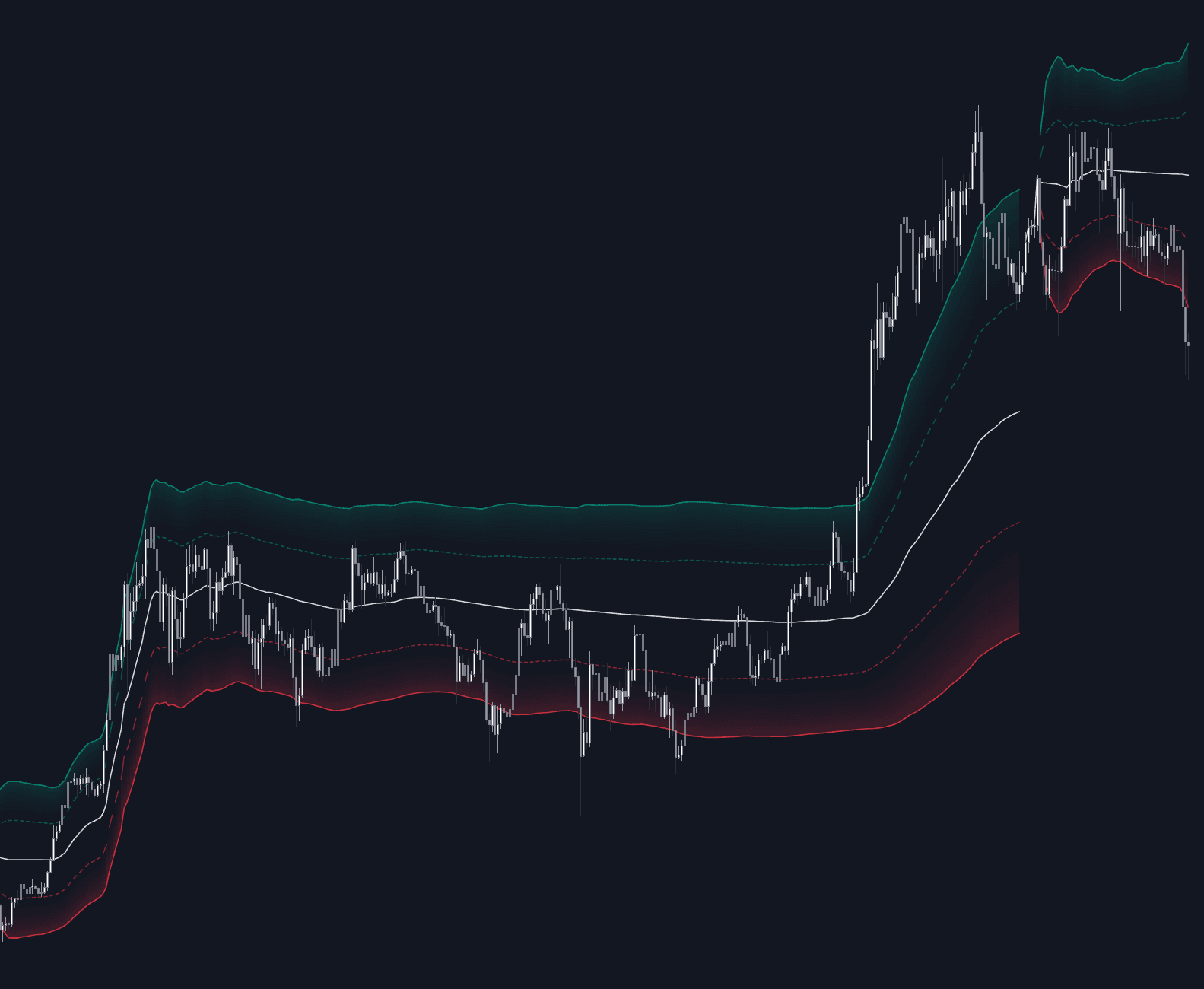
What is the Kaufman Efficiency Ratio?
The Kaufman Efficiency Ratio measures how directly price traveled over a lookback window. Take the absolute net change (the close now versus the close N bars ago) and divide it by the sum of the absolute bar-to-bar changes across the same window. The result lies between 0 and 1: a value of 1 means every bar moved in the same direction, a perfectly straight path, while values near 0 mean price churned back and forth and finished close to where it started. Perry Kaufman introduced the ratio (he also called it fractal efficiency) in the mid-1990s as the signal-to-noise engine of his adaptive moving average.
Kaufman presented it in his 1995 book Smarter Trading as the measurement that lets one indicator serve two regimes: rather than choosing between a fast average that whipsaws and a slow one that lags, his adaptive average reads the ratio each bar and slides its smoothing between the two extremes. The ratio itself is deliberately primitive, one division on closing prices, which is why it reacts within a window's length when a market's character changes.
Because it compares displacement to distance traveled, the ratio gauges trendiness, not direction: a clean downtrend scores as high as a clean uptrend. Its best-known role is inside KAMA, where it maps to a smoothing constant so the average accelerates in efficient moves and flattens in noise, but it also stands on its own as a regime filter.
Its blind spots are the price of its simplicity. Built on closes alone, it never sees intrabar violence, so a market of huge wicks and flat closes can read as efficient; a single outsized bar can prop the net change and flatter the ratio; and the reading is hostage to its window, with a 10-bar ratio and a 50-bar ratio routinely disagreeing about the same chart. Thresholds are conventions to be tested, not constants, which is why the ratio is usually read against its own recent history.
How to read the efficiency ratio on a chart
The ratio plots as a 0-to-1 line (or percentage) in its own pane; the reading is level, persistence, and change.
- 1Plot the ratio with its window (10 bars is the common default; longer windows describe slower regimes).
- 2Read the level against the instrument's own recent range of readings rather than an absolute constant; markets differ in their baseline efficiency.
- 3Watch persistence: a ratio that rises and holds marks a move traveling cleanly, while a spike that immediately decays was one impulsive bar, not a regime.
- 4Treat decay as the actionable event: the ratio rolling over while price still grinds is often the earliest mechanical sign that chop is returning.
- 5Add direction separately, from structure or an MA slope filter, because the ratio scores straightness without caring which way the line points.
How it's calculated
The Efficiency Ratio measures how much of a window's total price travel was net directional progress, from 0 in pure chop to 1 in a perfectly straight move.
Published in Perry Kaufman's Smarter Trading (1995) as the adaptivity input for KAMA; lines 4 and 5 show that standard use.
If Volatility_t is 0 because price never moved, implementations set ER to 0 to avoid division by zero.
A signed variant drops the abs() around Direction so ER runs from -1 to +1 and carries trend direction.
How traders use it
- As a regime filter: trend systems trade only while the ratio holds above a chosen threshold and stand aside, or hand off to mean-reversion logic, when it decays toward zero.
- As the adaptive engine inside KAMA and related averages, scaling the smoothing constant between fast and slow limits so one tool behaves differently in trend and chop.
- As a ranking metric across symbols or timeframes, sorting for markets currently trending efficiently enough to justify breakout or pullback playbooks.
- As a gate on entries: requiring a minimum efficiency before honoring a breakout or crossover signal filters the triggers that fire inside congestion, where such signals fail most often.
- As a design pattern: the same displacement-over-path measurement drives other adaptive-lookback tools, which swap parameters dynamically instead of asking the trader to re-tune per regime.
Efficiency ratio vs other trendiness gauges
Adaptive-lookback MA: Adaptive averages are the ratio's chief consumers: they convert a trendiness measurement into a smoothing decision each bar. The ratio is the sensor; the adaptive average is the actuator built on top of it.
MA Slope Filter: A slope filter measures the direction and steepness of a smoothed line, blending trendiness with direction. The efficiency ratio isolates path quality alone: a market can grind efficiently with a shallow slope, and the two reads disagree in exactly the cases worth noticing.
Trend Regime Label: A regime label outputs a discrete state, often by combining several conditions. The efficiency ratio is one of the cleanest raw inputs such labels consume: continuous, bounded, and cheap, but silent about direction and blind to intrabar range.
Concept family
Trend
100 concepts mapped · 100 in the Library
Kaufman Efficiency Ratio FAQ
Turn Kaufman Efficiency Ratio into a trading strategy.
Take the implementation from this page into Quant, then build on it, backtest it on real data, and keep refining it in conversation.