Concept
Adaptive Stochastic
Adaptive Stochastic is a Momentum & Oscillators concept. The Library holds 1 implementation, a working definition you can pull into Quant.
Ehlers
Top Adaptive Stochastic indicator
The top custom implementation, built on the original standard Adaptive Stochastic formula.
1 total
The Adaptive Stochastic implementation below can become a backtested trading strategy — describe your rules and Quant writes the code.
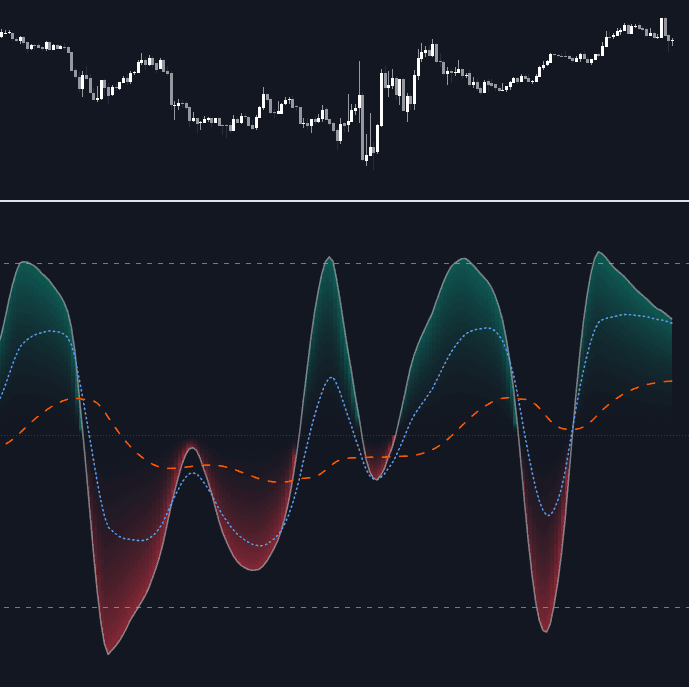
What is an Adaptive Stochastic?
An Adaptive Stochastic is a Stochastic Oscillator whose lookback is not fixed but recomputed bar by bar from a measurement of current conditions, most commonly the dominant cycle period. The best-known versions come from John Ehlers, whose argument is simple: a stochastic tuned to the measured cycle stays in phase with the market's actual rhythm, while a fixed 14-period setting drifts out of tune whenever the cycle lengthens or shortens.
The underlying oscillator is far older, commonly credited to George Lane and his colleagues in the 1950s. Ehlers' contribution, developed across his books and articles on signal processing for traders, was to treat the lookback as a tuning problem: measure the dominant cycle, size the window to it, and in later versions compute the stochastic on band-filtered data so the ranking sees only cycle-scale movement before smoothing the result.
Implementations differ in what drives the adaptation. Cycle-driven versions derive the window from a dominant-cycle estimate; other variants scale the lookback from volatility or an efficiency ratio instead, shortening it when conditions speed up and stretching it when they quiet down. The output is read like any stochastic, as a bounded range-position gauge, with one caveat unique to the adaptive form: identical readings can reflect very different effective lookbacks.
The reading grammar carries over: %K and %D lines, extreme zones, and divergence all mean what they mean on the fixed version. What changes is the claim behind a value: a reading of 90 says the close sits near the top of the currently measured swing rather than of an arbitrary two-week window. Regular divergences near cycle turns are the events cycle-oriented users watch most, with hidden divergence playing its usual continuation role.
How to read an adaptive stochastic on a chart
Interpretation matches the classic oscillator; the extra work is knowing what steers the window.
- 1Check the settings for the adaptation driver (cycle measurement, volatility, or efficiency) and note any minimum and maximum bounds on the effective lookback.
- 2Read %K/%D crossings and the 80/20 zones exactly as on a fixed stochastic; the values answer the same question about position within the recent range.
- 3Plot a fixed 14-period version alongside: stretches where the two disagree mark the regime changes the adaptive window is responding to.
- 4In strong trends, expect saturation near an extreme regardless of adaptation, and treat exits from the extreme zone as the event rather than entries into it.
How it's calculated
A stochastic oscillator whose lookback length varies bar by bar with market conditions instead of staying fixed.
Adaptive stochastics are a family rather than one fixed formula; the version shown drives the lookback with Kaufman's efficiency ratio, shortening it in efficient trends and lengthening it in choppy conditions.
Ehlers' adaptive stochastic instead sets the lookback from a measured dominant cycle; other versions drive it with volatility, as in Chande and Kroll's dynamic indicators.
Some implementations also smooth %K before taking %D, as in the slow stochastic.
How traders use it
- For overbought/oversold timing that tracks the current cycle: extremes mark stretched positioning within the measured swing rather than against an arbitrary fixed window, though strong trends can still pin any stochastic at an extreme for long stretches.
- As the timing leg of cycle-based systems: %K/%D crossings or exits from the extreme zones are taken near the turn windows the measured cycle implies.
- As a working example of adaptive parameter design: running it beside a fixed-length stochastic shows exactly where static settings fall out of tune with changing regimes.
- As timing inside a directional filter: a common pairing lets a slower tool such as MACD or plain momentum set the tradable direction while the adaptive stochastic times entries and exits within it.
- Beside its sibling oscillator: adaptive/dynamic RSI applies the same philosophy to a different formula, and running both shows whether a signal is formula-specific noise or a regime-wide condition.
Adaptive Stochastic vs related oscillators
Stochastic Oscillator: The fixed baseline: the close ranked within the highest high and lowest low of a constant window. The adaptive version keeps the formula and frees the window; nothing else about the reading changes.
Stochastic RSI: A stochastic calculated on RSI values rather than price, with fixed windows. It sharpens sluggish extremes by double-processing the data instead of adapting parameters, at the cost of extra noise.
Stochastic Momentum Index: William Blau's redesign of the numerator: it measures the close against the midpoint of the high-low range and double-smooths the result. It refines the formula while keeping fixed lengths; the adaptive stochastic does the opposite.
Adaptive/dynamic RSI: The same adaptive philosophy applied to Wilder's oscillator. RSI measures the balance of gains and losses, while the stochastic measures position within a range, so the two adapt different questions.
Concept family
Momentum & Oscillators
91 concepts mapped · 91 in the Library
Adaptive Stochastic FAQ
Turn Adaptive Stochastic into a trading strategy.
Take the implementation from this page into Quant, then build on it, backtest it on real data, and keep refining it in conversation.