Concept
Breakout-pullback-continuation
Breakout-pullback-continuation is a Market Structure concept. The Library holds 1 implementation, a working definition you can pull into Quant.
Top Breakout-pullback-continuation indicator
The top custom implementation, built on the original standard Breakout-pullback-continuation formula.
1 total
Want to trade Breakout-pullback-continuation? The implementation below is one prompt away from a backtested strategy in Quant.
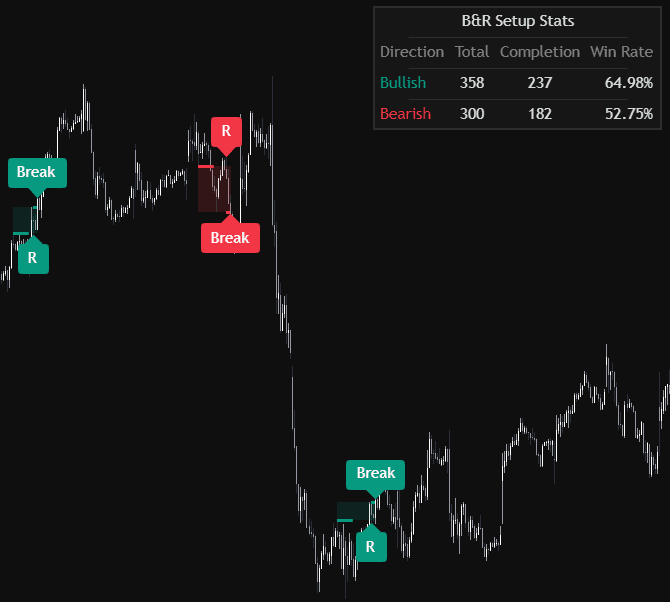
What is Breakout-pullback-continuation?
Breakout-pullback-continuation is the three-phase sequence behind the classic break-and-retest trade: a breakout through a level, a pullback that returns to test the level from the other side, and a continuation in the breakout's direction once the test holds. The logic is role reversal: after resistance breaks, shorts covering and breakout buyers defending their entries should turn the old ceiling into a floor, so a held retest is read as evidence the break was genuine rather than a stop run.
The sequence predates its modern names. Role reversal, broken resistance acting as support, runs through the classical charting literature, and the return move has had a name at least since Edwards and Magee: a throwback after an upside break, a pullback after a downside one. The confirmation logic descends from Dow Theory's insistence that a trend proves itself by holding successive levels. Newer structure-based vocabularies restate the same sequence as a break of structure followed by a corrective retest, and break-and-retest is the everyday shorthand.
In swing terms the template is an impulse leg through the level, a corrective leg back into it, and a second impulse away from it. The retest's turning point prints a higher low above old resistance (or a lower high below old support), registering a fresh swing high or low in the break's direction. That is what separates a continuation retest from chop around a level: structure keeps building one way while the level changes roles.
Entering on the pullback instead of the initial break trades immediacy for definition: the entry sits closer to its invalidation (a stop beyond the retested level) and avoids chasing an extended breakout bar. The costs are just as concrete. The strongest breaks sometimes never pull back, so the method misses them entirely, and a pullback that trades decisively back inside the prior range is the signature of a false breakout, not a continuation setup.
How to identify breakout-pullback-continuation on a chart
The sequence is only as good as the level it forms around, so identification starts before the breakout bar.
- 1Start from a level that mattered: the boundary of a mapped trading range, a prior swing extreme, or a defended neckline.
- 2Confirm the break: at least one decisive close beyond the level, ideally on an expanded bar, rather than a lone intrabar poke.
- 3Wait for the return: a corrective drift or a sharp probe back into the level's vicinity, without demanding a to-the-tick touch.
- 4Watch the hold: rejection wicks, a stall, then a turn that prints a higher low at or above the broken level in the bullish case (mirrored in the bearish one).
- 5Enter on the turn with the stop beyond the retested level, and treat acceptance back inside the prior range as the exit condition.
How traders use it
- As an entry template: skip the initial break, wait for price to return to the broken level, and enter when it holds and turns, with the stop placed beyond the level so the trade dies exactly where the idea does.
- As a breakout quality check: a shallow pullback that holds the broken level upgrades the breakout read, while a deep return into the old range downgrades it toward failure.
- As a regime cue for range traders: once a boundary breaks and survives its retest, fading that edge stops making sense and the playbook shifts from mean reversion to continuation.
- As a multi-timeframe routine: mapping the break on a higher timeframe and executing the retest on a lower one, an everyday form of multi-timeframe structure alignment, so direction comes from the larger structure while entry risk stays small.
- As a range-resolution classifier: a break that survives its retest suggests the range resolved with intent, while a poke that immediately returns inside reads as a deviation above or below the range.
Breakout-pullback-continuation vs neighboring structure concepts
False Breakout: The same first two phases with the opposite ending: the retest fails, price accepts back inside the range, and the breakout entries become fuel for the reversal. The retest is where the paths separate.
Break of Structure: A break of structure labels the event, the close through a swing point. This template is the tradable sequence around it, adding the corrective retest and the second leg that turn a label into an entry, stop, and target.
Swing Failure Pattern: A swing failure runs a level and reverses without acceptance beyond it. If the break cannot close beyond the level before reversing, swing-failure logic applies and the idea inverts.
Concept family
Market Structure
31 concepts mapped · 31 in the Library
Breakout-pullback-continuation FAQ
Turn Breakout-pullback-continuation into a trading strategy.
Take the implementation from this page into Quant, then build on it, backtest it on real data, and keep refining it in conversation.