Concept
Turtle Soup
Turtle Soup, also known as ICT turtle soup, is a Market Structure concept. The Library holds 1 implementation, a working definition you can pull into Quant.
Connors
Top Turtle Soup indicator
The top custom implementation, built on the original standard Turtle Soup formula.
1 total
The Turtle Soup implementation below can become a backtested trading strategy — describe your rules and Quant writes the code.
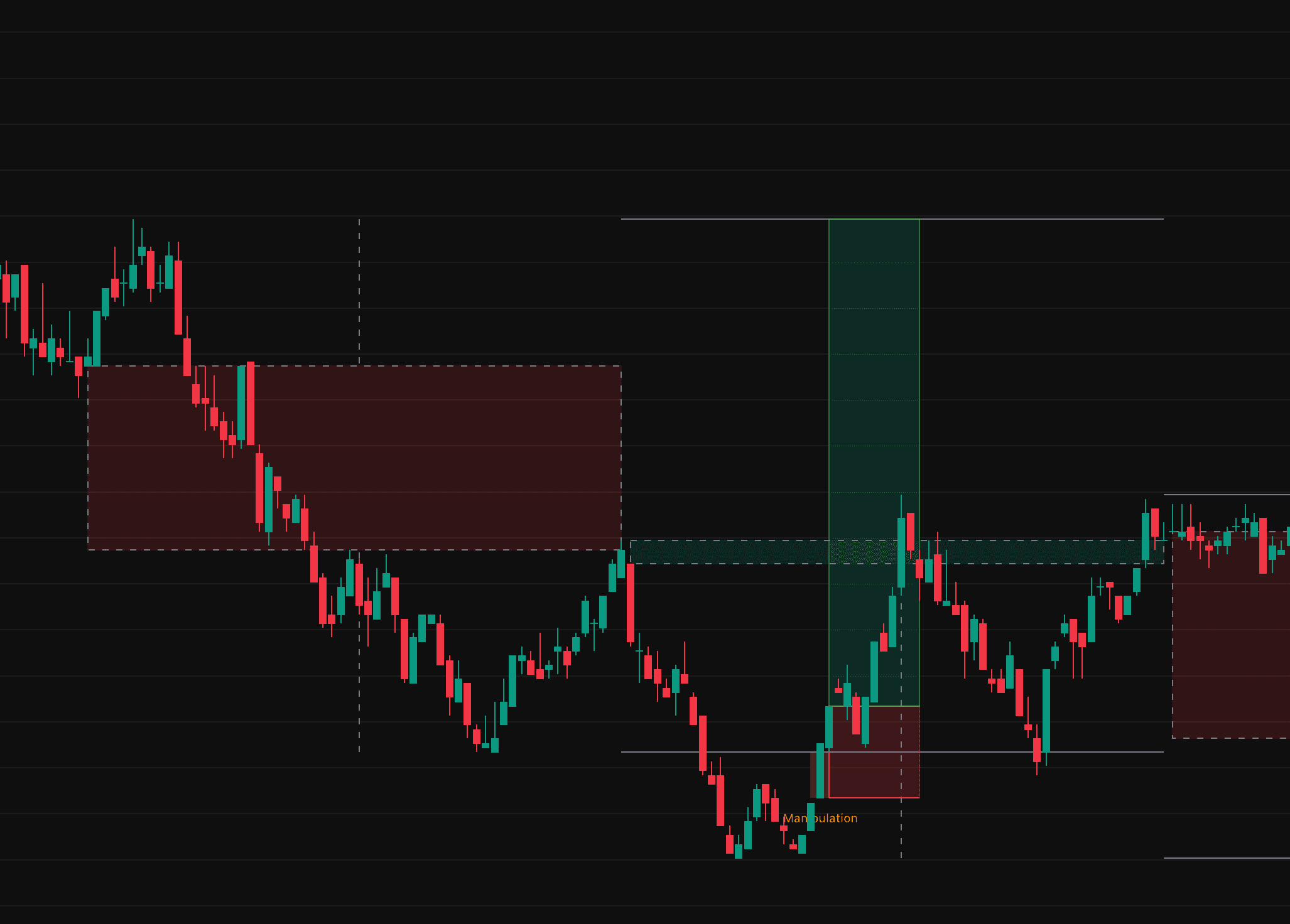
What is Turtle Soup?
Turtle Soup is a failed-breakout reversal setup published by Laurence Connors and Linda Raschke in Street Smarts (1995), named at the expense of the Turtles, the trend-following group trained by Richard Dennis whose rules bought 20-day channel breakouts. The setup fades exactly that entry. In the original buy rules, today prints a new 20-day low while the previous 20-day low is at least four sessions old; the trade enters on a buy stop back above that prior low, so it only triggers if the breakout is already failing, with the initial stop below the new extreme. The sell side mirrors this at fresh 20-day highs, and a next-day variant (Turtle Soup Plus One) allows the reclaim to happen one session later.
Smart Money Concepts traders later borrowed the name for the same event told in liquidity language: price runs an obvious prior high or low, the liquidity sweep consumes resting stops and breakout entries, and the failure to hold beyond the level becomes the reversal trade. The chart event is identical; the difference is that the original is a rule-defined, countertrend fade of fresh 20-day extremes, while the ICT version is discretionary and usually demands structure confirmation before entry. Either way, the edge claimed is positioning against trapped breakout traders, and it fails whenever the breakout turns out to be real.
The mechanics matter because they define who is trapped. A fresh 20-day extreme is exactly where channel-breakout systems enter and where stops beyond the old extreme concentrate, so a failed break leaves two crowds on the wrong side at once: breakout entrants under water immediately, and stopped-out holders watching price return without them. Requiring the prior extreme to be at least four sessions old keeps the level obvious enough to have attracted that positioning. Entering on a stop back inside the range, rather than at the new extreme itself, is the discipline in the design: the market must already be repairing the break before the trade can exist, which filters the cleanest failures from breaks that simply keep going.
It is still a countertrend trade, and the honest accounting starts there. When the breakout is real, the setup sells the launch point of a new trend, and the loss is taken just as the move accelerates; expectancy depends on cutting those quickly while letting successful fades rotate across the trading range. The exact parameters have been public since 1995, and edges that specific decay. The durable part is the structural logic of trapped traders, which is why modern liquidity-based variants re-derive the same trade from positioning reasoning rather than fixed lookbacks.
How to identify a Turtle Soup setup on charts
Both the classic and the liquidity-flavored versions reduce to the same sequence: an obvious extreme, a break that fails, and a reclaim that can be traded with defined risk.
- 1Mark the reference extreme: the lowest low or highest high of the last 20 sessions in the original rules, or any swing high or low with visible stop concentration in the discretionary version.
- 2Check the age of the prior extreme: Connors and Raschke required it to be at least four sessions old, long enough for positioning to have built around it.
- 3Wait for the break: a new extreme prints beyond the reference level, the event breakout systems trade in the other direction.
- 4Arm the entry where failure is proven: a stop order back inside the violated level, so the position only exists if price reclaims the range; discretionary traders often also require a break of structure in the fade direction before arming it.
- 5Define the exit rails before entry: initial stop beyond the sweep's furthest point, first target toward the opposite side of the range, and abandon the idea if price closes back beyond the reclaimed level.
How traders use it
- As a rule-based fade of fresh extremes: the classic form buys a failed break below a 20-day low (or sells a failed break above a 20-day high), entering on a stop back inside the old range so the market must already be reclaiming the level before any position exists.
- As an entry model inside Smart Money Concepts: a raid through an old high or low that immediately rejects is traded back toward the opposite liquidity, typically only after a change of character or an impulsive leg away from the swept level confirms the reversal.
- As a risk template: the violated extreme supplies the invalidation. Stops sit beyond the sweep's furthest point, and the idea is abandoned if price closes back outside the reclaimed level instead of rotating away from it.
- As a rotation entry at range extremes: a failed poke beyond a rotational bracket, the deviation above/below range event, is turtle soup in range clothing, entered on re-entry into the bracket and targeted at the opposite extreme.
- As a higher-timeframe filtered fade: multi-timeframe structure alignment narrows the take to sweeps against minor extremes in the direction of the larger trend, so the countertrend entry on the trading timeframe is a with-trend entry one degree up.
Turtle Soup vs similar setups
Liquidity Sweep: A sweep names the raid itself: the run through resting stops beyond a level. Turtle Soup is a tradeable setup built on that event, with a defined entry back inside the range and a stop beyond the raid's extreme. Every turtle soup starts with a sweep; most sweeps are never traded.
Swing Failure Pattern: The SFP applies the same failure logic to any swing high or low and usually requires a close back inside the level. Original Turtle Soup is narrower: it fades specifically a fresh 20-day extreme whose prior extreme is at least several sessions old.
False Breakout: The umbrella term for any break that fails to hold, with no entry mechanics attached. Turtle Soup is one codified way to trade a false breakout, aimed at the stops and late entries stranded when a channel breakout fails.
Concept family
Market Structure
31 concepts mapped · 31 in the Library
Turtle Soup FAQ
Turn Turtle Soup into a trading strategy.
Take the implementation from this page into Quant, then build on it, backtest it on real data, and keep refining it in conversation.