Concept
Swing Magnitude Filters
Swing Magnitude Filters are Market Structure concepts. The Library holds 1 implementation, a working definition you can pull into Quant.
Top Swing Magnitude Filters indicator
The top custom implementation, built on the original standard Swing Magnitude Filters formula.
1 total
From studying Swing Magnitude Filters to trading it: take the implementation below into Quant and backtest it instantly.
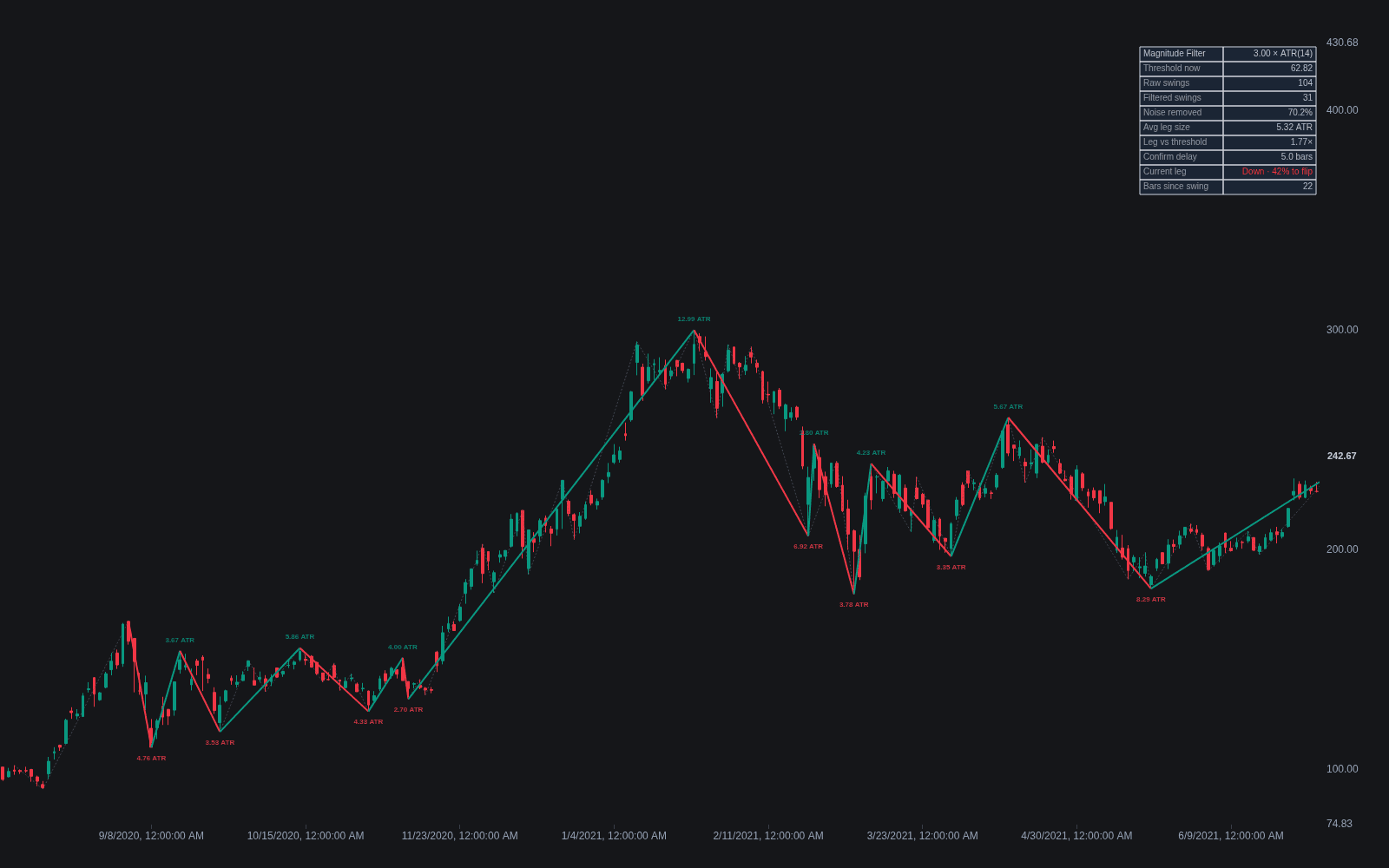
What are Swing Magnitude Filters?
A swing magnitude filter is a minimum-size rule applied to swing detection: a move only counts as a new structural leg if it travels at least a threshold distance from the prior extreme. The threshold is usually a fixed percentage, an absolute point value, or a multiple of ATR so the filter scales with current volatility. This is the mechanism inside zigzag structure: the algorithm confirms a swing high or low only after price has reversed by the required amount, which is also why the most recent leg always stays provisional.
Size-filtering swings is one of the oldest ideas in technical analysis. Dow Theory already sorted movements into primary, secondary, and minor tiers, an informal magnitude filter expressed in prose. Arthur Merrill's Filtered Waves (1977) made the rule explicit by studying only moves that exceeded a fixed percentage, and point-and-figure charting encodes the same principle in its box and reversal sizes. The modern zigzag indicator is the direct descendant, with a threshold deciding which reversals earn a new line.
The point is noise control. Every downstream structure read (higher highs and lows, breaks of structure, pattern anchors) inherits the quality of the swings it is built on, and unfiltered pivots flip constantly on lower timeframes. The trade-off is unavoidable: a larger threshold produces fewer, more meaningful swings but confirms them later, while a smaller one reacts quickly and relabels often. No threshold is objectively correct; choosing one is choosing the scale of structure you intend to analyze.
The filter matters because structure tools consume swings, not prices. Swing structure grammar labels, break of structure events, and the segmentation of impulse and corrective legs all take the swing sequence as input, so the threshold quietly decides what those tools can see. Wave analysts meet the same problem as degree separation, and volatility-scaled thresholds, typically ATR multiples, keep the swing count roughly stable across regimes in a way fixed percentages cannot.
How to apply a swing magnitude filter
The filter is a rule imposed on swing detection, so identifying it means configuring and sanity-checking it.
- 1Start from candidate pivots: local highs and lows from a bar-count rule, or simply every directional reversal in the series.
- 2Pick the threshold type: a percentage for comparability across instruments, absolute points for a single contract, or an ATR multiple so the filter breathes with volatility.
- 3Confirm a new swing only when price has traveled the full threshold from the prior extreme; smaller counter-moves extend the current leg instead.
- 4Treat the newest leg as provisional: until a reversal clears the threshold, the latest extreme can still be replaced.
- 5Calibrate visually: raise the threshold until the plotted swings match the scale you actually trade, then leave it alone so structure reads stay consistent.
How traders use it
- As a cleanup layer for structure maps: applying an ATR or percentage threshold before labeling higher highs and lows keeps break-of-structure and trend labels from flipping on every minor wiggle.
- As a scale selector: a small threshold maps intraday swing grammar, a large one maps campaign-level legs, and running two filters side by side approximates multi-timeframe structure alignment from a single chart.
- As a signal gate: some traders only honor divergences, patterns, or entries anchored to swings that cleared the magnitude filter, discarding setups built on sub-threshold noise.
- As breakout hygiene: requiring the broken swing to be magnitude-qualified keeps false breakouts of micro-pivots from triggering structure-based entries.
- As a range detector: when no leg clears the threshold for an extended stretch, the silence itself flags a trading range at your chosen scale, a cue to switch from breakout to rotation tactics.
Swing magnitude filters vs related rules
Williams Fractal: A fractal defines a swing by bar-count symmetry, a high flanked by lower highs on each side, regardless of distance traveled. A magnitude filter demands displacement and ignores bar counts. Fractals fire freely in quiet drift; magnitude filters stay silent until something actually moved.
Zigzag Structure: Zigzag is the drawing; the magnitude filter is the rule inside it. Every zigzag embeds a minimum-move threshold, so choosing zigzag settings is choosing a filter. Naming the filter separately just makes that hidden decision explicit and testable.
Swing Structure Grammar: Structure grammar assigns meaning to swings: higher highs, lower lows, breaks, shifts. The magnitude filter decides which swings exist to be labeled. Grammar built on unfiltered pivots relabels constantly, so the filter acts as the quality gate feeding it.
Concept family
Market Structure
31 concepts mapped · 31 in the Library
Swing Magnitude Filters FAQ
Turn Swing Magnitude Filters into a trading strategy.
Take the implementation from this page into Quant, then build on it, backtest it on real data, and keep refining it in conversation.