Concept
Pivot Strength
Pivot Strength is a Market Structure concept. The Library holds 1 implementation, a working definition you can pull into Quant.
left/right bars
Top Pivot Strength indicator
The top custom implementation, built on the original standard Pivot Strength formula.
1 total
The Pivot Strength implementation below can become a backtested trading strategy — describe your rules and Quant writes the code.
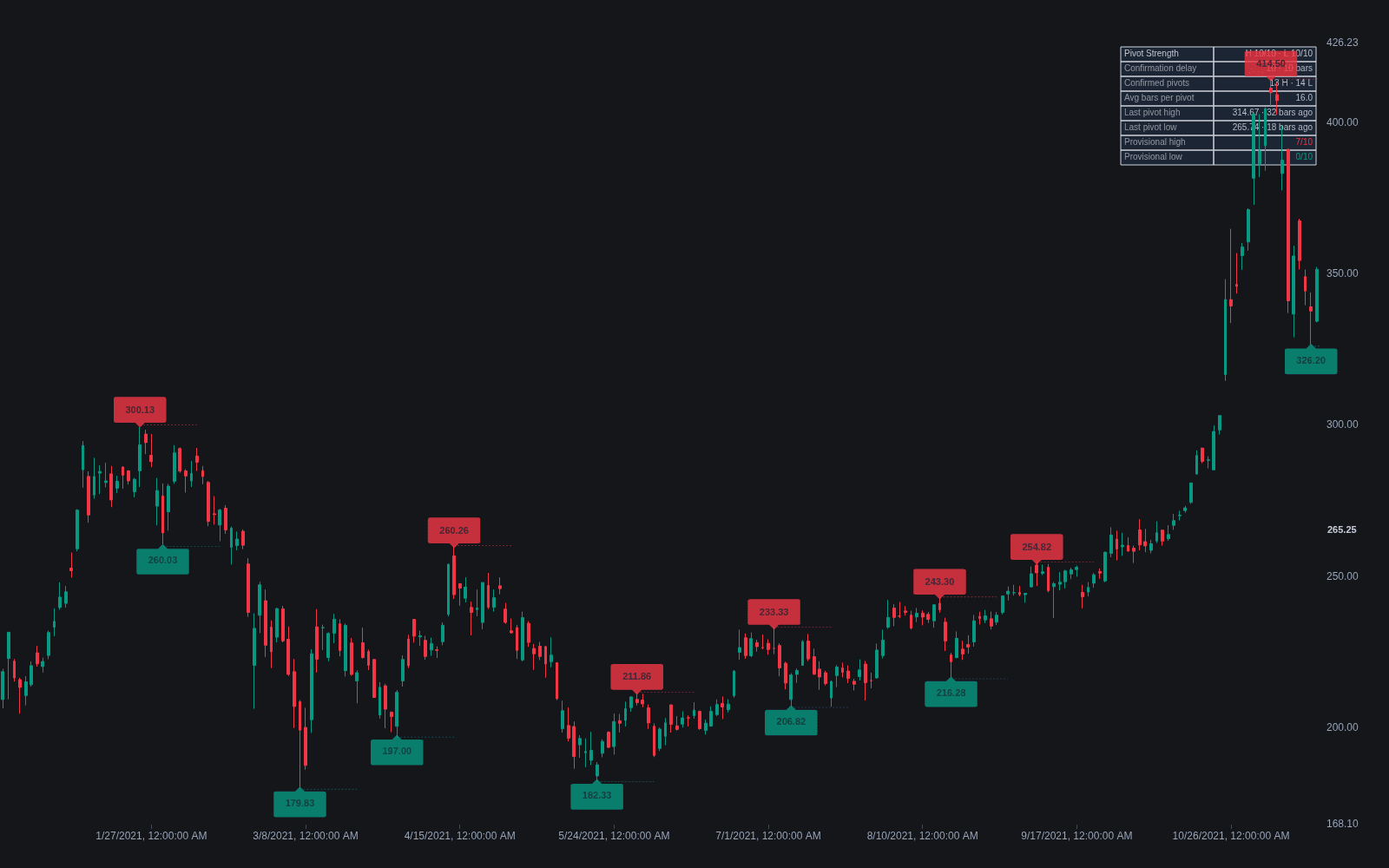
What is Pivot Strength?
Pivot strength is the bar-count rule that defines a swing point: a pivot high of strength N is a bar whose high exceeds the highs of the N bars to its left and the N bars to its right, with the mirror definition for pivot lows (left and right counts can be set independently). The larger the strength, the more neighbors the bar must dominate, so fewer and more significant pivots survive. The Williams fractal is the fixed strength-2 special case, and general swing high/low detection is usually this rule with adjustable settings.
Strength buys significance with delay. A pivot cannot be confirmed until every right-side bar has closed, so a strength-10 pivot is only knowable 10 bars after it printed. That lag is structural, and tools that draw the label back at the pivot bar can look prescient in replay, which is the classic repaint-safe engineering concern. Choosing a strength setting is therefore choosing both the scale of structure you map and the confirmation delay you accept.
Everything structural downstream inherits the setting. Confirmed pivots are the alphabet of swing structure grammar: higher highs, lower lows, breaks and characters are all statements about pivots, so the strength dial silently decides which structure story the chart tells. Asymmetric settings encode intent, a large left count with a small right count demands a significant structure before the turn but confirms quickly, while the reverse waits for overwhelming proof. High-strength pivots also mark where stop orders concentrate, which is why tools like QuantNomad's Significant PP watch them specifically for swing failure and stop-run events.
The bar-count rule is one of two common significance definitions. The other, used by zigzag tools, requires a minimum price move, a percentage or ATR multiple, before a swing counts; bar-count pivots measure dominance in time while move-based swings measure magnitude, and the two disagree exactly where it matters, in fast vertical markets and slow drifts. There is no optimal N: the honest practice is scaling the setting to the structure you trade, layering two or three strengths for hierarchy, and keeping the choice fixed so that structure reads stay comparable across charts and dates.
How to identify pivots by strength
The rule is mechanical, so the craft is in the settings and in respecting the confirmation delay.
- 1Set the left and right bar counts; remember the right count is also the confirmation delay in bars.
- 2Scan for bars whose high exceeds every neighbor's high within both windows (mirror for lows); ties are handled by convention, so check how your tool breaks them.
- 3Distinguish provisional from confirmed: within the right-side window a candidate can still be voided, and honest tools mark that state visibly.
- 4Layer strengths for hierarchy: a small-N pass maps minor swings, a large-N pass maps the major legs, and nesting the two shows which minor pivots live inside which major structure.
- 5Anchor downstream tools, structure labels, trendlines, retracement grids, stop placements, only to confirmed pivots of the strength that matches the trade's scale.
How it's calculated
Pivot strength is the number of bars on each side that a candidate swing high or low must exceed to qualify as a pivot.
A Williams fractal is the special case n_left = n_right = 2.
Implementations differ on ties: strict > and < reject equal highs or lows, while >= and <= accept them.
Also appears as pivot length, pivot period, or swing length in indicator settings.
How traders use it
- As a scale dial: low strength maps fine intraday swing grammar, high strength maps the major legs, and mismatched settings are a common reason two traders disagree about what the structure is.
- As an anchor rule: confirmed pivots anchor structure labels, trendlines, retracement grids, and structure-based stops, so the strength setting quietly parameterizes everything built on top of them.
- As backtest hygiene: acting only on pivots after their right-side bars close keeps historical tests honest, since using the final label at the pivot's own bar leaks future information.
- As a stop-run watchlist: high-strength pivots are where resting stops concentrate, so sweeps through them that immediately fail, false breakouts in structure terms, are monitored as trade events in their own right.
- For leg segmentation: pivots of an appropriate strength split price into impulse and corrective legs, the raw material for trend anatomy, ratio measurements, and structure-based targets.
Pivot strength vs related swing definitions
Williams Fractal: The fractal is this exact rule frozen at strength 2: two bars each side. It confirms fast and prints often, which suits it to minor-swing mapping; adjustable pivot strength generalizes the same test to any scale of structure.
ZigZag Structure: Zigzag defines a swing by minimum price movement, a percentage or volatility multiple, rather than bar dominance. Move-based swings ignore time, so one vertical day can print a pivot bar-count rules would skip, and a slow drift can dominate weeks without ever moving enough to register.
Swing High/Low: Swing high/low is the concept; pivot strength is its most common parameterization. Any tool that claims to detect swings has answered the strength question somehow, and reading its settings tells you which structure scale it actually maps.
Concept family
Market Structure
31 concepts mapped · 31 in the Library
Pivot Strength FAQ
Turn Pivot Strength into a trading strategy.
Take the implementation from this page into Quant, then build on it, backtest it on real data, and keep refining it in conversation.