Concept
Strong vs Weak Swings
Strong vs Weak Swings, also known as strong/weak highs and lows, protected highs/lows, are Market Structure concepts. The Library holds 1 implementation, a working definition you can pull into Quant.
Top Strong vs Weak Swings indicator
The top custom implementation, built on the original standard Strong vs Weak Swings formula.
1 total
The Strong vs Weak Swings implementation below can become a backtested trading strategy — describe your rules and Quant writes the code.
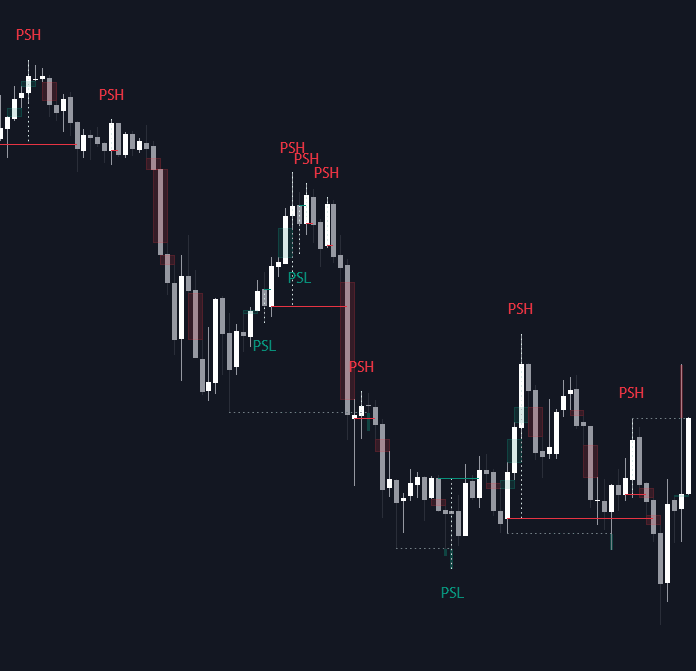
What are Strong vs Weak Swings?
Strong vs weak swings is Smart Money Concepts vocabulary for grading swing points by what they accomplished. A strong low is the low that launched a break of structure upward: it produced the new high, bullish structure is measured from it, and it is treated as protected, meaning the market should not trade back through it while the uptrend is intact. A weak high is a high that failed to exceed the previous high: it achieved nothing structurally, so it is expected to be taken out eventually. In an uptrend the working map is strong lows below and weak highs above; downtrends mirror the labels.
The vocabulary spread through Smart Money Concepts communities in the late 2010s and early 2020s, but the underlying test is far older: Dow Theory graded trends by whether successive swings made new extremes more than a century ago. The modern framing adds the liquidity interpretation and the protected label, turning a trend definition into a map of which levels should hold, which should break, and where the resting orders sit.
The grading doubles as a liquidity map. Weak swings accumulate stops, so a weak high is resting buy-side liquidity and a natural draw, while strong swings are where structure traders anchor invalidation. The labels are conditional, not promises: when a protected low finally gives way, that break is exactly what change of character describes, so every strong or weak assignment is a running hypothesis that the next structural event can revise.
Labeling quality depends on swing detection and timeframe. The grading inherits whatever pivot definition feeds it, whether Williams fractals, a zigzag threshold, or discretionary marking, and presupposes the higher-high, higher-low bookkeeping formalized in swing structure grammar. Labels are also timeframe-relative: a high that is weak on the hourly can be the strong origin of a whole leg on the five-minute, so practitioners check multi-timeframe structure alignment before trusting a label. Inside a trading range most internal swings are weak by definition; the first boundary to break decisively assigns strength.
How to identify strong and weak swings on a chart
The labels fall out mechanically once swings and the latest structural breaks are located.
- 1Detect swing points objectively, with a fractal rule, a zigzag threshold, or a consistent manual convention, so grading is not built on cherry-picked pivots.
- 2Find the most recent break of structure: the close beyond a prior swing extreme that defines the current trend direction.
- 3Trace back to the swing that launched the break and label it strong (protected); in an uptrend this is the low that produced the new high.
- 4Label swings that failed to exceed the prior extreme as weak: highs making no new high in an uptrend, lows making no new low in a downtrend.
- 5Re-run the labels after every structural event, since a fresh break of structure or change of character reassigns strength and demotes old protected levels.
How traders use it
- As target selection: weak highs and weak lows are the default objectives for continuation trades, since the side that failed to make structure is assumed to hold the resting orders.
- As invalidation placement: stops belong beyond strong swings, because their loss does not just cost money, it overturns the structural thesis the trade was built on.
- As bias maintenance: a trend read stays valid while strong swings hold and weak swings keep breaking; the first protected level to fail is the earliest structural warning of transition.
- As a sweep filter: a wick through a weak high that closes straight back inside reads as a swing failure pattern or false breakout rather than continuation, and the label flags in advance which levels invite that trap.
- As leg bookkeeping: strong lows sit at the origin of impulse legs, weak highs typically cap corrective legs, so the swing grades and the leg vocabulary cross-check each other.
Strong vs Weak Swings vs related structure concepts
Swing High/low: Swing detection finds the pivots; strong vs weak grades them. Two identical-looking swings can carry opposite labels because grading depends on what each swing produced structurally, not on its geometry. Detection is the input; grading is the judgment on top.
Swing Failure Pattern: A swing failure pattern is an event: price sweeps a swing point and closes back inside, trapping breakout traders. Strong vs weak is a standing classification that predicts where such events concentrate; an SFP at a weak high is its resting orders being taken without structure changing.
Concept family
Market Structure
31 concepts mapped · 31 in the Library
Strong vs Weak Swings FAQ
Turn Strong vs Weak Swings into a trading strategy.
Take the implementation from this page into Quant, then build on it, backtest it on real data, and keep refining it in conversation.