Concept
Chandelier Stop
Chandelier Stop is a Trend concept. The Library holds 2 implementations, each one a working definition you can pull into Quant.
Top Chandelier Stop indicator
The top custom implementation, built on the original standard Chandelier Stop formula.
2 total
Want to trade Chandelier Stop? Any of the 2 implementations below is one prompt away from a backtested strategy in Quant.
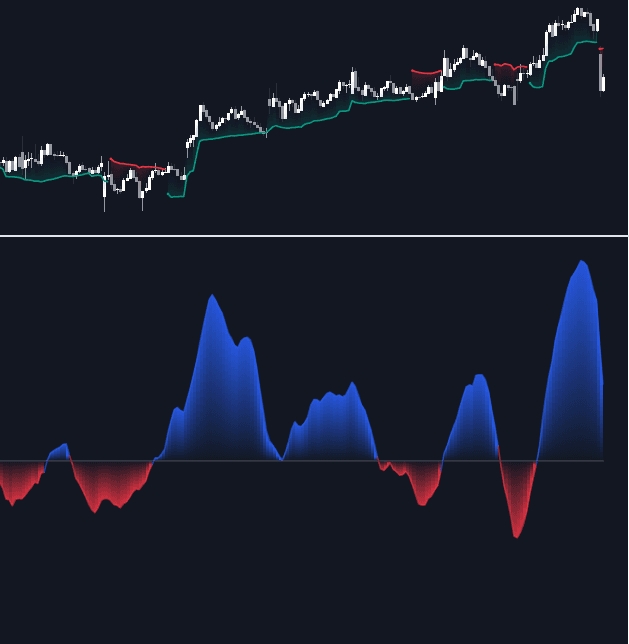
The standard Chandelier Stop indicator
Chandelier Stop exactly as classically defined: the faithful reference build of the original formula, free to run in Quant.
What is a Chandelier Stop?
The chandelier stop, usually called the chandelier exit, is a volatility-scaled trailing stop developed by Chuck LeBeau and popularized by Alexander Elder. For a long position it hangs from the highest high of the lookback: the stop is that high minus a multiple of the Average True Range (ATR); shorts mirror it from the lowest low plus the multiple. A common parameterization uses a 22-bar extreme and 3 ATRs. The name comes from the stop hanging from the price ceiling like a chandelier.
Anchoring to the extreme rather than the close is the distinctive design choice: the stop advances whenever the trend prints a new extreme and gives ground mainly when volatility expands (or when the anchoring extreme ages out of the lookback window). In the raw formula, a rising ATR without a new high lowers a long stop; many implementations therefore add a ratchet so the stop can only tighten. The two behaviors differ meaningfully in volatile pullbacks, so know which one you are running.
LeBeau, co-author of Computer Analysis of the Futures Market and a specialist in exit design, introduced the chandelier exit through his System Traders Club bulletins in the late 1990s. Alexander Elder then featured it, with credit, in Come Into My Trading Room (2002), which carried it to a wide audience. LeBeau's argument: traders overinvest in entries while exits decide outcomes, and a good trailing stop should anchor to the trade's best point and scale by current volatility, tolerating quiet and volatile markets alike without re-tuning.
In practice the chandelier competes with structure-based exits, such as stops beneath swing lows or a broken trendline, and with average-based ones like a close below an EMA. Its edge is that the distance is explicit and volatility-denominated; its cost is indifference to structure: it will happily sit mid-range where structure traders see nothing. It is an exit overlay rather than a complete system: entries typically come from a breakout, a crossover, or a pattern, and double-sided versions that flip at each breach double as a reversal-style regime line.
How to identify the chandelier stop on a chart
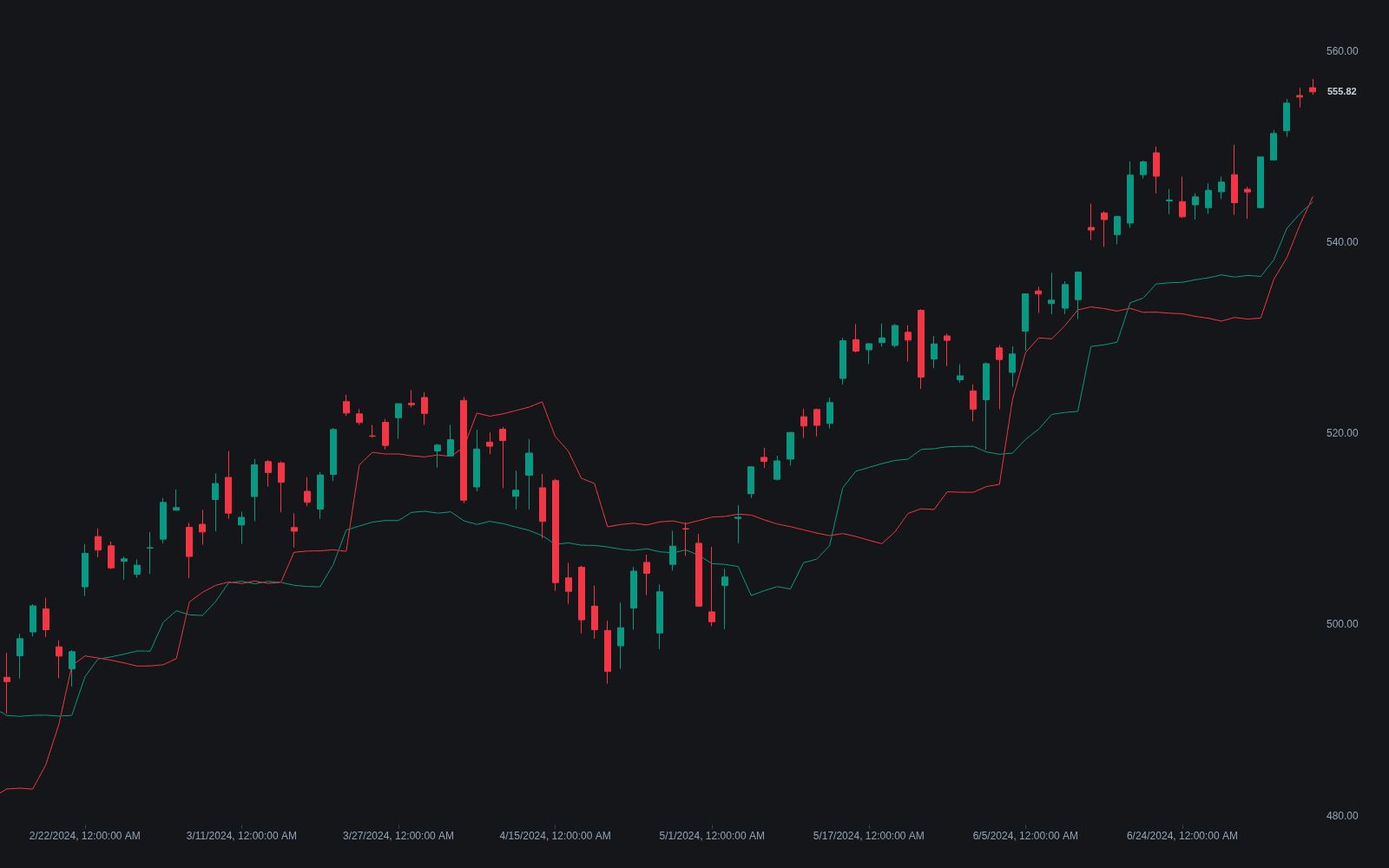
Plotted, the chandelier exit is a stepped line trailing beneath price in uptrends and above it in downtrends.
- 1Apply the indicator with its common defaults and confirm which side of price the active line is on.
- 2Find the anchor: the line sits one ATR multiple below the highest high of the lookback (above the lowest low for shorts), so each new extreme steps it forward.
- 3Treat a close through the line as the event most implementations signal on; double-sided versions flip the plot to the other side of price there.
How it's calculated
The Chandelier stop trails a long position a multiple of ATR below the recent highest high, and a short position the same distance above the recent lowest low.
Chuck LeBeau's original hangs the stop from the highest high (or highest close) since trade entry; the fixed 22-bar lookback is the common charting adaptation.
Many implementations add a ratchet so the long stop never falls and the short stop never rises while the position is open.
How traders use it
- As the exit leg of trend-following systems: the ATR cushion is sized to tolerate ordinary noise while forcing an exit once price gives back a volatility-scaled chunk from the peak; wider multiples exit later, tighter ones get shaken out more often.
- As a continuous bias line: plotted on both sides and flipped on breach, it acts as a volatility-based trend regime label, with price above the long stop read as an intact uptrend.
- As the sizing input: because the initial stop is expressed in ATRs, risk per unit is known up front and slots directly into ATR-denominated position sizing.
- Gated by a trend filter: pairing the exit with an MA slope filter or a moving-average crossover regime keeps flip-style versions from churning in flat markets, as some published variants do.
Chandelier Stop vs other trailing methods
Supertrend: Supertrend also offsets by an ATR multiple, but from the bar midpoint rather than the extreme, with band logic and a built-in ratchet that flips a plotted regime line. The chandelier tracks trend extremes directly and is usually framed as an exit rather than a signal plot.
Dynamic S/R Via MA: Using a moving average as trailing support means the exit distance is whatever gap exists between price and the average, and it shrinks as trends stall. The chandelier's cushion is explicit, peak-anchored, and volatility-scaled, so it does not tighten just because price paused.
MA Envelope: An envelope offsets a moving average by a fixed percentage, so its width ignores volatility changes and its center lags price. The chandelier anchors to the extreme itself and lets ATR set the width, adapting to regime shifts a fixed percentage cannot.
Concept family
Trend
100 concepts mapped · 100 in the Library
Chandelier Stop FAQ
Turn Chandelier Stop into a trading strategy.
Take any implementation from this page into Quant, then build on it, backtest it on real data, and keep refining it in conversation.