Concept
Supertrend
Supertrend is a Trend concept. The Library holds 11 implementations, each one a working definition you can pull into Quant.
Top Supertrend indicators
The top custom implementations, built on the original standard Supertrend formula.
11 total
Want to trade Supertrend? Any of the 11 implementations below is one prompt away from a backtested strategy in Quant.
.png&w=3840&q=75)
.png&w=3840&q=75)
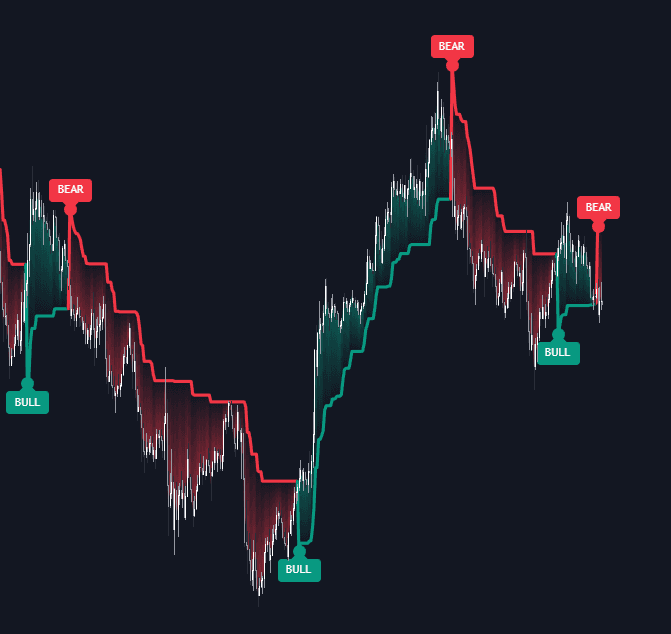
The standard Supertrend indicator
Supertrend exactly as classically defined: the faithful reference build of the original formula, free to run in Quant.
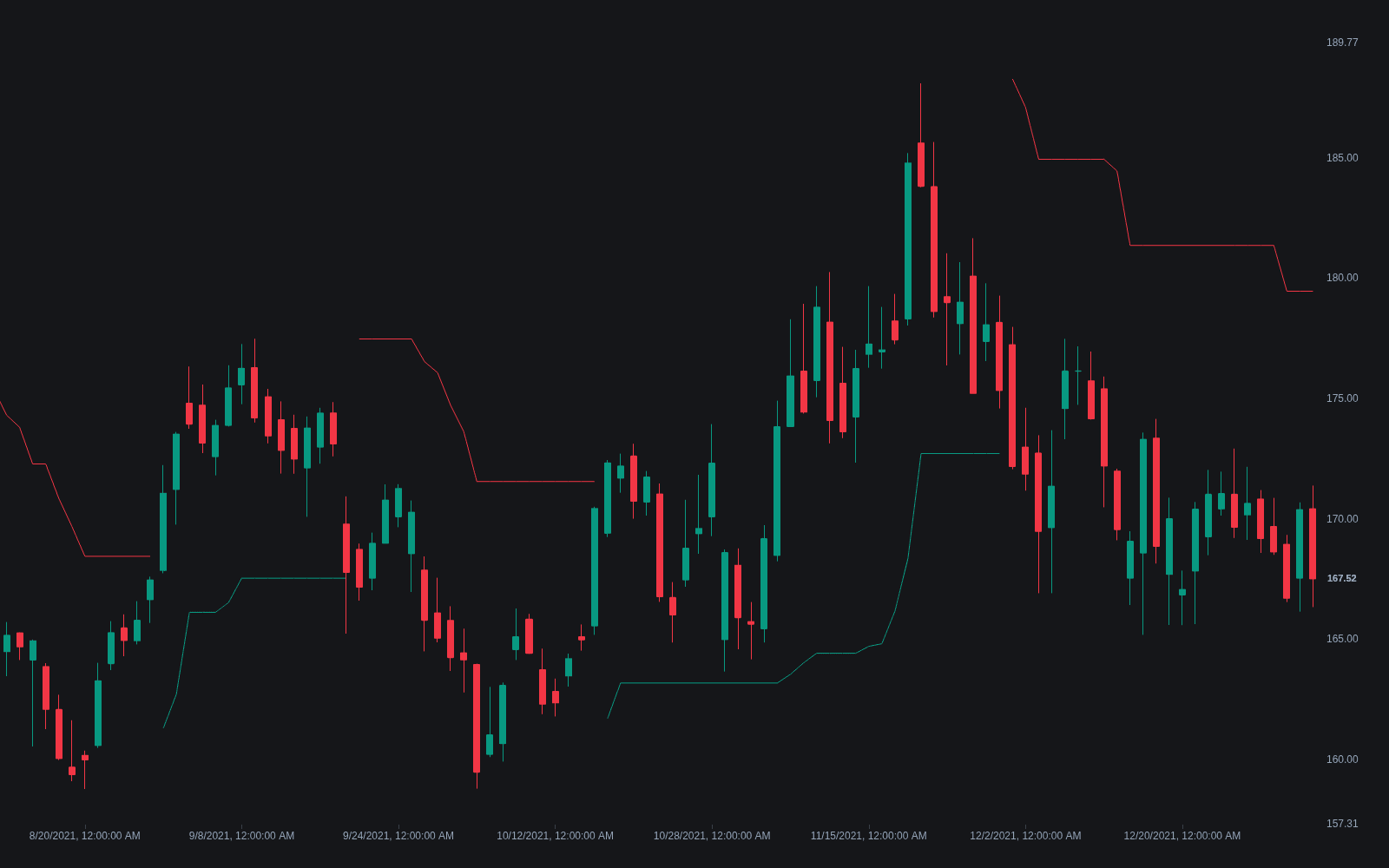
What is Supertrend?
Supertrend is a volatility-trailing overlay that plots a single stop-and-reverse line: below price while the trend state is up, above it while the state is down. It builds bands a fixed multiple of ATR away from the bar midpoint (high plus low, divided by two), then ratchets them so the active band can move toward price but never away from it, until a close through the band flips the state. The common default is a 10-period ATR with a multiplier of 3.
The output is deliberately binary. On every bar the market is either in the up state or the down state, and the line itself doubles as the trailing invalidation level. Because the offset is ATR-based, the line sits wide in volatile conditions and tight in quiet ones, adapting stop distance without a parameter change. The design is commonly credited to French trader Olivier Seban.
Supertrend matters because it compresses three decisions (direction, stop placement, and reversal trigger) into one auditable line, which is why it anchors so many trend-following templates and alert setups. The tradeoff is the one every trailing method inherits: it performs when moves run and bleeds in chop, where alternating flips end up selling range lows and buying range highs.
How to calculate Supertrend
The calculation is a pair of ATR bands with a one-way ratchet:
- 1Compute ATR over the chosen length (commonly 10) and form two basic bands from the bar midpoint: (high + low) / 2 plus multiplier times ATR for the upper band, minus it for the lower (multiplier commonly 3).
- 2Ratchet the active band: in the up state the plotted lower band is the higher of the current basic lower band and the previous plotted band, so it can rise or hold but never fall while price stays above it. The upper band mirrors this logic in the down state.
- 3Flip on a close through the band: a close below the trailing lower band switches the state to down and the plot jumps to the upper band, and vice versa. The opposite band resets from its basic value at the flip.
- 4Read the result: line below price means up state, with the line acting as trailing support; line above price means down state, with the line acting as trailing resistance.
How it's calculated
Supertrend plots a trailing stop line a multiple of ATR away from the bar midpoint, switching sides when price closes through it.
Defaults are n = 10 and m = 3.
The min/max ratchet stops each band from moving against the open trend, which is what makes the line trail price.
Implementations that smooth ATR with an SMA or EMA instead of Wilder's method flip on slightly different bars.
How traders use it
- As a regime filter: take or hold longs only in the up state and shorts only in the down state, often delegating actual entries to pullbacks or breakouts that occur inside that regime.
- As a trailing stop: the line is a ready-made volatility stop that tightens in quiet tape and widens in fast tape, so many traders exit on the flip rather than at a fixed target. The broader trailing method taxonomy shows where it sits among the alternatives.
- As a stop-and-reverse system: because a flip simultaneously closes one side and defines the opposite state, Supertrend supports always-in strategies, with all the range-market whipsaw that implies.
- In multiples: running several Supertrends with different multipliers turns the binary state into a graded one (how many lines agree), while pairing the chart-timeframe line with a higher-timeframe trend filter version suppresses counter-trend flips.
Supertrend vs similar trailing systems
Parabolic SAR: Both are flip-on-cross trailing systems, but Wilder's SAR tightens by an acceleration factor as new extremes print, so time and progress squeeze the stop toward price. Supertrend's distance is repriced from current ATR instead, so it can trail patiently through pauses that would force a SAR flip.
Chandelier Stop: The chandelier hangs a multiple of ATR from the highest high (or lowest low) of a lookback window, while Supertrend offsets from the bar midpoint and ratchets. Both are ATR trails; the chandelier anchors to swing extremes, Supertrend to typical price with an explicit flip convention.
Halftrend: Halftrend builds a similar flip line from moving-average extremes and ATR envelopes. The visual read is nearly identical, a line that swaps sides on trend change, but the trigger logic differs, so the two can disagree precisely in the transition zones where the decision matters.
ATR Trailing Regime: The umbrella category: any stop trailed at a multiple of ATR defines an up/down regime. Supertrend is the most codified member, standardizing the midpoint anchor, the ratchet rule, and the close-through flip.
More Supertrend implementations
Concept family
Trend
100 concepts mapped · 100 in the Library
Supertrend FAQ
Turn Supertrend into a trading strategy.
Take any implementation from this page into Quant, then build on it, backtest it on real data, and keep refining it in conversation.