Concept
NR4/NR7 Narrow-range Bars
NR4/NR7 Narrow-range Bars, also known as ID/NR4, are Volatility concepts. The Library holds 1 implementation, a working definition you can pull into Quant.
Top NR4/NR7 Narrow-range Bars indicator
The top custom implementation, built on the original standard NR4/NR7 Narrow-range Bars formula.
1 total
From studying NR4/NR7 Narrow-range Bars to trading it: take the implementation below into Quant and backtest it instantly.
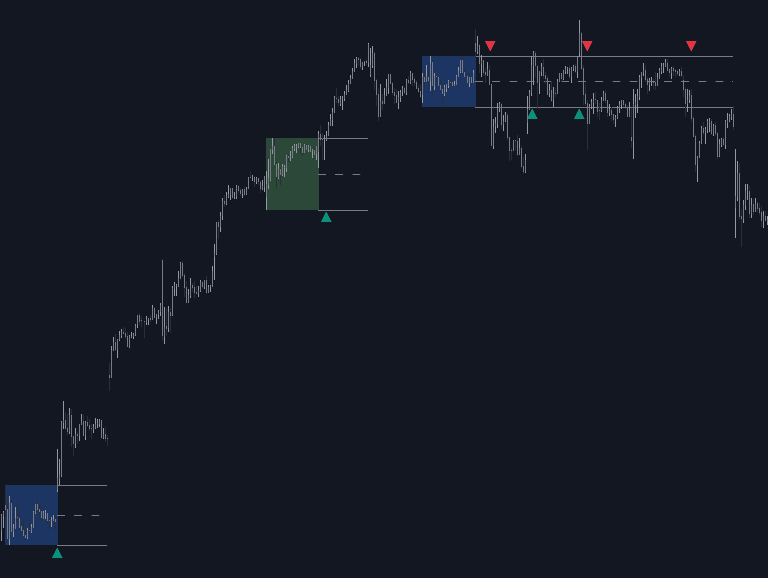
What are NR4/NR7 Narrow-range Bars?
An NR4 bar is a bar whose high-to-low range is the narrowest of the most recent four bars; an NR7 is the narrowest of the most recent seven. The definitions come from Toby Crabel's short-term futures research and are deliberately mechanical: no pattern judgment, just a range comparison, which makes them easy to scan for and to test. The ID/NR4 variant adds the requirement that the bar also be an inside bar, compressing both its range and its position within the prior bar.
The premise is that markets alternate between contraction and range expansion: an unusually narrow bar marks a coiled session that frequently precedes a larger directional bar, so the classic treatment brackets it with entry stops on both sides. Frequently is not always; narrow bars also crowd into dead, choppy tape and ahead of holidays.
The source is one of trading's famous rare books: Crabel's Day Trading with Short Term Price Patterns and Opening Range Breakout, published in 1990, withdrawn by its author, and long traded second-hand at collector prices. Its method was ahead of its era, tabulated statistics for every pattern rather than anecdotes, and its core finding was the alternation principle: contraction begets expansion often enough to build systems on, with the narrow-range flags as the contraction detectors and opening-range breakout logic as the expansion harvester. NR4 and NR7 are the surviving vocabulary of that research program.
Modern practice keeps the flags and adds guards. An absolute-range or ATR floor filters the false economy of dead tape, where every bar is narrow and the flag means nothing; trend filters supply the directional lean the pattern deliberately lacks; and the Library's NR4/NR7 breakout implementation wires the classic bracket automatically. In the volatility toolkit the flags are the single-bar members of a family that scales up through multi-bar squeezes to multi-week bases: same alternation premise, different compression clocks.
How to identify NR4 and NR7 bars
The check is mechanical and works on any timeframe, though the pattern was developed on daily bars.
- 1Measure each bar's full range, high minus low. Wicks count; this is not a body comparison.
- 2Compare the current bar's range with the prior three bars for NR4, or the prior six for NR7. If it is the narrowest of the set, the flag fires.
- 3For ID/NR4, also require an inside bar: the high below the prior bar's high and the low above the prior bar's low.
- 4Mark the narrow bar's high and low. The classic play places entry stops just beyond both sides and exits or reverses at the opposite extreme.
- 5Add an absolute floor: requiring the bar's range to also sit below a fraction of ATR keeps the flag meaningful in already-dead tape, where everything is narrow and nothing is coiled.
How traders use it
- As a breakout trigger: entry stops beyond the narrow bar's high and low, taking whichever side fires first, with the opposite side as the stop or a stop-and-reverse point.
- As a compression gauge: clusters of NR7 flags inside a base signal the tightening that setups like the volatility contraction pattern formalize over longer horizons.
- As session context: day traders often treat an NR7 daily bar as a reason to expect a livelier next session and lean on opening-range logic to trade it.
- With direction borrowed from context: the flag is neutral, so systematic versions take only the bracket side that agrees with a higher-timeframe trend filter, converting a two-sided coin flip into a one-sided continuation entry.
- Screened at scale: because the definition is pure arithmetic, NR7 scans across whole watchlists surface the day's coiled candidates, with the ID/NR4 variant as the stricter cut when the list runs long.
Narrow-range bars vs related compression reads
Volatility Contraction Pattern: The VCP is compression at campaign scale: successively tighter pullbacks across weeks inside a base. NR4/NR7 is compression at bar scale, one session's coil. They nest naturally, with NR7 flags appearing in a VCP's final tightening, but they answer different-horizon questions.
Bollinger Squeeze: The squeeze measures compression statistically, band width at a long-lookback low, a regime condition that can persist for weeks. The NR flags are events: this specific bar is the narrowest of its set. Regime tells you the market is coiling; the bar flag nominates tonight's bracket.
Inside Bar: The inside bar compresses position, held within the prior bar's range; NR bars compress size, the narrowest range of the set. ID/NR4 demands both at once, which is why it is the rarest and, in Crabel's framing, the most loaded of the family.
Concept family
Volatility
57 concepts mapped · 57 in the Library
NR4/NR7 Narrow-range Bars FAQ
Turn NR4/NR7 Narrow-range Bars into a trading strategy.
Take the implementation from this page into Quant, then build on it, backtest it on real data, and keep refining it in conversation.