Swing Breakout Sequence
Swing Breakout Sequence, also known as SBS, is a Market Structure concept. The Library holds 1 implementation, a working definition you can pull into Quant.
Top Swing Breakout Sequence indicator
The top custom implementation, built on the original standard Swing Breakout Sequence formula.
1 total
The Swing Breakout Sequence implementation below can become a backtested trading strategy — describe your rules and Quant writes the code.
What is the Swing Breakout Sequence (SBS)?
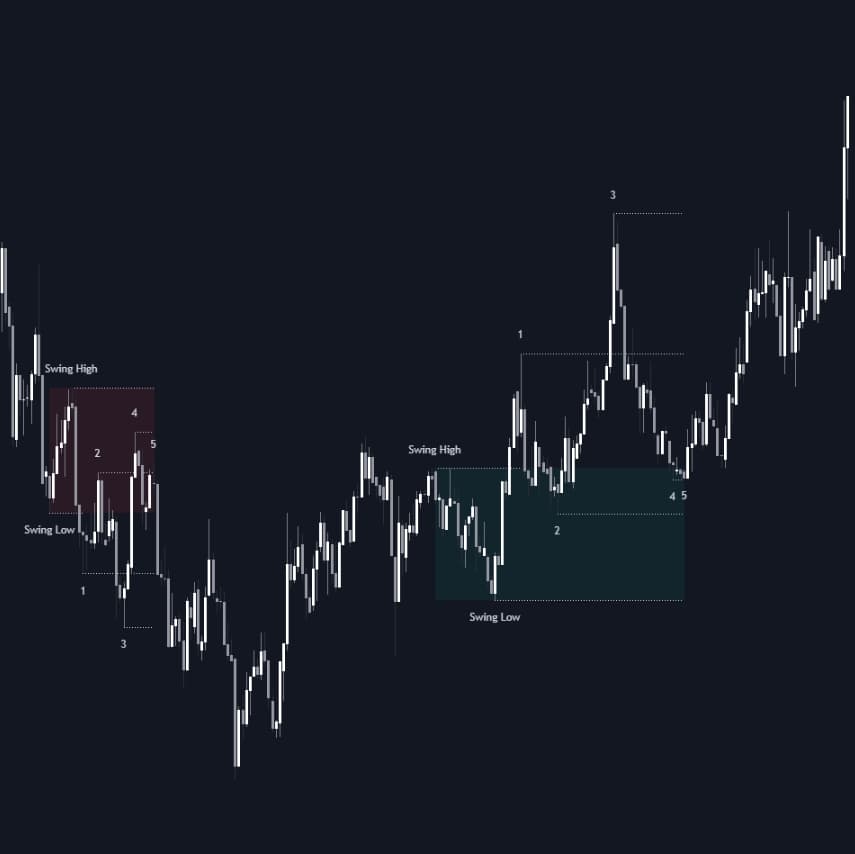
The Swing Breakout Sequence (SBS) is a five-point setup built around a swing zone, the range between a swing high and the swing low after it. Price breaks out of the zone twice and falls back inside both times, the second pullback reaching deeper into the liquidity left by the first, and a reversal structure there anticipates a third, decisive break in the original direction.
The logic is trapped positioning. In the bullish case, buyers of the first two breakouts are under water by point 4, and the pullback beneath point 2 runs their stops, a liquidity sweep inside the zone. Once that liquidity is taken and a double bottom holds, a break of structure beyond point 3 confirms the third attempt.
SBS is a niche retail model from Smart Money Concepts-adjacent communities with no canonical source, and community scripts define it with five or six points that differ in detail. Clean sequences are far easier to spot in hindsight than live, and the third break is a scenario, not an obligation.
How to identify a Swing Breakout Sequence
The bullish sequence is described; mirror it for a bearish SBS.
- 1Define the swing zone from a confirmed swing high and the swing low after it.
- 2Point 1 breaks above the zone; point 2 pulls back inside it.
- 3Point 3 makes a higher high beyond point 1 and also fails, pulling back into the zone.
- 4Point 4 reaches deeper, ideally below point 2, sweeping the stops of the breakout buyers.
- 5Point 5, an equal low or similar reversal at point 4, completes the setup; invalidation sits below point 4.
How traders use it
- As a scalping entry: positions are taken at point 5 with the stop beyond point 4, targeting the zone high and then a break through point 3.
- In tooling: LuxAlgo's Swing Breakout Sequence detects the zone and all five points from swing and internal pivots, boxes and labels them, and can require point 4 beyond point 2 and an equal high or low at point 5 within an ATR-scaled threshold.
Swing Breakout Sequence vs related structure
False Breakout: A false breakout is a single failed break. SBS strings two of them together inside one zone and trades the third attempt rather than the failure.
Liquidity Sweep: The sweep is one step of the sequence, point 4 running the liquidity under point 2. SBS is the whole campaign around it.
Breakout-pullback-continuation: Break, retest, continue in one pass. SBS expects the first two breaks to fail back into the zone before the continuation comes.
Concept family
Market Structure
33 concepts mapped · 33 in the Library
Swing Breakout Sequence FAQ
Turn Swing Breakout Sequence into a trading strategy.
Take the implementation from this page into Quant, then build on it, backtest it on real data, and keep refining it in conversation.