Bar Counting H1/H2
Bar Counting H1/H2, also known as H1/H2, L1/L2, High 2, Low 2, is a Market Structure concept. The Library holds 1 implementation, a working definition you can pull into Quant.
Top Bar Counting H1/H2 indicator
The top custom implementation, built on the original standard Bar Counting H1/H2 formula.
1 total
Want to trade Bar Counting H1/H2? The implementation below is one prompt away from a backtested strategy in Quant.
What is Bar Counting (High 1/High 2, Low 1/Low 2)?
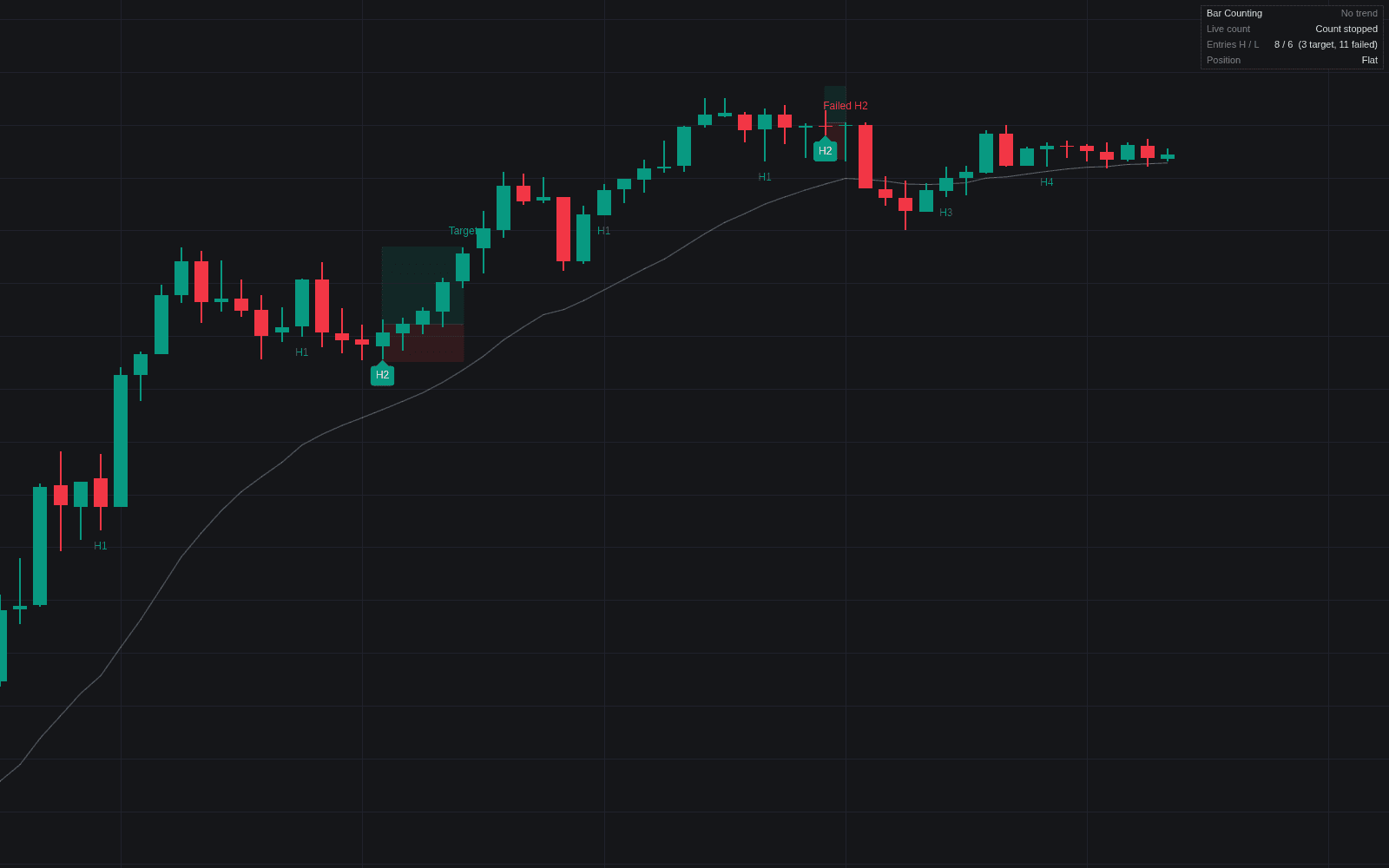
Bar counting is Al Brooks' method of numbering the attempts a pullback makes to end. In a bull trend pullback, each bar whose high rises above the prior bar's high is an attempt to resume the trend: the first is a High 1 (H1), and if the pullback continues lower and a later bar again trades above its prior bar's high, that is a High 2 (H2). Rallies in a bear trend are counted the same way with lows, as Low 1 (L1) and Low 2 (L2). The bar that sets up an attempt is the signal bar, and the standard entry is a stop order one tick beyond it.
The count exists because pullbacks often come in two legs. Brooks teaches that the first attempt to resume a trend frequently fails, so the second attempt (an H2 in a bull trend, an L2 in a bear trend) is commonly the better entry: the correction has had both legs, often an ABC shape, and traders who bet against the trend on the failed first attempt are trapped when the second one triggers. In strong trends, pullbacks are shallow and H1 or L1 entries work; in weaker trends and in trading ranges, traders wait for the second entry.
The count extends and resets. A third attempt is a High 3 or Low 3, which Brooks associates with wedge flags (three pushes); by a fourth, the pullback has lasted long enough to question the trend itself. The count restarts when the trend makes a new extreme, and a failed H2 or L2 (triggered, then broken through the signal bar's other end) is information in its own right, often a sign of a range or a reversal. The method runs through Brooks' Reading Price Charts Bar by Bar (Wiley, 2009) and his three-volume Trading Price Action series.
How to count H1 and H2 in a bull pullback
Count bars, not swings; the L1/L2 count in a bear rally mirrors every step using lows.
- 1Start in a bull trend: higher highs, with price holding above a rising moving average (Brooks uses the 20-bar exponential moving average).
- 2Wait for the pullback: one or more bars with lower highs.
- 3The first bar whose high exceeds the prior bar's high is the High 1. If the pullback then resumes with lower highs, keep counting.
- 4The next bar whose high exceeds the prior bar's high is the High 2. The entry is a buy stop one tick above the H2 signal bar, with the protective stop below that bar or below the pullback low.
- 5Continue to H3 and H4 if needed, and reset the count when price makes a new trend high.
How traders use it
- As second-entry timing: in a pullback to the moving average, traders skip the H1 and wait for the H2, accepting a later entry in exchange for a completed two-legged correction.
- As a strength gauge: a trend in which H1s keep working is strong; one that needs H2s, H3s and wedges to resume is weakening.
- Inside trading ranges: H2 buys near the range low and L2 sells near the range high are standard setups, because ranges reward second attempts at their extremes and punish breakouts.
- With the rest of Brooks' vocabulary: counts are read alongside spikes, channels and final flags, where a late-trend second entry that fails can mark the end of the trend.
Bar counting vs related concepts
Pullback: A pullback is the counter-trend move itself. Bar counting is a way of timing its end, numbering the bar-by-bar attempts to resume the trend.
Corrective Leg: The corrective leg is the structural segment between impulses. Bar counting subdivides it into attempts and treats the second as the common end of a two-legged correction.
Two-bar Reversal: A two-bar reversal is a specific reversal shape. An H2 or L2 can form from many bar shapes; it is defined by its place in the count, not by its own anatomy, though a strong reversal bar makes a better signal bar.
Concept family
Market Structure
33 concepts mapped · 33 in the Library
Bar Counting H1/H2 FAQ
Turn Bar Counting H1/H2 into a trading strategy.
Take the implementation from this page into Quant, then build on it, backtest it on real data, and keep refining it in conversation.