Concept
Wolfe Waves
Wolfe Waves are Chart & Candlestick Patterns concepts. The Library holds 1 implementation, a working definition you can pull into Quant.
Bill Wolfe
Top Wolfe Waves indicator
The top custom implementation, built on the original standard Wolfe Waves formula.
1 total
The Wolfe Waves implementation below can become a backtested trading strategy — describe your rules and Quant writes the code.
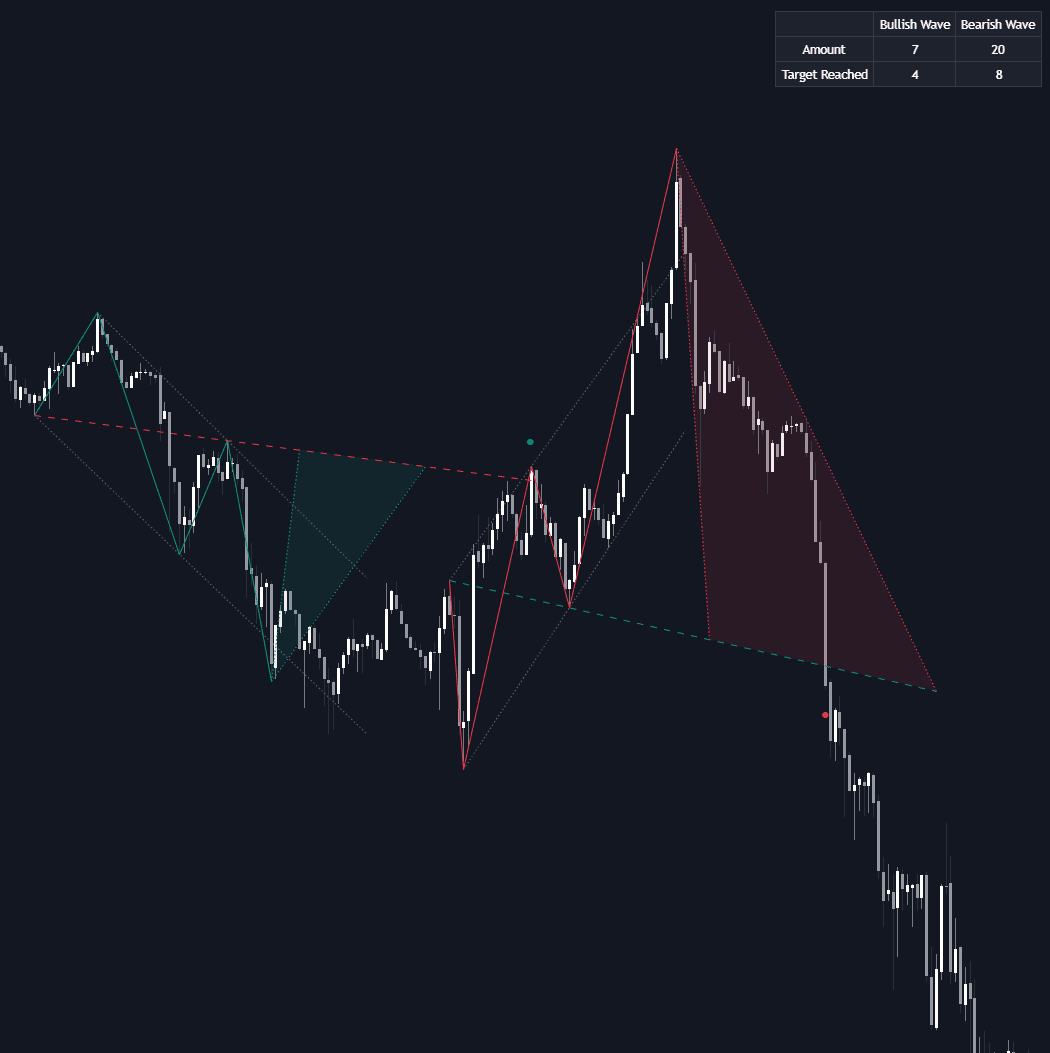
What are Wolfe Waves?
Wolfe Waves are a five-point reversal pattern developed by Bill Wolfe, built from swing points labeled 1 through 5 inside a converging channel. In the bullish case, 1 is a swing low, 2 a high above it, 3 a low beneath 1, 4 a high beneath 2, and 5 a final undercut that breaks the trendline drawn through points 1 and 3, often overshooting it into what practitioners call the sweet zone. That terminal break behaves like a false breakout: the final flush takes out stops in the very area where the pattern looks for the turn.
What separates it from a generic falling wedge is the projection. The target is not a fixed level but the EPA line (estimated price at arrival), drawn from point 1 through point 4 and extended forward; some practitioners also estimate timing, the ETA, from the intersection of the extended 1-3 and 2-4 lines. Wolfe emphasized symmetry, preferring waves of similar duration and slope, and strict point selection is what separates a tradable wave from wishful line drawing.
Wolfe, who taught the pattern from the 1990s onward through course materials, framed it on the intuition that every action has an equal and opposite reaction: waves 1 through 4 wind the spring, wave 5's overshoot is the action, and the travel back toward the 1-4 line is the reaction to ride. The idea spread through forums and books in the 2000s; practitioners differ on exact point rules while agreeing on the five-touch converging skeleton and the sloping target.
The skeleton is kin to other converging formations such as the ascending, descending or symmetrical triangle, and the wave-5 flush often ends with recognizable bar behavior: a wide-range bar through the 1-3 line, a pin bar rejecting the sweet zone, or a two-bar reversal back inside the channel; the pattern adds a plan, defined invalidation beyond the overshoot and a target that moves with time.
How to identify Wolfe Waves
Wolfe Waves are drawn rather than detected from a single bar: the construction is the identification. The steps below describe the bullish case; the bearish case mirrors every rule.
- 1Locate a converging swing sequence: low 1, high 2, lower low 3, lower high 4, with the 1-3 and 2-4 trendlines narrowing toward each other.
- 2Check symmetry: Wolfe's guidelines prefer waves of similar duration and slope, so wildly uneven legs disqualify the count.
- 3Wait for point 5: price breaks the 1-3 trendline, often overshooting into the sweet zone, then stalls. This break is the trigger, not the earlier touches.
- 4Demand confirmation at 5: a reversal bar such as a hammer or bullish engulfing closing back inside the 1-3 line distinguishes a sweet-zone rejection from a channel that simply broke down.
- 5Project the exit: draw the EPA line from point 1 through point 4 and extend it forward as the target; optionally estimate timing from where the extended 1-3 and 2-4 lines intersect.
How traders use it
- As a countertrend entry at point 5: taken on the break or overshoot of the 1-3 trendline, with the stop beyond the sweet-zone extreme.
- As a moving target: profit is measured against the sloping 1-4 EPA line as of when price reaches it, so the objective drifts with time rather than sitting at one fixed price.
- As a filter on wedge-shaped reversals: only structures with five clean, roughly symmetric touches qualify, which discards most casual channel drawings.
- As a mirror image: the bearish count flips every relation (high 1, low 2, higher high 3, higher low 4, overshoot above the 1-3 line at point 5) and is traded short with identical logic, often where a final high overthrows a prior high near double top structures.
Wolfe Waves vs other converging patterns
Rising/falling Wedge: A wedge is traded on the break, whichever way it comes, with a target projected from its height. A Wolfe Wave requires a specific five-touch count, enters against the terminal overshoot, and projects to the sloping 1-4 line.
Ascending/descending/symmetrical Triangle: Triangles are usually continuation structures resolved by breakout, with loose touch counts and a fixed measured move. The Wolfe count is stricter, the trade is countertrend at point 5, and the objective drifts with time.
Double Top/bottom: A double top or bottom is defined by two roughly equal horizontal extremes and a neckline, with a fixed measured target. A Wolfe Wave is built from five converging swings; when wave 5 undercuts wave 3 it can resemble a failed double bottom, exactly the trap the pattern tries to exploit.
Concept family
Chart & Candlestick Patterns
84 concepts mapped · 84 in the Library
Wolfe Waves FAQ
Turn Wolfe Waves into a trading strategy.
Take the implementation from this page into Quant, then build on it, backtest it on real data, and keep refining it in conversation.