Concept
Optimal Trade Entry
Optimal Trade Entry, also known as OTE, 62–79% retracement, IOFED, is a Smart Money Concepts / ICT concept. The Library holds 1 implementation, a working definition you can pull into Quant.
Top Optimal Trade Entry indicator
The top custom implementation, built on the original standard Optimal Trade Entry formula.
1 total
Want to trade Optimal Trade Entry? The implementation below is one prompt away from a backtested strategy in Quant.
What is Optimal Trade Entry?
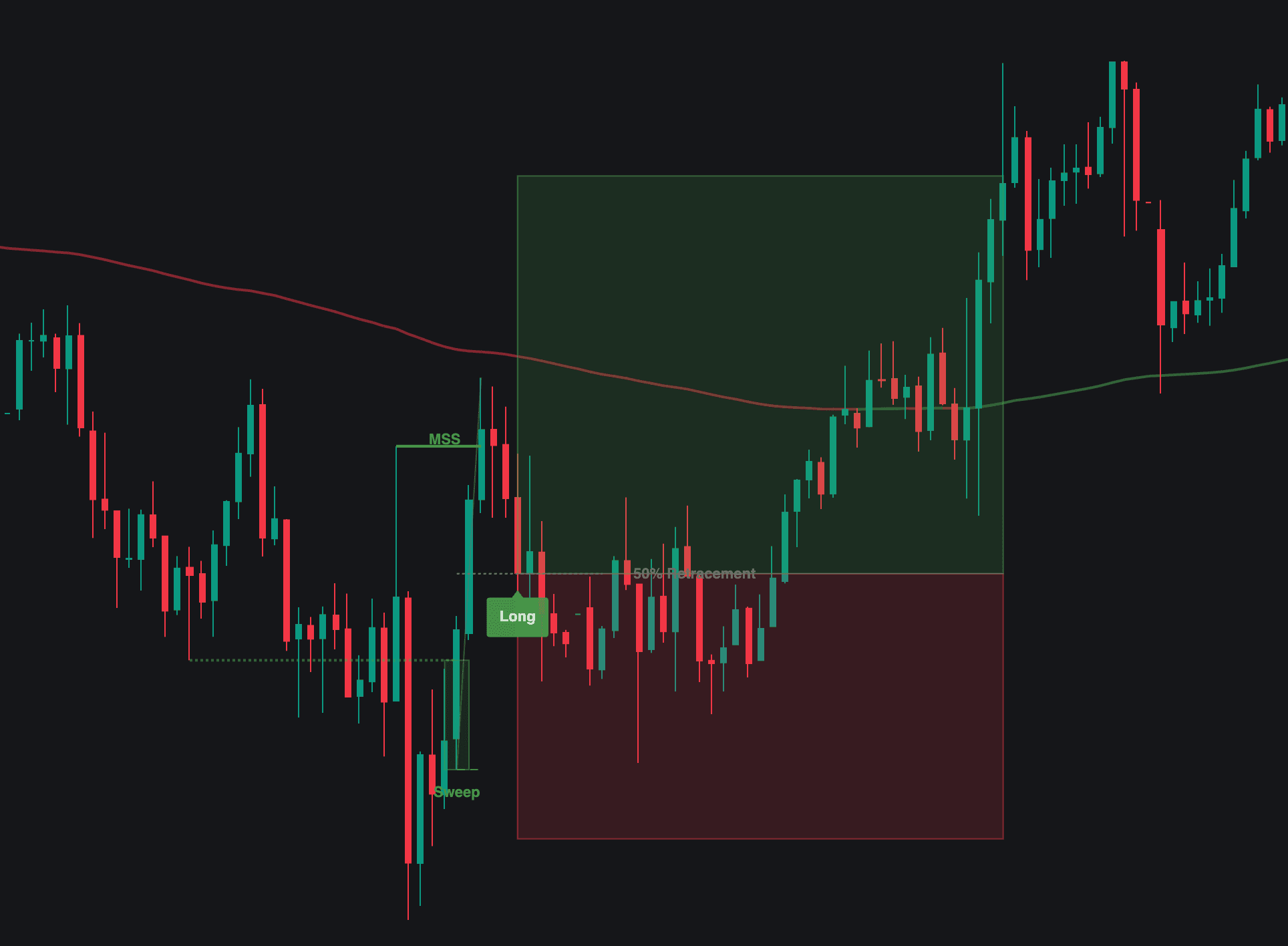
Optimal trade entry is the ICT name for a specific retracement band: the span between the 61.8% and 79% pullback of an impulse leg, with 70.5% (the midpoint) often marked as the sweet spot. After a displacement, a Fibonacci retracement is anchored across the leg (swing low to swing high for longs), and the OTE band is where entries are hunted: deep enough that the stop beyond the swing origin stays close, early enough that the leg's continuation is still ahead.
The band operationalizes premium and discount: for longs it sits well below the leg's equilibrium, so the entry is taken at a discount rather than a chase. In ICT practice OTE is not a standalone signal: the standard sequence is liquidity taken, structure shifted, then a retracement into the band, ideally into a PD array (an order block or gap) that overlaps it. The ratios themselves have no mechanical force; the zone is a place to look for evidence, and price is under no obligation to reach it or to hold there.
How to mark an optimal trade entry zone
OTE is a measurement rather than a pattern, so identifying it well is mostly about choosing the right leg to measure.
- 1Pick the impulse leg: a displacement that breaks structure in the intended direction, with an unambiguous swing low and swing high. A drifting, overlapping move is not an impulse, and measuring one produces a meaningless band.
- 2Anchor the Fibonacci retracement across the leg: swing low to swing high for longs, swing high to swing low for shorts.
- 3Mark the band between the 0.62 and 0.79 retracement levels; many templates add 0.705 as the midline. The band, not any single ratio, is the OTE zone.
- 4Decide in advance what counts as an entry there. A resting limit at 0.705 and a confirmation entry after a lower-timeframe structure shift are both common, and they are different trades with different failure modes.
How it's calculated
An entry zone spanning the 62% to 79% retracement of an impulsive price leg, with 70.5% as its midpoint.
0.62, 0.705 and 0.79 are the ICT convention; classical Fibonacci tools use 0.618 and 0.786 for the same band.
The zone is only evaluated after the leg completes and price retraces into it; a move beyond the leg's origin invalidates the setup.
How traders use it
- As the entry framework after displacement: instead of buying the breakout, anchor the retracement on the leg that broke structure and wait for price to return into 0.62–0.79, treating the pullback as the trade rather than the move that already happened.
- As a confluence filter, the band carries more weight when something independent sits inside it: an order block, a fair value gap, or a session level inside 0.62–0.79 turns a generic pullback into a stacked location, and many models require that overlap before the zone is tradeable.
- As a risk template. The stop goes beyond the swing that anchors the measurement, and classic templates project targets from the same tool: the swing itself first, then extension levels beyond it. The depth of the entry is what makes the arithmetic work: the same trade taken at a 38% pullback carries a far wider stop relative to its target.
- As a filter on when to trust the measurement: the textbook sequence puts a liquidity sweep and a structure shift before the retracement, so an OTE tag inside an untouched, still-ranging market is treated as a much weaker setup than one that follows a stop run.
OTE vs. other retracement zones
Fib Retracement: The general tool. A Fibonacci retracement is any set of ratio levels drawn across a swing; OTE is one specific band of it (0.62 to 0.79) plus rules about which legs deserve to be measured at all.
Golden Pocket: Narrower and shallower: 0.618–0.65. The golden pocket is a general-purpose pullback zone, while OTE extends deeper to 0.79 and conventionally requires a prior sweep and structure shift before it counts as a setup. A pullback can tag the golden pocket while barely entering the OTE band.
Premium & Discount: The parent framework. Premium/discount splits a range at its 50% equilibrium and asks only which half price is in; OTE is a precise slice deep in the discount (for longs) where the entry is taught as optimal rather than merely acceptable.
Concept family
Smart Money Concepts / ICT
54 concepts mapped · 54 in the Library
Optimal Trade Entry FAQ
Turn Optimal Trade Entry into a trading strategy.
Take the implementation from this page into Quant, then build on it, backtest it on real data, and keep refining it in conversation.