Concept
Gann Square-of-9 Levels
Gann Square-of-9 Levels, also known as Gann anniversaries, are Support/Resistance & Levels concepts. The Library holds 1 implementation, a working definition you can pull into Quant.
Top Gann Square-of-9 Levels indicator
The top custom implementation, built on the original standard Gann Square-of-9 Levels formula.
1 total
The Gann Square-of-9 Levels implementation below can become a backtested trading strategy — describe your rules and Quant writes the code.
What are Gann Square-of-9 Levels?
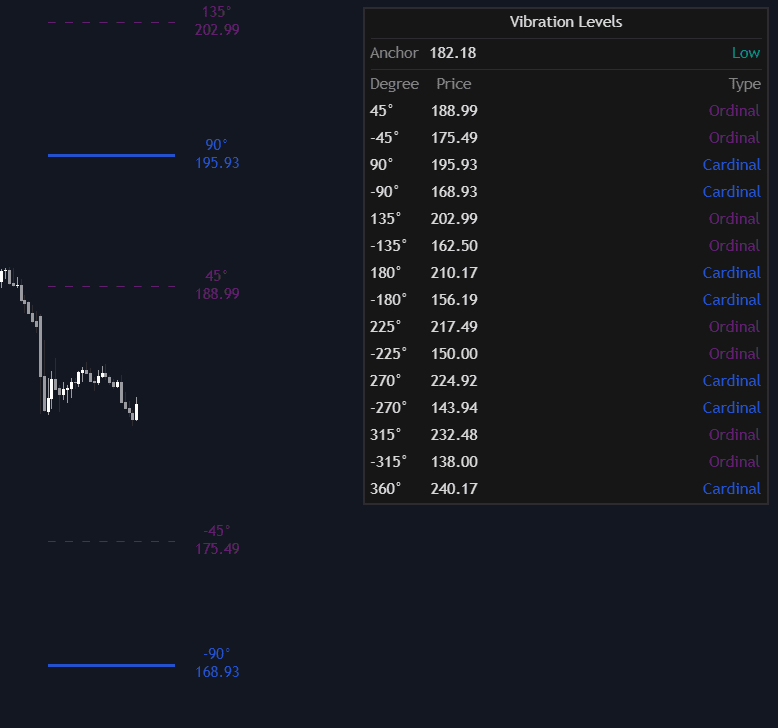
Gann Square-of-9 levels are horizontal support and resistance prices projected from W.D. Gann's Square of 9, a spiral of integers winding outward from 1 so that each full loop returns to the same angle at a higher number. Prices falling on the same spoke of the wheel are treated as harmonically related, and the spokes at the cardinal and diagonal angles supply the levels. The arithmetic is a square-root transform: take the square root of a significant pivot price, add or subtract a fixed increment, and square the result. An increment of 2 corresponds to a full 360-degree rotation, 1 to 180 degrees, 0.5 to 90, and 0.25 to 45, which also means the spacing between levels widens as price rises, following the square root of price.
The projections descend from Gann's course materials and calculators of the early twentieth century, but their modern life is software-driven: charting platforms compute the rotations instantly, which turned a laborious wheel-reading exercise into a routine overlay, often labeled vibration levels. The alias Gann anniversaries covers the time-based half of the same idea: dates a quarter, half, or full year from major highs and lows are watched as candidate turn windows, the same instinct that drives Fib time tools.
Because traded prices come in every magnitude, practitioners first rescale the input to a convenient size (a convention, not mathematics: 1.2345 might be worked as 12345). None of this asserts a market mechanism. Unlike option strike walls, where hedging flows give levels a documented reason to matter, a Square-of-9 rung has no known force behind it beyond the traders watching it, so the levels deserve attention only where price demonstrably reacts to them.
Within the wider family of level frameworks, the distinguishing features are the single anchor and the square-root spacing. Session formulas such as floor pivots rebuild their ladders from each prior period's high, low, and close, and a Fibonacci retracement needs a swing's two endpoints; the Square of 9 needs one price and produces rungs whose absolute spacing widens as price climbs. In use they all converge on the same discipline: projected prices are hypotheses, and level interaction rules decide which ones graduate into trades.
How to calculate Gann Square-of-9 levels
The wheel itself is rarely drawn in practice; the levels come from a square-root transform that works on any calculator.
- 1Choose a significant anchor price, usually a major swing high or low, and rescale it to a convenient magnitude if needed (for example treat 1.2345 as 12345, or 0.0475 as 475).
- 2Take the square root of the scaled price.
- 3Add or subtract the rotation increment: 0.25 for 45 degrees, 0.5 for 90, 1 for 180, and 2 for a full 360-degree rotation. Adding projects levels above the anchor, subtracting projects below.
- 4Square the result and undo the scaling. Repeat with larger increments to ladder several rotations, keeping in mind that level spacing widens as price rises.
- 5Audit before trusting: overlay the ladder on past data and keep it only if swings repeatedly turned near its rungs without prompting; a grid the market has ignored is a grid to discard.
How it's calculated
Square-of-9 levels are prices reached by rotating around Gann's number spiral, where one full 360-degree turn adds 2 to the square root of price.
45-degree steps are the most common angle set; 90, 180, and 360 degrees add 0.5, 1, and 2 to sqrt(price) respectively.
The time counterpart, Gann anniversaries, applies the same rotations to calendar days from a pivot date, one full turn being roughly a year (360 degrees against 365 days).
Scaling conventions vary by market and author; there is no single canonical rule for choosing m.
How traders use it
- To build a static ladder: project quarter, half, and full rotations above and below a major swing high or low, then treat those prices like any other untested levels, requiring an actual reaction before trading them.
- For confluence: a rotation landing on an independently derived level, such as a Fibonacci retracement or a prior high, earns more weight than a rotation in isolation.
- For timing: watch anniversary dates counted from significant pivots as candidate turn windows, again demanding price confirmation rather than trading the calendar blind.
- With interaction rules: define in advance what counts as a reaction at a rung (a rejection wick, a failed retest, acceptance beyond it), so a support level or resistance level generated by the wheel is traded by the same standards as any other level.
- Alongside session references: rotations that coincide with period opens or prior period levels form the shortlist, while isolated rungs stay on the watch list until price proves them.
Gann Square-of-9 Levels vs other level frameworks
Fib Retracement: Retracements scale ratios across a chosen swing's range, so they need two anchors and live inside that swing. Square-of-9 rungs grow from one anchor by square-root steps and extend indefinitely above and below it.
Floor Pivots: Floor pivots rebuild each session from the prior period's high, low, and close, so the map refreshes on schedule. A Square-of-9 ladder is static until the analyst re-anchors it.
Camarilla: Camarilla also derives from the prior day's range but is tuned for intraday mean reversion around its inner rungs. Square-of-9 levels carry no session logic and no preferred trading style.
Fibonacci Pivots: Fibonacci pivots splice ratio spacing onto the pivot formula's period-refreshed base, a hybrid of the two ideas. The Square of 9 replaces both range and ratios with square-root arithmetic from a single price.
Concept family
Support/Resistance & Levels
38 concepts mapped · 38 in the Library
Gann Square-of-9 Levels FAQ
Turn Gann Square-of-9 Levels into a trading strategy.
Take the implementation from this page into Quant, then build on it, backtest it on real data, and keep refining it in conversation.