Concept
DeMark Pivots
DeMark Pivots are Support/Resistance & Levels concepts. The Library holds 1 implementation, a working definition you can pull into Quant.
Top DeMark Pivots indicator
The top custom implementation, built on the original standard DeMark Pivots formula.
1 total
The DeMark Pivots implementation below can become a backtested trading strategy — describe your rules and Quant writes the code.
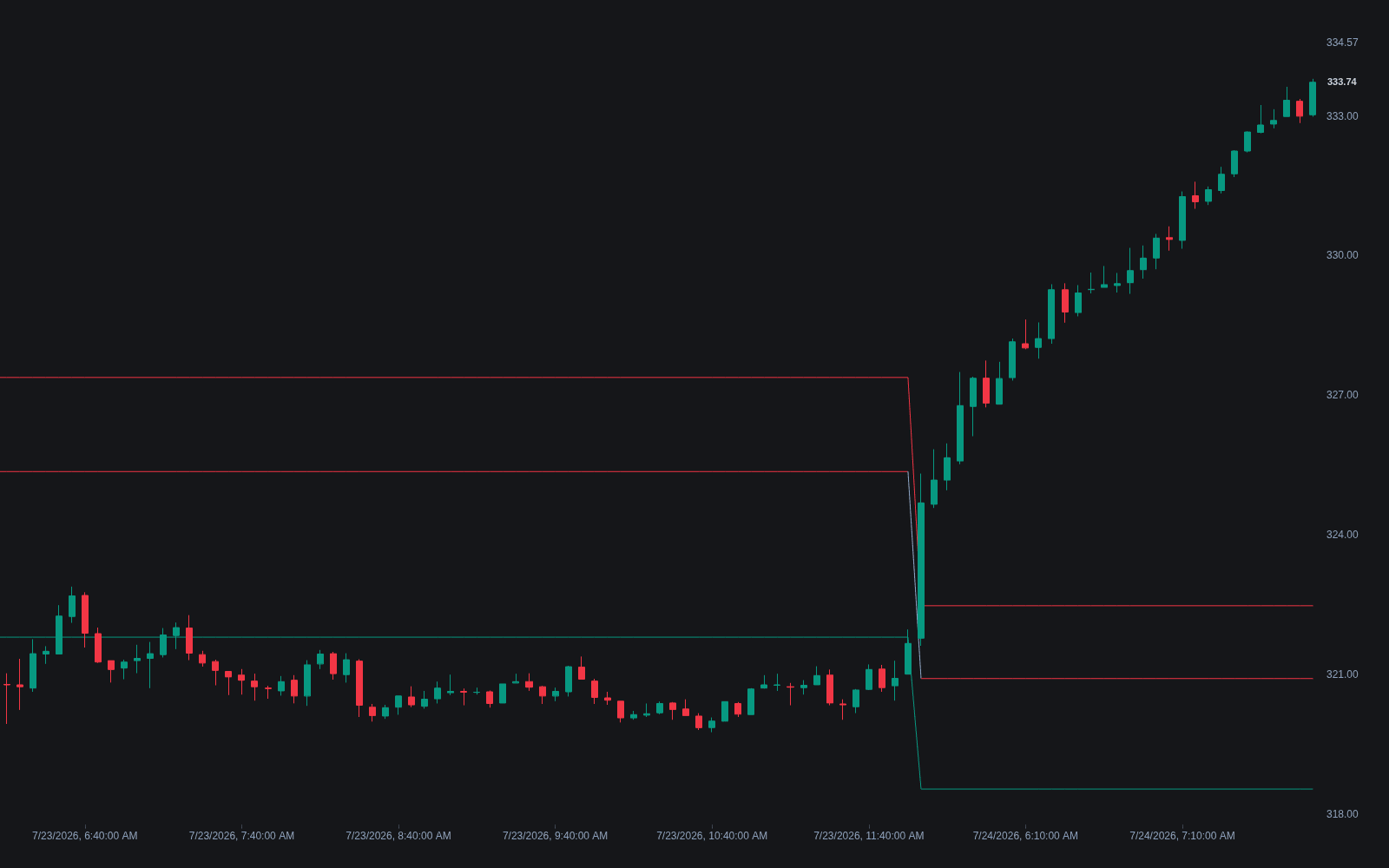
What are DeMark pivots?
DeMark pivots are a conditional pivot system attributed to Tom DeMark, the analyst also known for TD Sequential and the wider TD study family. Unlike the classic floor formula, which always averages the prior high, low, and close the same way, the DeMark version first asks how the prior session closed relative to its open and then weights the inputs differently in each case. The output is deliberately sparse: a reference pivot plus one projected resistance and one projected support, rather than a full ladder of rungs.
The conditional weighting is the distinctive idea. A session that closed below its open gets extra weight on the low, a session that closed above its open gets extra weight on the high, and a flat session weights the close. The system therefore encodes a simple directional read of the prior session into the levels themselves, tilting the projected range in the direction of the prior day's pressure.
Traders care about DeMark pivots for the same reasons as the rest of the pivot point family: the levels are objective, computed before the session opens, and identical for everyone using the same session data. The single R1 and S1 keep charts clean, at the cost of offering no deeper targets once the first level breaks.
How it's calculated
The intermediate value X is chosen by the prior session's open-close relationship, then converted into the levels.
Some platforms plot only R1 and S1 and omit PP, since DeMark's own presentation emphasized the projected high and low.
As with all pivots, the session definition (regular hours versus 24-hour) changes the inputs and therefore the levels.
How traders use it
- As a projected daily range: R1 and S1 are read as tomorrow's estimated high and low, giving intraday traders a pre-session envelope for fading extremes or framing breakout trades.
- As a bias cue: because the weighting tilts with the prior session's direction, price opening beyond the DeMark pivot in the tilted direction is often read as continuation pressure.
- For clean targeting: with only one level per side, the system suits traders who want a single reference above and below rather than a dense grid, though it offers nothing once R1 or S1 gives way.
- In comparison work: some traders run DeMark levels alongside floor pivots and pay attention where the two systems agree, treating overlap as stronger reference.
- With honest expectations: the conditional weighting is a heuristic, and there is no rigorous public evidence that DeMark pivots contain price better than other pivot variants.
DeMark pivots vs other pivot systems
Floor Pivots: Floor pivots use one unconditional formula and produce up to three rungs per side; DeMark pivots branch on the prior open-close relationship and produce a single projected high and low.
Camarilla: Camarilla emphasizes tight inner levels (H3/L4) designed for fading moves within the prior range; DeMark pivots instead estimate the coming session's range boundaries with directional weighting.
Fibonacci Pivots: Fibonacci pivots scale the prior range by fixed ratios around a standard pivot; DeMark's system changes the pivot itself based on how the prior session closed.
Concept family
Support/Resistance & Levels
38 concepts mapped · 38 in the Library
DeMark Pivots FAQ
Turn DeMark Pivots into a trading strategy.
Take the implementation from this page into Quant, then build on it, backtest it on real data, and keep refining it in conversation.