Concept
Monday Range
Monday Range is a Support/Resistance & Levels concept. The Library holds 1 implementation, a working definition you can pull into Quant.
Top Monday Range indicator
The top custom implementation, built on the original standard Monday Range formula.
1 total
The Monday Range implementation below can become a backtested trading strategy — describe your rules and Quant writes the code.
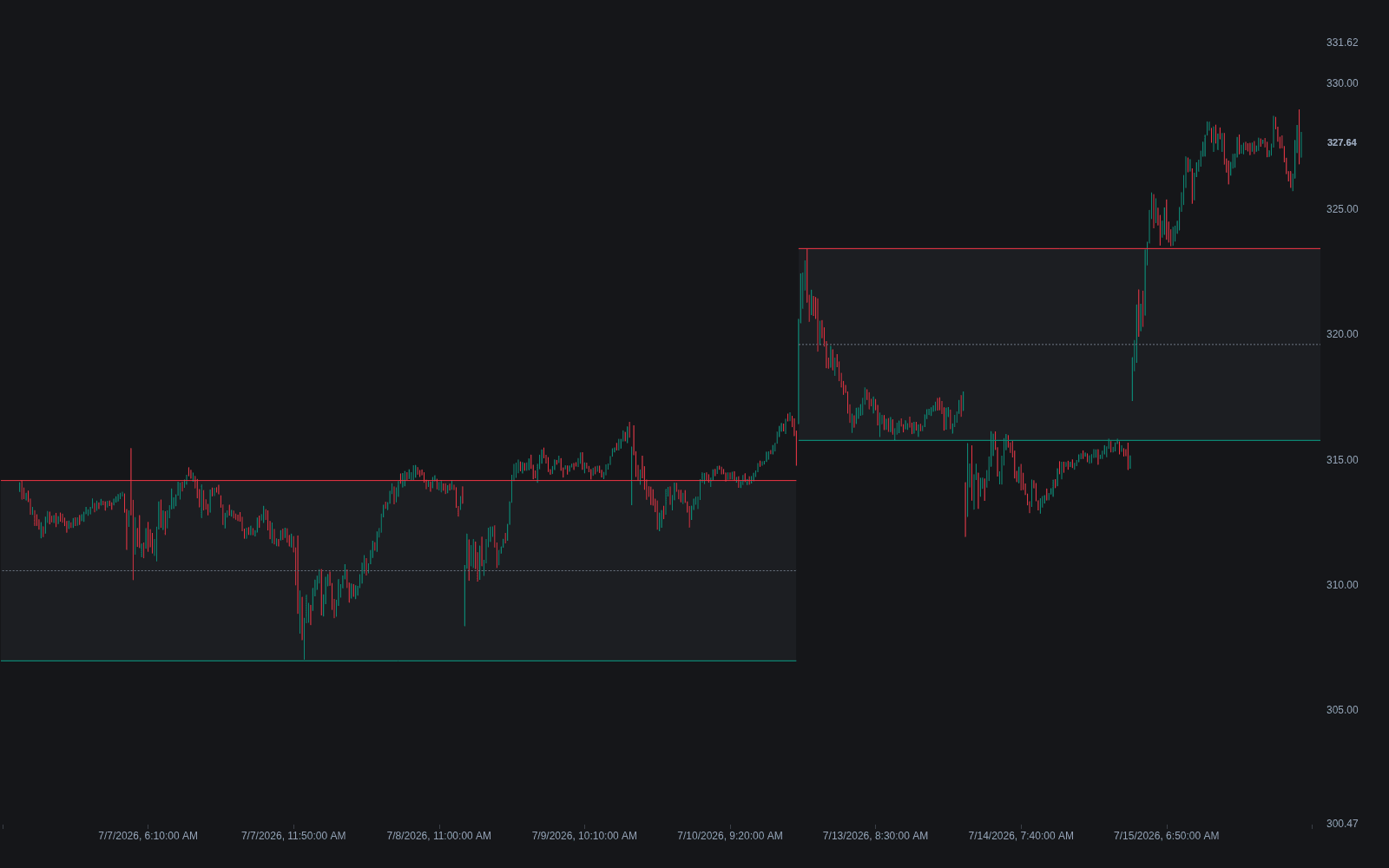
What is the Monday range?
The Monday range is the high and low of Monday's trading, held on the chart as a reference frame for the rest of the week. The premise is that Monday, as the first session after the weekend, often forms an initial balance for the week: early business absorbs weekend news and positioning, and the extremes of that first session become natural reference prices that later sessions test, break, or reject.
The concept is essentially a weekly-scale analog of the opening range. Where an intraday opening range uses the first 30 or 60 minutes of a session, the Monday range uses the first day of the week, and the same playbook applies: breakouts from the range suggest weekly range extension, while failed breaks back into it suggest a rotational week. It has been popularized mainly in crypto and forex circles, where weekend gaps and 24-hour trading make the week's first full session a meaningful anchor.
Traders care because the levels are objective and fixed early: by Monday's close the frame is set for four more sessions, and everyone marking it gets the same two lines. As with any single-session reference, its authority is statistical tendency rather than mechanism, so it works best inside a broader map of weekly references such as period opens and prior period levels.
How to mark the Monday range
The construction is mechanical; the only judgment is in defining the session.
- 1Decide what counts as Monday: the exchange session for equities and futures, or a chosen day boundary (often UTC or New York time) for 24-hour markets. Consistency matters more than the specific choice.
- 2After Monday's close, mark the session high and low and extend both lines through Friday.
- 3Optionally add the range midpoint, which some traders treat as the week's equilibrium in the same spirit as a session half-back.
- 4Through the week, log how price behaves at the extremes: clean breaks and retests, or sweeps that reclaim the range, the latter reading as failed breakouts.
- 5Archive the levels at week's end; a stale Monday range from a prior week is rarely watched.
How traders use it
- As a weekly bias frame: sustained acceptance above the Monday high tilts the week bullish and below the Monday low bearish, while price rotating inside the range argues for a balanced, mean-reverting week.
- As a target for sweeps: because stops gather beyond obvious extremes, a push through the Monday high or low that immediately reverses is read by many as a liquidity sweep and traded back toward the range.
- As trade location: the Monday high, low, and midpoint give predefined levels for entries and exits later in the week, useful for traders who prefer acting at references set in advance.
- With statistical humility: how often the weekly high or low forms on Monday varies by market and era, and published figures are mostly community backtests. Verify the tendency on your instrument before leaning on it.
- In confluence: a Monday extreme that lines up with a weekly open or a prior week's high is generally treated as a stronger reference than either level alone, per standard day-of-week and level-stacking logic.
Monday range vs adjacent references
Opening Range & ORB: The opening range frames a single session using its first minutes; the Monday range frames the week using its first day. Same logic, one scale up.
Prior Period Levels: The prior week's high and low come from the completed week; the Monday range is set inside the current week, so it is available sooner but reflects only one session of business.
ICT Session Ranges: Session-range frameworks slice each day into named sessions (Asia, London, New York) and trade their extremes; the Monday range applies the same range-and-deviation thinking to a whole calendar day within the week.
Concept family
Support/Resistance & Levels
38 concepts mapped · 38 in the Library
Monday Range FAQ
Turn Monday Range into a trading strategy.
Take the implementation from this page into Quant, then build on it, backtest it on real data, and keep refining it in conversation.