Concept
Consequent Encroachment
Consequent Encroachment, also known as CE, FVG midpoint, is a Smart Money Concepts / ICT concept. The Library holds 1 implementation, a working definition you can pull into Quant.
Top Consequent Encroachment indicator
The top custom implementation, built on the original standard Consequent Encroachment formula.
1 total
From studying Consequent Encroachment to trading it: take the implementation below into Quant and backtest it instantly.
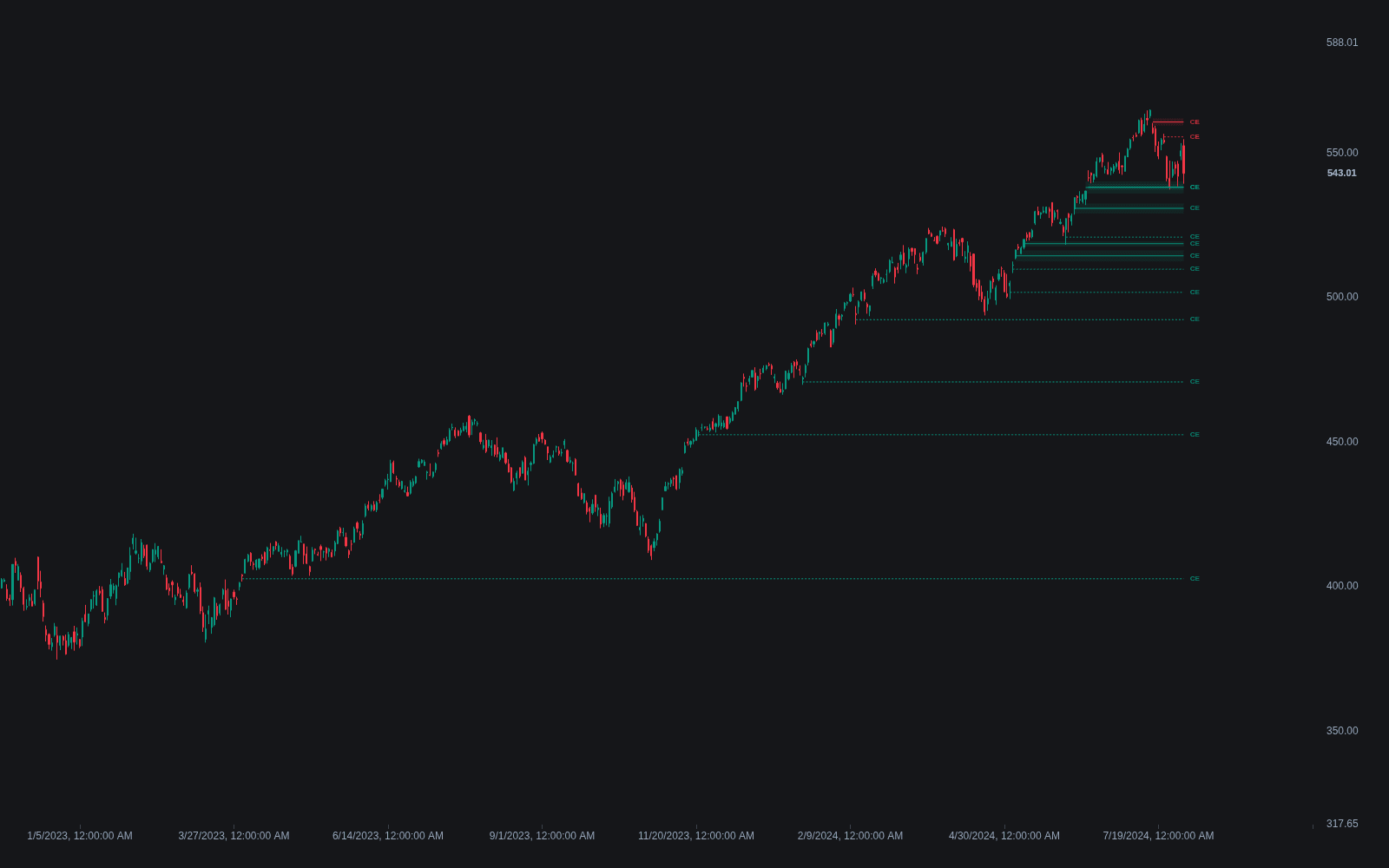
What is Consequent Encroachment?
Consequent encroachment (usually just CE) is the midpoint of a fair value gap: the 50% line between the gap's boundaries. ICT vocabulary applies the same term to the midpoint of a candle wick, which the methodology reads as a small single-candle inefficiency of its own. In both cases CE turns a zone into something more precise: an exact middle against which reactions can be judged.
The midpoint matters because it splits the imbalance into its own premium and discount halves; a return that reaches CE has rebalanced half the inefficiency. Many FVG playbooks anchor rules to that line: entries at it, invalidation through it, respected-versus-disrespected reads around it. Reaction at CE is a tendency the methodology claims and builds on, not a guarantee: plenty of gaps trade straight through their midpoint without pausing.
The midpoint discipline runs through the whole ICT inventory, not just three-candle gaps. Opening gaps, daily and weekly, are marked with high, low, and CE, and the midpoint read decides whether the halt's repricing is being defended or unwound; prominent wicks get the same treatment on the argument that a wick is a one-candle auction the market may only half-revisit; and the order block has its own analogous line, the mean threshold, the 50% level of the block's range. Across all of them the logic is identical: the middle is where a probe becomes a violation.
In practice CE converts vague zone-touch trading into gradeable events. A return that rejects at or before the midpoint leaves the gap respected and its bias intact; closes through CE downgrade the gap and shift expectation toward a full fill, the reading collected under FVG behavior rules. Alert tooling like twingall's FVGs & CEs study automates the marking so the levels exist before price arrives. The honest footing: the 50% convention is internal to the methodology, with no independent statistics behind it, so its value is the precision it adds to planning, entries, stops and invalidation defined to the tick rather than to a feeling.
How to identify consequent encroachment
CE is one measurement applied consistently across gaps, wicks, and halts.
- 1Mark the imbalance's boundaries: the two edges of the fair value gap, the wick's extremes, or the opening gap's close and open prints.
- 2Compute the exact midpoint; that line is the CE, and precision matters because rules key off it to the tick.
- 3Judge reactions against it: rejection at or before CE reads as the imbalance respected, closes through it as weakened.
- 4Apply the same line to wicks worth trading: the wick's half-way point serves as reaction level or partial-fill target.
- 5Carry the discipline to session and weekly opening gaps, where the midpoint decides whether the halt's repricing is holding or being unwound.
How it's calculated
The 50% midpoint of a fair value gap, the reference level ICT methodology uses to judge partial fills of the imbalance.
The middle candle is the displacement candle; the gap exists because its move left the first and third candle ranges non-overlapping.
ICT applies the same 50% rule to wicks and other single price voids, calling that midpoint consequent encroachment as well.
In practice, a reaction at CE without a full fill is read as the gap holding, while acceptance beyond the far edge completes the fill.
How traders use it
- As an entry refinement inside a gap, rather than bidding the near edge, wait for price to reach CE and reject there. The trade-off is explicit: tighter entries and smaller stops on the fills you get, in exchange for missing the gaps that turn before the midpoint.
- As a validity line: a common rule-set treats a gap as respected while closes hold on the near side of CE, and as weakened once price closes through it, shifting expectation toward a full fill; FVG behavior rules collects these conventions.
- As a wick-based level: the midpoint of a prominent wick is watched the same way, as a reaction level or partial-fill target, on the reading that a long wick is an inefficiency the market may only half-revisit.
- On opening gaps: the CE of a daily or weekly halt gap serves as its decision line, with acceptance through the midpoint arguing the weekend or overnight repricing is being fully unwound.
- With session timing: CE tests that occur inside active killzones are trusted more than drifts through the level in dead hours, since the respect-or-violate verdict needs real participation behind it.
Consequent encroachment vs related precision tools
Fair Value Gap: The gap is the zone; CE is the line that gives the zone a verdict point. Without the midpoint, a gap touch is one ambiguous event; with it, the same touch splits into respected, half-filled, or violated, each carrying its own follow-on rule.
Optimal Trade Entry: OTE refines entries with a fib zone measured on a whole displacement leg; CE refines them with the exact middle of a single imbalance. Both answer where inside the pullback, from different anchors, and they frequently overlap at the same handful of prices.
Standard-deviation Projections: Projections extend a measured swing outward to estimate where a move is headed; CE divides an existing imbalance inward to judge how a retracement behaves. One extrapolates targets, the other grades reactions.
Concept family
Smart Money Concepts / ICT
54 concepts mapped · 54 in the Library
Consequent Encroachment FAQ
Turn Consequent Encroachment into a trading strategy.
Take the implementation from this page into Quant, then build on it, backtest it on real data, and keep refining it in conversation.