Concept
Propulsion Block
Propulsion Block is a Smart Money Concepts / ICT concept. The Library holds 1 implementation, a working definition you can pull into Quant.
Top Propulsion Block indicator
The top custom implementation, built on the original standard Propulsion Block formula.
1 total
From studying Propulsion Block to trading it: take the implementation below into Quant and backtest it instantly.
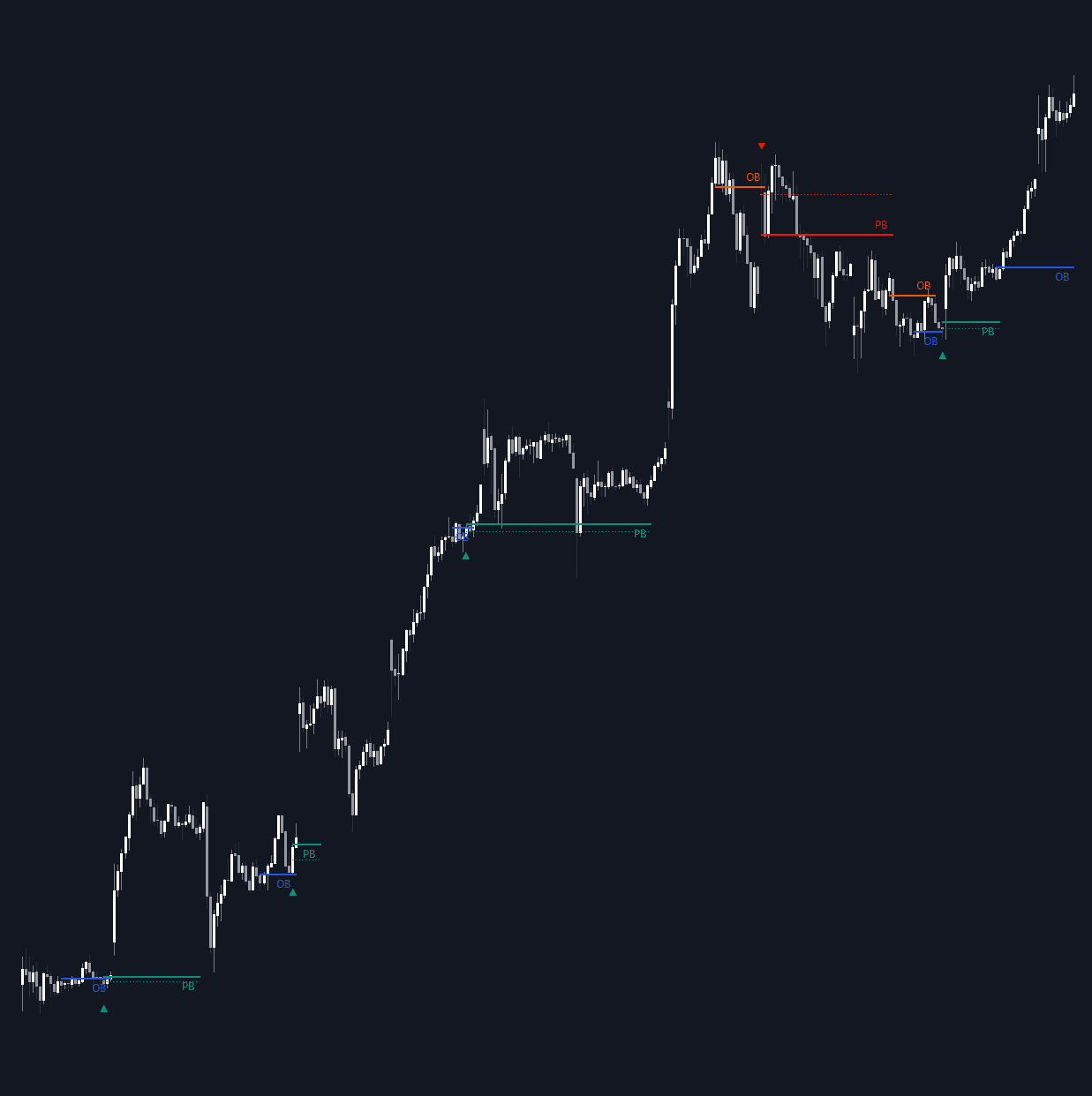
What is a Propulsion Block?
A propulsion block is an ICT order-block variant: a candle that trades back into a prior order block, respects it, and drives away, becoming a tradable block in its own right. In the bullish case, a down-closing candle dips into an earlier bullish order block's range, holds, and price propels higher; that down-close candle is the propulsion block, and its range is expected to offer support on a later revisit. The bearish case mirrors it: an up-close candle trading into a bearish order block before price drives lower.
The term comes from Michael J. Huddleston, the Inner Circle Trader, whose framework names a family of candle-derived zones: breaker blocks, mitigation blocks, and rejection blocks among them. The propulsion block is the continuation member. A breaker records a block that failed and flipped polarity; a propulsion block records one that passed its retest, so it tends to appear mid-trend, stacked with the prevailing delivery rather than at turns.
The logic is confirmation plus refinement. The original block held on the retest; the propulsion block records exactly where it did, leaving a newer, nearer, and usually tighter level aligned with the displacement that followed. Like every order-block concept it marks a zone that may hold, not one that must: a clean trade-through typically sends attention back to the original block behind it.
Qualifiers do real work here. The retest candle should reach into the prior block's range, commonly its upper half or mean threshold in the bullish case, without closing through the far side; the departure should be energetic, ideally leaving a fair value gap and running nearby session liquidity. Those conditions separate a propulsion block from a random candle overlapping an old zone, and explain why the pattern is scarcer than standard order blocks.
How to identify a propulsion block on a chart
The pattern is a sequence, so identification works backward from a displacement leg.
- 1Start with a valid prior order block: the last opposing candle before a displacing move, ideally formed with a liquidity sweep or a structure break behind it.
- 2Wait for the return: price trades back into the block's range and prints an opposing candle there (a down-close inside a bullish block) without closing beyond the far edge.
- 3Demand a propulsive departure: the next leg should leave with conviction, ideally gapping an imbalance and taking a nearby short-term high or low.
- 4Mark the propulsion candle: the opposing candle that traded into the old block is the new zone. Draw its full range, or refine to the open-to-extreme portion for tighter definitions.
- 5Trade the revisit, not the formation: the zone becomes actionable when price retraces into it later, and a close through it returns focus to the original block behind.
How traders use it
- As a continuation entry: after the propulsion leg, a retrace into the propulsion block gives a defined place to join the move, with invalidation just beyond the block rather than beyond the whole prior range.
- As zone refinement: instead of trading the full width of the older block, the propulsion block narrows attention to the slice that actually produced the reaction, giving a tighter stop for the same idea.
- As a strength read: a prior block that holds and launches a new leg is evidence of continued interest, while a propulsion block failing on its first retest is an early warning that the leg is losing participation.
- As part of a time-filtered model: ICT execution ranks a propulsion-block retest higher inside the London or New York killzones or at other ICT time anchors, when displacement is likeliest.
- As one leg of a target plan: propulsion-block entries conventionally aim at the nearest liquidity pool, typically the old high or low, with standard-deviation projections as an extension guide beyond it.
Propulsion Block vs related concepts
Bullish/bearish Order Block: The standard order block is the parent pattern: the last opposing candle before displacement. A propulsion block adds a requirement, forming while successfully retesting an earlier block. Every propulsion block is an order block; very few order blocks earn the propulsion label.
Breaker Block: The two record opposite retest outcomes. A breaker is born when an order block fails and price closes through it, flipping the zone's polarity. A propulsion block is born when the block holds. Failure creates a reversal tool; success creates a continuation tool.
Fair Value Gap: A fair value gap is a three-candle imbalance, a void rather than a candle range. Propulsion blocks and FVGs often overlap, since a propulsive departure tends to leave a gap; the overlap is commonly traded as one refined zone.
Concept family
Smart Money Concepts / ICT
54 concepts mapped · 54 in the Library
Propulsion Block FAQ
Turn Propulsion Block into a trading strategy.
Take the implementation from this page into Quant, then build on it, backtest it on real data, and keep refining it in conversation.